Jharkhand CM Office: Fruit Trees Empowering Rural Women
Synopsis
The Jharkhand Chief Minister's Office on 18 June 2026 spotlighted JSLPS-driven fruit-tree cultivation as a tool for rural women's economic empowerment, linking horticulture to self-reliance and financial stability under the National Rural Livelihood Mission framework.
Key Takeaways
The Chief Minister's Office of Jharkhand publicly credited JSLPS for enabling rural women's self-reliance through fruit-bearing tree initiatives on 18 June 2026 .
JSLPS (Jharkhand State Livelihood Promotion Society) is the state's nodal agency for implementing the National Rural Livelihood Mission .
The National Rural Livelihood Mission was launched in 2011 to promote self-employment and economic stability among rural households via women's SHGs.
Jharkhand's model integrates horticulture and agroforestry into NRLM-style programmes, targeting year-round income for tribal and rural women.
The initiative aims to reduce dependence on seasonal wage labour and strengthen local agricultural value chains across rural Jharkhand .
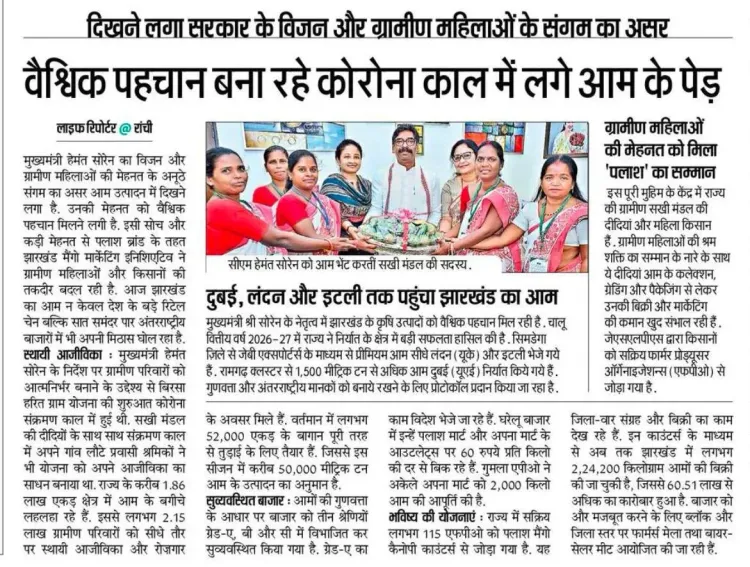
The Chief Minister's Office of Jharkhand on Thursday, 18 June 2026 highlighted how fruit-bearing trees are enabling rural women across the state to achieve financial independence and economic stability, crediting the initiative to the work of Jharkhand State Livelihood Promotion Society (JSLPS).
Context
The post, shared in Hindi, states: 'Aaj phaldaar vrikshon se graameen mahilaen na sirf aatmanirbhar ban rahi hain, balki unke jeevan mein aarthik sthirta bhi aayi hai' — 'Today, through fruit-bearing trees, rural women are not only becoming self-reliant but have also gained economic stability in their lives.' The message tags @onlineJSLPS, the official handle of the Jharkhand State Livelihood Promotion Society, signalling the government's acknowledgement of the agency's on-ground work.
JSLPS is the nodal body implementing the National Rural Livelihood Mission (NRLM) in Jharkhand, mobilising women's self-help groups (SHGs) for income-generating activities across rural and tribal districts of the state.
Policy Backdrop
The National Rural Livelihood Mission, launched by the Government of India in 2011, was designed to promote self-employment and economic resilience among rural households, primarily through the formation and strengthening of women's SHGs. Horticulture and agroforestry have since been integrated into NRLM-aligned livelihood programmes in several states.
Jharkhand's focus on fruit-bearing trees reflects a broader state strategy of linking orchard development and forest-produce cultivation to women's collectives. This approach aims to provide year-round income streams and ecological sustainability, particularly relevant for the state's large tribal and forest-dependent population.
Stakeholders and Impact
The primary beneficiaries are rural and tribal women enrolled in SHGs under JSLPS, who tend orchards and sell fruit produce, supplementing household incomes. The model also benefits the wider rural economy by reducing dependence on seasonal wage labour and strengthening local agricultural value chains.
Similar horticulture-linked livelihood models have been adopted in other eastern Indian states, where forest produce and orchard clusters tied to women's collectives have demonstrated gains in both household income and environmental stewardship. Jharkhand's iteration, channelled through JSLPS, positions the state as an active participant in this regional pattern.
What's Next
Observers and policy watchers will look to JSLPS for progress reports on horticulture cluster expansion and any new budget allocations for women's orchard schemes in the upcoming fiscal cycle. The government's public communication on this initiative suggests continued political and administrative priority for farm-based women's livelihood programmes in Jharkhand.
Point of View
Grassroots welfare outcomes ahead of potential budget cycles. Anchoring women's empowerment messaging to a tangible asset — fruit-bearing trees — signals a shift from cash-transfer optics to productivity-linked narratives. This fits a broader eastern India pattern where state governments are rebranding NRLM outcomes as their own policy wins. The move also reflects an effort to deepen institutional visibility for JSLPS, which has historically operated below the public communications radar.
NationPress
19 Sept 2026
Frequently Asked Questions
What is JSLPS and what does it do in Jharkhand?
JSLPS, or Jharkhand State Livelihood Promotion Society, is the state government body that implements the National Rural Livelihood Mission in Jharkhand, mobilising women's self-help groups for income-generating activities including horticulture and farm-based livelihoods.
How are fruit-bearing trees helping rural women in Jharkhand?
Fruit-bearing trees provide rural women enrolled in SHGs with a year-round source of income from orchard produce, reducing dependence on seasonal wage labour and contributing to economic stability at the household level.
What is the National Rural Livelihood Mission?
The National Rural Livelihood Mission is a central government scheme launched in 2011 that supports rural households, especially women, through self-help groups, skill training, and sustainable livelihood interventions including farm and forest-based activities.
What did the Jharkhand Chief Minister's Office post about on 18 June 2026?
The Jharkhand CMO posted on 18 June 2026 highlighting that rural women are becoming self-reliant and economically stable through fruit-bearing tree cultivation, tagging JSLPS for its role in the initiative.
Which women benefit from Jharkhand's horticulture livelihood programmes?
Rural and tribal women enrolled in self-help groups under JSLPS are the primary beneficiaries, gaining income through orchard cultivation and fruit produce sales across Jharkhand's rural districts.