Jharkhand CMO announces CMEGP call centre, e-cycles for remote students
Synopsis
The Jharkhand CMO announced a CMEGP monitoring call centre, e-cycles for remote-area students, demand-aligned skill training reform, and priority construction of tribal and community buildings including Manjhi-Pargana and Dhumkudiya structures.
Key Takeaways
A call centre will be established to monitor the Chief Minister's Employment Generation Programme (CMEGP) for real-time scheme oversight.
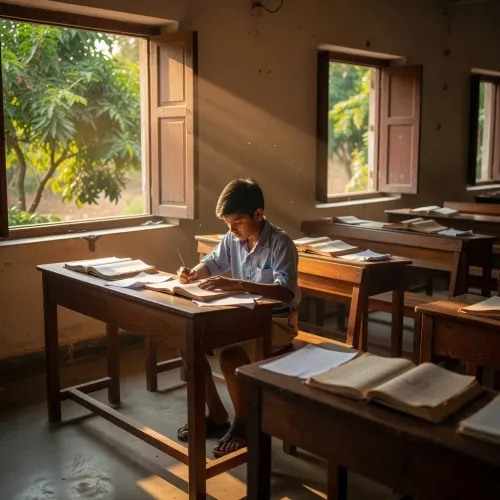
E-cycles will be provided to students in remote and geographically difficult areas to improve school access.
Youth vocational training will be restructured to align with actual employment demand , making it more practical.
Construction of Manjhi, Pargana, Padha, Manki-Munda and Dhumkudiya community buildings will be treated as a priority.
Graveyard enclosures ( kabristan gherabandi ) are also included, extending the infrastructure push to minority communities.
The measures target three key groups: remote students, unemployed youth, and tribal and minority communities across Jharkhand.
The Chief Minister's Office of Jharkhand announced on Monday, June 1, 2026 a package of welfare and employment measures covering scheme monitoring, last-mile education access, skill training reform, and priority construction of tribal community infrastructure across the state.
Context
The post, shared from the official Jharkhand CMO account, outlines four distinct policy directions. In translation, it states: 'A call centre will be set up for monitoring CMEGP; e-cycles will now be provided for students in remote areas; youth training will be made practical and aligned with employment demand; and the construction of graveyard enclosures and Manjhi, Pargana, Padha, Manki-Munda and Dhumkudiya buildings will be completed on priority.'
The announcement bundles livelihood, education, and tribal cultural infrastructure into a single policy communication, signalling a broad-front welfare push by the state government.
Policy Backdrop
The Chief Minister's Employment Generation Programme (CMEGP) is a Jharkhand government scheme that provides financial assistance and support for micro-enterprises to generate self-employment and livelihoods. A dedicated call centre for monitoring would mark a step toward real-time oversight of beneficiary progress across the state's geographically dispersed districts.
The proposal to introduce e-cycles for students in remote areas addresses a persistent access barrier in Jharkhand, where hilly and forested terrain makes daily commutes to schools difficult. Jharkhand has previously used targeted mobility interventions to improve educational attendance in tribal-majority blocks.
On skill development, the Jharkhand Skill Development Mission was expanded in 2018-19 to better align vocational training with industry requirements. The new direction to make training 'practical and aligned with employment demand' continues that trajectory, responding to persistent criticism that certificate courses do not translate into actual job placement.
Stakeholders and Impact
Manjhi, Pargana, Padha and Manki-Munda are traditional village and regional leadership institutions recognised under Jharkhand's customary laws, primarily among Santhal, Munda and Oraon communities. Dhumkudiya are traditional communal youth dormitories in tribal villages, used for cultural education and community activities. Prioritising the construction of dedicated buildings for these institutions is a recognition of their role in preserving tribal governance and culture.
Graveyard enclosures (kabristan gherabandi) for Muslim communities are also included, indicating the package spans multiple religious and ethnic communities. Tribal welfare infrastructure in Jharkhand has historically been funded under the Tribal Sub-Plan since the state's formation in 2000.
Collectively, the measures are directed at three primary groups: remote students lacking mobility, unemployed youth seeking market-relevant skills, and tribal and minority communities awaiting community infrastructure.
What's Next
The critical next steps will be state budget allocations and tendering processes for the proposed CMEGP call centre and the e-cycle distribution programme. Progress on the construction of Manjhi-Pargana and Dhumkudiya buildings under the Tribal Welfare Department will be a key indicator of implementation intent.
If the call centre model proves effective for CMEGP monitoring, it could serve as a template for real-time oversight of other state livelihood schemes, deepening accountability in last-mile delivery across Jharkhand's remote districts.
Point of View
Remote students, and unemployed youth — in a single communication. Anchoring the package around CMEGP monitoring signals an acknowledgement that scheme delivery, not just scheme design, is a political vulnerability. The inclusion of traditional tribal institutions such as Manjhi-Pargana and Dhumkudiya alongside minority graveyard enclosures suggests a deliberate coalition-building logic. Whether these directions translate into budgeted, tendered action or remain aspirational will determine their real policy weight.
NationPress
16 Oct 2026
Frequently Asked Questions
What is CMEGP in Jharkhand?
CMEGP, or the Chief Minister's Employment Generation Programme, is a Jharkhand government scheme that provides financial assistance and support for micro-enterprises to promote self-employment and livelihood generation across the state.
Why is Jharkhand giving e-cycles to students?
The Jharkhand government announced e-cycles for students in remote areas to address the challenge of long and difficult commutes in hilly and forested terrain, aiming to improve school attendance and access to education.
What are Manjhi, Pargana and Dhumkudiya in Jharkhand?
Manjhi, Pargana and Manki-Munda are traditional tribal leadership institutions recognised under Jharkhand's customary laws among Santhal, Munda and Oraon communities. Dhumkudiya are traditional communal youth dormitories used for cultural education and community activities in tribal villages.
What is the CMEGP monitoring call centre for?
The proposed call centre is intended to monitor the progress and implementation of CMEGP, enabling real-time oversight of beneficiaries and scheme delivery across Jharkhand's geographically dispersed districts.
What tribal infrastructure is Jharkhand building on priority?
Jharkhand has announced priority construction of buildings for Manjhi, Pargana, Padha, Manki-Munda and Dhumkudiya institutions, as well as graveyard enclosures, under its tribal and community welfare agenda.