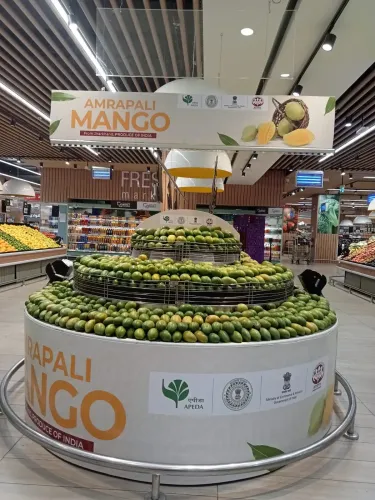
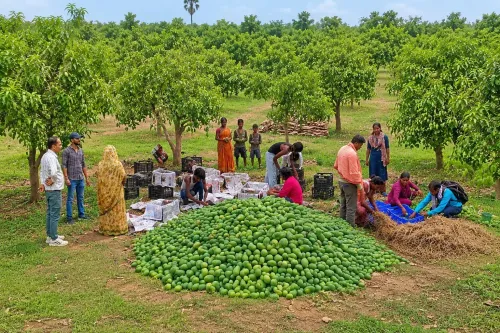
CM Hemant Soren's Birsa Harit Gram Yojana Sends Amrapali Mangoes to London

Synopsis
Jharkhand's Birsa Harit Gram Yojana, launched under CM Hemant Soren's vision, has dispatched its first Amrapali mango consignment to London. The scheme covers 1.86 lakh acres and provides permanent employment to 2.15 lakh rural families, marking a significant milestone in tribal livelihood and agricultural export policy.
Key Takeaways
The Chief Minister's Office of Jharkhand announced the first export consignment of Amrapali mangoes to London under the Birsa Harit Gram Yojana on June 11, 2026 .
The scheme, conceived under CM Hemant Soren's vision, has enrolled 2.15 lakh rural families and provided them with permanent employment.
Mango orchards under the programme span 1.86 lakh acres across Jharkhand.
JSLPS (Jharkhand State Livelihood Promotion Society) is the nodal implementing agency, working through self-help group networks.
The scheme is named after Birsa Munda , the iconic tribal leader, reflecting the government's focus on tribal and rural welfare.
The London export signals Jharkhand's entry into international agricultural markets and a structural shift away from mining-dependent livelihoods.
The Chief Minister's Office of Jharkhand announced on Thursday, June 11, 2026, that the Birsa Harit Gram Yojana — a flagship horticulture scheme conceived under the vision of Chief Minister Hemant Soren — has achieved a landmark milestone: the first commercial consignment of Amrapali mangoes has been dispatched to London, marking Jharkhand's entry into international fruit export markets.
The post by the Chief Minister's Office states that the scheme has provided permanent employment to 2.15 lakh rural families across the state, and that mango orchards under the programme now span 1.86 lakh acres of land. The Jharkhand State Livelihood Promotion Society (JSLPS) is the nodal agency credited with implementation.
Context
The Birsa Harit Gram Yojana takes its name from Birsa Munda, the revered late-19th-century tribal leader who remains a defining symbol of Jharkhand's identity and resistance. Naming welfare and land-linked schemes after him is a deliberate political and cultural choice that underscores the government's stated commitment to tribal and rural communities. The scheme promotes the cultivation of fruit orchards — primarily mango — on private and community land, with the goal of generating year-round, recurring income for households that have historically depended on daily-wage labour or mining-adjacent work.
Jharkhand is one of India's most mineral-rich states, yet its large Scheduled Tribe population has long faced income volatility tied to extractive industries. Horticulture-based livelihood programmes are seen as a structural shift toward perennial, farm-based income that also carries ecological value through increased green cover.
Policy Backdrop
The scheme draws on a policy lineage that includes the National Horticulture Mission (2005-06), which provided the national framework for expanding fruit cultivation in states like Jharkhand. The Mahatma Gandhi National Rural Employment Guarantee Act (MGNREGA, 2005) earlier established the precedent for large-scale rural employment guarantees; state horticulture schemes such as Birsa Harit Gram Yojana are designed to complement that guarantee with permanent, asset-based income rather than temporary wage work.
The Amrapali variety — a hybrid mango developed by Indian agricultural research institutions — is known for its consistent yield, compact tree size suitable for high-density planting, and strong consumer acceptance in export markets. Its selection for the London consignment aligns with the national push for agricultural exports and crop diversification championed by bodies such as APEDA (Agricultural and Processed Food Products Export Development Authority).
Stakeholders and Impact
The primary beneficiaries of the scheme are rural and tribal households across Jharkhand's districts, particularly those with access to rain-fed or irrigated land suitable for orchard development. The involvement of JSLPS means implementation is channelled through self-help group networks, giving women-led collectives a direct stake in orchard management and income. A spread of 1.86 lakh acres under mango cultivation represents a significant land-use shift with implications for both household income and the state's agricultural export profile.
For the broader rural economy, the London shipment signals that produce grown under a state welfare scheme can meet international phytosanitary and quality standards — a reputational milestone that could attract further export interest and potentially higher farm-gate prices for growers enrolled in the programme.
What's Next
The first London consignment is likely to be followed by further export shipments if market response is favourable. Observers will watch whether the Amrapali mango from Jharkhand pursues a Geographical Indication (GI) tag or formal APEDA facilitation, either of which would strengthen its brand in overseas markets. Mid-term evaluations of income gains among the 2.15 lakh enrolled families will also be a key indicator of whether the scheme delivers on its promise of sthayi rozgar (permanent employment). The Soren government's ability to sustain orchard support — through irrigation, cold-chain infrastructure, and market linkages — will determine whether this export milestone becomes a recurring achievement or a one-off.
Point of View
The Chief Minister's Office ties tribal identity, rural employment, and export ambition into a single narrative ahead of the political calendar. The scale cited — 2.15 lakh families and 1.86 lakh acres — positions this as one of the larger state-level horticulture interventions in eastern India, inviting scrutiny of whether ground-level income gains match the headline numbers. If cold-chain and market-linkage infrastructure keeps pace, Jharkhand could establish a replicable model for mineral-rich, tribal-majority states seeking to diversify their economic base.
NationPress
22 Sept 2026
Frequently Asked Questions
What is Birsa Harit Gram Yojana in Jharkhand?
Birsa Harit Gram Yojana is a Jharkhand state government scheme that promotes fruit orchard cultivation — primarily mango — on private and community land to generate permanent, recurring income for rural and tribal households. It is named after the tribal leader Birsa Munda and is implemented by JSLPS.
Which mango variety was exported to London from Jharkhand?
The Amrapali mango variety was exported to London in the first commercial consignment under the Birsa Harit Gram Yojana. Amrapali is a hybrid variety known for consistent yield and strong export-market acceptance.
How many families benefit from Birsa Harit Gram Yojana?
According to the Chief Minister's Office of Jharkhand, 2.15 lakh rural families have received permanent employment through the scheme, with orchards covering 1.86 lakh acres across the state.
What is JSLPS and what role does it play in the mango scheme?
JSLPS stands for Jharkhand State Livelihood Promotion Society. It is the nodal government agency responsible for implementing self-help group and natural-resource-based livelihood programmes in Jharkhand, including the Birsa Harit Gram Yojana mango orchard initiative.
Why is Jharkhand focusing on mango exports?
Jharkhand is diversifying its rural economy away from mining-dependent livelihoods. Horticulture schemes like Birsa Harit Gram Yojana offer tribal and rural households perennial, farm-based income. The London export aligns with India's broader push for agricultural exports and crop diversification.