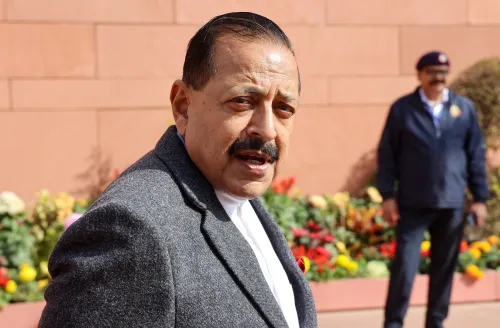
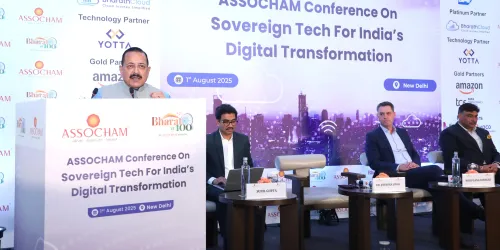
Science Minister Jitendra Singh meets biotech leaders in Delhi
Synopsis
Union Science and Technology Minister Dr. Jitendra Singh held a frank interaction with biotech leaders at CII's 2nd Global Genomics Summit 2026 in New Delhi and cited PM Narendra Modi's Rs 1 lakh crore RDI Fund as the push for industry-led research.
Key Takeaways
Union Science and Technology Minister Dr.
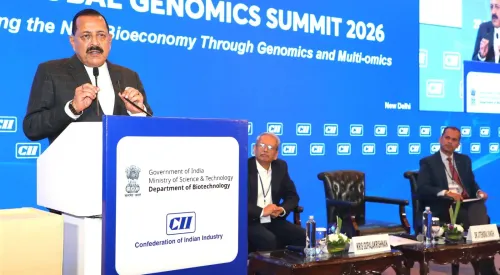
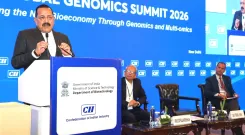
Jitendra Singh met biotech industry leaders at the 2nd Global Genomics Summit 2026 in New Delhi on 25 November 2026.
The summit was organised by the Confederation of Indian Industry (CII).
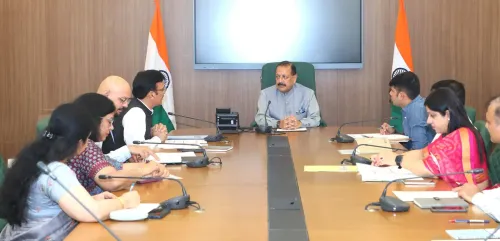
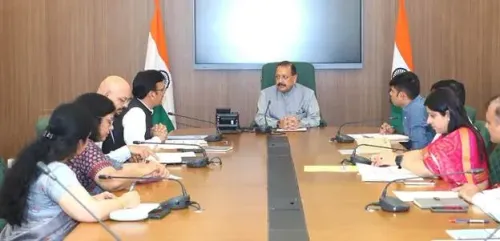
He said he noted industry inputs, suggestions and experiences with an open mind and would respond to the points raised.
He cited Prime Minister Narendra Modi’s Rs 1 lakh crore RDI Fund as evidence of the government’s intent to draw Indian industry into research.
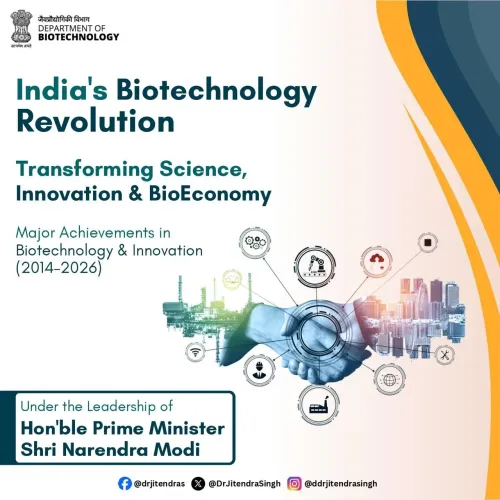
BIRAC, set up in 2012 under the Department of Biotechnology, remains the earlier template for academia-industry partnerships in biotech.
Union Science and Technology Minister Dr. Jitendra Singh gave biotechnology industry leaders a free and frank hearing in New Delhi on Wednesday, 25 November 2026, at the 2nd Global Genomics Summit 2026 organised by the Confederation of Indian Industry. He took a note of their inputs, suggestions and experiences with an open mind and assured them he would respond to the points they raised.
He did not stop at listening. The minister held up Prime Minister Narendra Modi’s announcement of a Rs 1 lakh crore Research, Development and Innovation Fund as proof that New Delhi wants Indian industry inside the research pipeline. ‘The government’s intent to encourage the participation of Indian industry is evident,’ he said, from the fact that ‘none less than’ the Prime Minister had gone ahead to announce the corpus to accelerate industry’s participation in research.
Rs 1 lakh crore RDI Fund as the industry invitation
That fund is meant to fix a stubborn gap: India’s research intensity still leans too heavily on public money. Genomics and biotechnology sit at the expensive end of the problem. Sequencing, diagnostics and bio-manufacturing consume capital long before they return it.
A dedicated RDI window is designed to change that risk calculus. Firms that once waited for a government grant cycle can, in principle, co-invest in frontier work. Dr. Jitendra Singh put the instrument on the table in front of the people expected to use it.
Frank talk at CII’s Global Genomics Summit
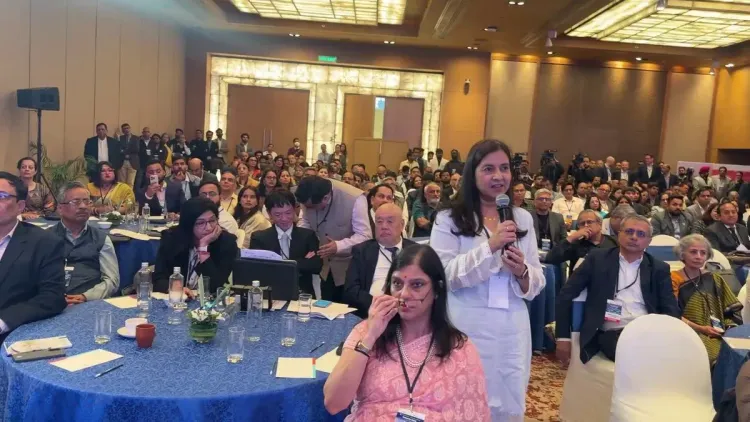
The Confederation of Indian Industry convened the second edition of the Global Genomics Summit in the capital. Dr. Jitendra Singh, who holds independent charge of Science and Technology and Earth Sciences and is also Minister of State in the Prime Minister’s Office and Personnel, described the session as a free, frank interaction with biotech leaders.
He said he had taken their inputs and experiences with an open mind. That pledge matters in a sector that often flags slow clearances and thin commercialisation pathways. Industry summits of this kind have become structured feedback channels under the Atmanirbhar Bharat innovation push. The test is whether the note-taking becomes a file movement.
BIRAC’s 2012 template meets a larger corpus
The Department of Biotechnology created BIRAC in 2012 to pull academia and industry into the same projects. That was the partnership model. The RDI Fund is the scale-up: a Rs 1 lakh crore attempt to lift overall R&D intensity and cut reliance on the public purse alone.
What follows is mechanical, not rhetorical. Roll-out mechanisms and project approvals under the fund in biotech and genomics will show whether Wednesday’s conversation was a listening exercise or a pipeline. Follow-up working groups after CII consultations are the other marker to watch.
The RDI Fund will be judged in Indian genomics labs, not in summit halls.
Point of View
Especially genomics. The Rs 1 lakh crore RDI Fund is the fiscal lever; CII summits are the listening posts. BIRAC in 2012 built the partnership template, but private R&D intensity has still lagged. Biotech firms will now watch whether fund windows and approvals actually follow the frank talk.
NationPress
25 Nov 2026
Frequently Asked Questions
What did Jitendra Singh discuss at the Global Genomics Summit 2026?
He held a free and frank interaction with biotechnology industry leaders in New Delhi, noted their inputs and suggestions, and assured them he would respond to the points raised. He also highlighted Prime Minister Narendra Modi’s Rs 1 lakh crore RDI Fund as evidence of the government’s intent to draw Indian industry into research.
What is the Rs 1 lakh crore RDI Fund?
It is a Research, Development and Innovation Fund announced by Prime Minister Narendra Modi to accelerate Indian industry’s participation in research. The government presents it as a tool to raise private-sector involvement in R&D and reduce reliance on public funding alone.
Who organised the 2nd Global Genomics Summit 2026?
The Confederation of Indian Industry (CII) organised the 2nd Global Genomics Summit 2026 in New Delhi. Union Science and Technology Minister Dr. Jitendra Singh attended and interacted with biotech industry leaders there.
Why is the government engaging biotech industry leaders?
The engagement is meant to take industry inputs on research, regulation and participation in frontier areas such as genomics. It fits a broader push to increase the private-sector share in India’s R&D ecosystem under the Atmanirbhar Bharat innovation agenda.
What is BIRAC’s role in Indian biotechnology?
BIRAC was set up in 2012 under the Department of Biotechnology to promote academia-industry partnerships in biotechnology. It remains a core institutional channel for translating lab work into industry projects alongside newer instruments such as the RDI Fund.