Pralhad Joshi Hails 12 Months Zero CRPF Deaths in LWE Ops
Synopsis
Union Minister Pralhad Joshi has highlighted what he calls a 47-year first: 12 straight months with zero CRPF personnel deaths in Left-Wing Extremism operations, crediting PM Modi and Home Minister Amit Shah's shift from negotiation to decisive kinetic action.
Key Takeaways
12 consecutive months of zero CRPF fatalities in LWE operations claimed — described as the first such streak in 47 years .
Union Consumer Affairs Minister Pralhad Joshi made the announcement on November 5, 2026 , crediting PM Narendra Modi and Home Minister Amit Shah .
The government's post-2014 doctrine shifted from negotiation to intensified kinetic operations and area domination in LWE-affected states like Chhattisgarh and Jharkhand .
The CRPF is the primary central paramilitary force deployed across red-corridor districts in the anti-Maoist campaign.
MHA annual reports have tracked a declining trend in LWE-related violence and security-force fatalities over the past decade, with this milestone representing the steepest data point yet.
The LWE security model parallels approaches applied in Jammu and Kashmir and the Northeast — governance-driven, Centre-coordinated, with development spending alongside operations.
For the first time in 47 years, India has gone 12 consecutive months without a single CRPF personnel fatality in the fight against Left-Wing Extremism — a milestone that Union Consumer Affairs Minister Pralhad Joshi called historic in a post on Thursday, November 5, 2026, crediting the security strategy of Prime Minister Narendra Modi and Union Home Minister Amit Shah.
From dialogue tables to Maoist strongholds
Joshi framed the achievement as a generational shift: 'Shifting from a legacy of endless negotiation to an era of decisive action, the government under PM Shri Narendra Modi and Home Minister Shri Amit Shah has taken the battle directly to Maoist strongholds.' The reference is pointed — for much of the insurgency's history, successive governments oscillated between kinetic pressure and periodic overtures to Maoist leadership, with neither approach decisively breaking the cycle of violence.
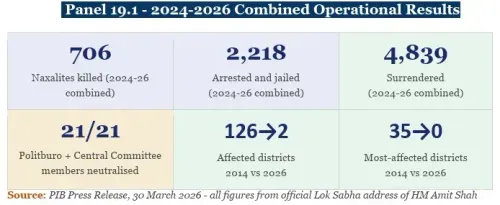
Since 2014, the Ministry of Home Affairs has pursued a markedly different doctrine: intensified security operations, area domination by central paramilitary forces, and simultaneous development spending in LWE-affected districts of states such as Chhattisgarh and Jharkhand. The CRPF, as the primary central force deployed across these red-corridor districts, has borne both the brunt of Maoist ambushes historically and, now, the credit for reversing that toll.
What zero fatalities over 12 months actually signals
A year without a single CRPF death in LWE theatre is not merely a statistic — it is an operational report card. It suggests that the combination of better intelligence-sharing with state police, forward deployment of specialised units, and denial of forest-cover logistics to Maoist columns has materially degraded ambush capability. The 47-year framing Joshi invokes places this alongside India's most turbulent decades of internal insurgency, making the contrast sharper.
Successive MHA annual reports have tracked a declining curve in LWE-related violence and security-force fatalities over the past decade — the claimed zero-fatality streak, if borne out in official records, would represent the sharpest data point yet on that curve. The minister also tagged @crpfindia directly, signalling the tribute is as much to the force's rank-and-file as to the policy architects in Delhi.
A template the government is applying beyond Chhattisgarh
The LWE model — kinetic pressure plus development investment, driven from the Centre — mirrors the approach the government has pursued in Jammu and Kashmir and parts of the Northeast. Each domain is distinct, but the political logic is consistent: demonstrate that governance, not negotiation, is the durable answer to armed non-state challenges. Joshi's post lands that argument in its most digestible form: 'Today, our borders are safer, our forces are protected and our nation stands resilient.'
What the government will want next is an MHA annual report and parliamentary testimony that formally codify the milestone — turning a ministerial social-media claim into a documented, auditable record. That is the moment the 47-year benchmark becomes history rather than assertion.
Point of View
Translating an operational metric into a broader governance narrative ahead of what will likely be the next MHA report cycle. The '47-year first' framing is designed to contrast sharply with the pre-2014 era of episodic dialogue, reinforcing the BJP's internal-security brand. If the zero-fatality claim is validated in official records, it hands the government a rare, concrete benchmark — not a projected target but a documented outcome — in a domain where progress has historically been difficult to quantify. The challenge now is institutionalising that gain: sustaining area domination as Maoist columns fragment and adapt, without letting development investment stall in newly cleared districts.
NationPress
6 Nov 2026
Frequently Asked Questions
What is the significance of zero CRPF casualties in LWE operations for 12 months?
It would mean that for 12 consecutive months no Central Reserve Police Force personnel died in Left-Wing Extremism-related operations — a claimed first in 47 years, indicating a significant degradation of Maoist ambush capability in the red-corridor states.
What is Left-Wing Extremism in India?
Left-Wing Extremism refers to the decades-long Maoist insurgency concentrated in central and eastern Indian states, particularly Chhattisgarh and Jharkhand, where armed groups have historically targeted security forces, infrastructure, and government officials.
What role does the CRPF play in anti-Naxal operations?
The Central Reserve Police Force is the primary central paramilitary force deployed across LWE-affected districts, conducting area domination exercises, counter-ambush operations, and joint missions with state police forces.
How has the government's approach to Left-Wing Extremism changed since 2014?
Since 2014, the Ministry of Home Affairs has pursued intensified kinetic operations and area domination in Maoist strongholds, replacing an earlier emphasis on dialogue and negotiation, alongside increased development spending in affected districts.
Who is Pralhad Joshi and why did he comment on LWE operations?
Pralhad Joshi is a senior BJP leader from Karnataka and currently serves as Union Minister of Consumer Affairs, Food and Public Distribution, and Minister of New and Renewable Energy. He posted on the LWE milestone as a broader endorsement of the Modi government's national-security record.