Joshi Alleges Massive Fraud in Karnataka Voter List Revision
Synopsis
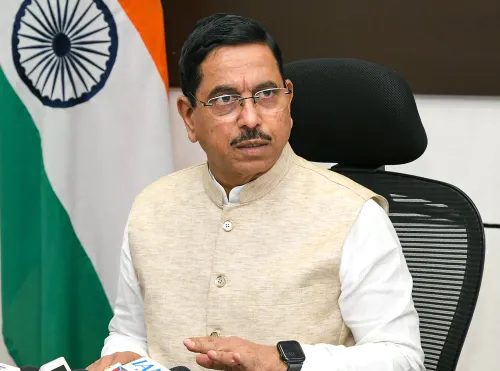
Union Minister Pralhad Joshi has accused Karnataka's Congress government of orchestrating systematic fraud in the ongoing Special Intensive Revision of electoral rolls, alleging that Booth Level Officers are flouting ECI norms and filling forms at mosques instead of conducting mandatory door-to-door verification. He has demanded an immediate ECI probe and strict action against officials and political actors involved.
Key Takeaways
Union Minister Pralhad Joshi alleged large-scale irregularities in Karnataka's Special Intensive Revision (SIR) of electoral rolls on 3 July 2026 .
He claimed violations were reported first in Ramanagara and then in Shiggaon and Savanur assembly constituencies, as well as multiple other parts of the state.
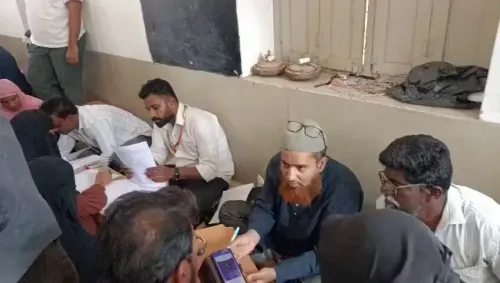
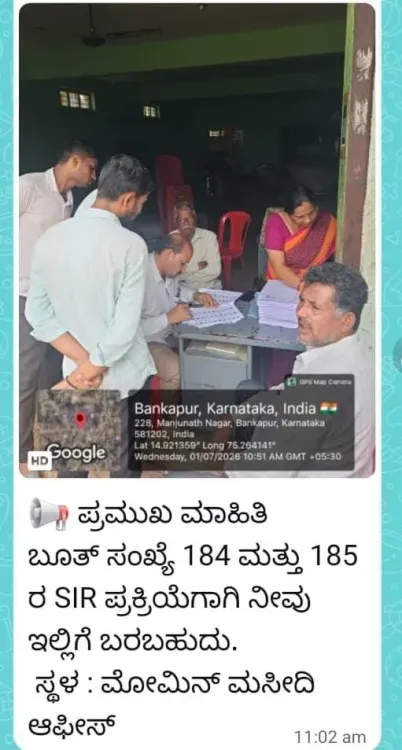
SIR rules require Booth Level Officers (BLOs) to conduct mandatory door-to-door visits; Joshi alleged forms were instead being filled inside mosques.
He alleged the violations were being openly promoted via WhatsApp groups and that complaints had poured in from across Karnataka.
Joshi demanded an immediate, impartial investigation and strict legal action against erring officials and political actors behind the alleged fraud.
The Election Commission of India has constitutional authority to order re-verification or an inquiry, and its response is now awaited.
Union Consumer Affairs Minister Pralhad Joshi on Friday, 3 July 2026, levelled serious allegations of systematic irregularities in the ongoing Special Intensive Revision (SIR) of electoral rolls across Karnataka, accusing the state's Congress government of betraying democratic principles for political gain.
What Joshi Alleged
In a strongly worded post in Kannada, Joshi claimed that the voter list revision process — which he described as a 'ಪ್ರಜಾಪ್ರಭುತ್ವದ ಆಶಯಗಳಿಗೆ ದ್ರೋಹ' ('betrayal of democratic aspirations') — was being carried out in flagrant violation of Election Commission of India (ECI) guidelines. He alleged that irregularities reported the previous day in Ramanagara had now spread to Shiggaon and Savanur assembly constituencies within his own Lok Sabha constituency, as well as to several other parts of the state.
The minister specifically alleged that Booth Level Officers (BLOs) — who are mandated under SIR rules to conduct door-to-door physical verification of family members — were instead filling enumeration forms while seated inside mosques. He further alleged that this practice was being openly promoted through WhatsApp groups, and that his office had received calls reporting similar violations from multiple locations across Karnataka.
Context: What SIR Rules Require
The Representation of the People Act, 1950, and ECI instructions governing Special Intensive Revisions require BLOs to visit each household individually and physically identify residents before updating the electoral roll. The objective is to prevent both wrongful inclusion and wrongful deletion of voters. Joshi quoted the rule directly: 'BLOs must mandatorily visit each home and personally identify the family members present there, strictly under the direction of District Election Officers (DEO/DC).'
Desk-based enumeration — filling forms at a central location rather than at voters' homes — is explicitly contrary to these guidelines. The ECI periodically reinforces these norms to ensure the integrity of the voter list, particularly ahead of elections.
Political Backdrop
Allegations of voter-list manipulation during pre-election revision exercises are a recurring feature of Indian electoral politics, with opposition parties in various states routinely approaching the ECI with complaints. Karnataka's Congress government, which came to power after the 2023 assembly elections, is the target of Joshi's accusations. The BJP, of which Joshi is a senior Karnataka leader, has been mounting sustained political pressure on the Siddaramaiah-led administration on multiple fronts.
Joshi demanded an 'immediate, impartial, and comprehensive investigation' into what he called a 'systematic conspiracy to suppress the voice of ordinary citizens.' He also called for strict legal action against erring officials and 'the political hands behind this.'
What Comes Next
The complaint is likely to prompt a formal representation to the Election Commission of India, which has the constitutional authority to direct re-verification or order an inquiry into SIR conduct. The ECI's response — and whether it directs Karnataka's Chief Electoral Officer to investigate the specific allegations — will be closely watched. The issue could also surface in the Karnataka Legislative Assembly or in Parliament, given the involvement of a Union Minister. If the ECI finds merit in the complaints, it could order fresh door-to-door enumeration in the affected constituencies, with significant implications for the final electoral roll.
Point of View
And it positions the BJP as the guardian of electoral integrity ahead of future state and national contests. By naming specific constituencies within his own Lok Sabha seat, Joshi grounds the allegation in verifiable geography, lending it more credibility than a generic statewide charge. The mosque reference is politically charged and likely to amplify the controversy well beyond electoral administration circles. Whether or not the ECI acts, the BJP has established a narrative — that the Congress state government is manipulating voter rolls — that will be difficult for the ruling party to dislodge quickly.
NationPress
3 Jul 2026
Frequently Asked Questions
What is Special Intensive Revision (SIR) of electoral rolls?
Special Intensive Revision (SIR) is an exercise conducted by the Election Commission of India in which Booth Level Officers visit every household to verify and update the voter list, ensuring accurate inclusion and exclusion of eligible voters.
What exactly did Pralhad Joshi allege about Karnataka's voter list revision?
Joshi alleged that BLOs were filling enumeration forms inside mosques instead of conducting mandatory door-to-door visits, that this was being promoted on WhatsApp groups, and that the Karnataka Congress government was orchestrating the violations for political gain.
Which areas in Karnataka are affected by the alleged voter list irregularities?
Joshi named Ramanagara, Shiggaon, and Savanur as specific locations, and said similar complaints had come in from multiple other parts of Karnataka.
What action has Pralhad Joshi demanded over the alleged fraud?
Joshi has demanded an immediate, impartial, and comprehensive investigation, as well as strict legal action against erring officials and the political actors he claims are behind the alleged manipulation.
Can the Election Commission of India intervene in Karnataka's voter list revision?
Yes. The ECI has full constitutional authority to supervise, direct, and control the preparation of electoral rolls, and can order re-verification, inquiry, or corrective action if it finds that SIR guidelines have been violated.