Pralhad Joshi Cites IMF 7% Forecast, Touts FTA Expansion
Synopsis
Union Minister Pralhad Joshi cited the IMF's 7% India growth forecast and the government's rapid FTA expansion as evidence of economic resilience under PM Modi, invoking the Viksit Bharat vision and Atmanirbhar Bharat framework in a post on October 13, 2026.
Key Takeaways
Union Minister Pralhad Joshi cited the IMF's 7% growth forecast for India as proof of economic resilience under PM Modi .
India signed the UAE Comprehensive Economic Partnership Agreement in February 2022 and the India-Australia ECTA in December 2022 as part of its FTA push.
The FTA expansion is designed to diversify trade partners, secure supply chains, and open new markets for Indian exporters and MSMEs .
The trade strategy operates under the broader Atmanirbhar Bharat framework, combining selective liberalisation with domestic manufacturing incentives.
Pending EU and UK FTA negotiations remain the critical next test for the government's trade diplomacy agenda.
The #ViksitBharat hashtag links the trade push to India's goal of achieving developed-economy status by 2047 .
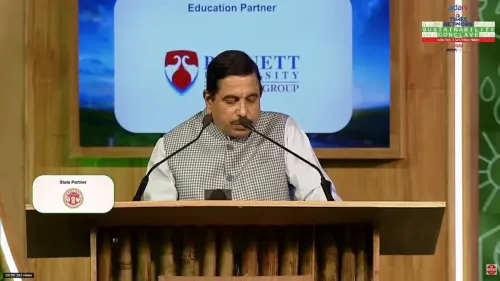
A 7% growth forecast from the International Monetary Fund is not just a number — it is, according to Union Consumer Affairs Minister Pralhad Joshi, a verdict on the direction of the Indian economy under Prime Minister Narendra Modi. Joshi made the assertion on Tuesday, October 13, 2026, framing the IMF projection alongside India's accelerating free trade agreement push as twin pillars of a self-reliant economic architecture.
The IMF Number and What Joshi Is Arguing
The minister's post cuts straight to a political-economic argument: that multilateral validation from a body like the IMF — which issues periodic World Economic Outlook forecasts for member countries — reflects the payoff of deliberate policy choices rather than structural luck. 'The IMF's 7% growth forecast stands as a testament to Bharat's economic resilience,' Joshi wrote, tagging Prime Minister Modi directly. The framing is intentional: a senior BJP leader from Karnataka anchoring a global institution's number to the ruling dispensation's governance record.
FTAs as the Engine: From UAE to a Wider Network
The second half of Joshi's argument is structural. India has been moving with unusual speed on trade agreements since 2020, a pivot driven partly by pandemic-era supply chain fractures and partly by a strategic need to diversify away from trade concentration risks. The Comprehensive Economic Partnership Agreement with the UAE, signed in February 2022, and the India-Australia Economic Cooperation and Trade Agreement, which entered force in December 2022, were the opening moves. Each deal opened preferential access for Indian exporters — including MSMEs — across goods and services categories that had previously faced tariff walls.
The minister describes the ongoing expansion as 'unlocking global markets, forging stronger international alliances and building rock-solid, resilient supply chains' — language that maps directly onto the government's Atmanirbhar Bharat framework, which pairs selective trade liberalisation with domestic manufacturing incentives. The hashtag #ViksitBharat — India's vision to achieve developed-economy status by 2047 — ties the trade push to the longer civilisational ambition the BJP has made central to its economic narrative.
Pending Deals and the Credibility Test Ahead
The argument will face its sharpest test on two fronts that remain unfinished: negotiations with the European Union and the United Kingdom. Both talks have been in progress for years, with gaps on tariffs, data flows, and regulatory alignment proving stubborn. A successful conclusion on either — or both — would dramatically expand the FTA network Joshi is celebrating and give the government's trade diplomacy a far larger canvas. The next IMF World Economic Outlook update will also be watched closely to see whether the 7% projection holds as global headwinds — from geopolitical friction to commodity volatility — continue to test emerging-market resilience.
For Indian exporters and MSMEs, the stakes are immediate: every new FTA translates into tariff concessions, rules-of-origin advantages, and market access that smaller firms can rarely negotiate on their own. A nation building 'rock-solid supply chains,' as Joshi puts it, needs those deals signed, ratified, and operational — not just announced.
Point of View
However, lies not in the IMF figure but in whether the EU and UK FTA negotiations — stalled for years — can be brought to conclusion, which would either validate or complicate the 'rapidly expanding FTA network' claim. Until those deals land, the narrative remains aspirational as much as it is retrospective.
NationPress
13 Oct 2026
Frequently Asked Questions
What is the IMF's growth forecast for India in 2026?
Union Minister Pralhad Joshi cited an IMF forecast of 7% growth for India, describing it as a testament to the country's economic resilience. The exact IMF World Economic Outlook update underpinning this figure has not been independently verified in available sources.
Which free trade agreements has India recently signed?
India signed a Comprehensive Economic Partnership Agreement with the UAE in February 2022 and the India-Australia Economic Cooperation and Trade Agreement , which entered force in December 2022 . Negotiations with the EU and UK are ongoing.
What is Viksit Bharat?
Viksit Bharat is the Indian government's vision to transform India into a fully developed economy by 2047 , the centenary of independence. It underpins a range of policy initiatives including trade expansion and domestic manufacturing incentives.
What is Atmanirbhar Bharat and how does it relate to FTAs?
Atmanirbhar Bharat ('Self-Reliant India') is the policy framework that pairs selective trade liberalisation — including FTAs — with domestic manufacturing incentives to reduce import dependence and build resilient supply chains.
How do India's FTAs benefit MSMEs and exporters?
Free trade agreements give Indian MSMEs and exporters preferential tariff rates, rules-of-origin advantages, and improved market access in partner countries — benefits that smaller firms cannot typically negotiate independently on global markets.