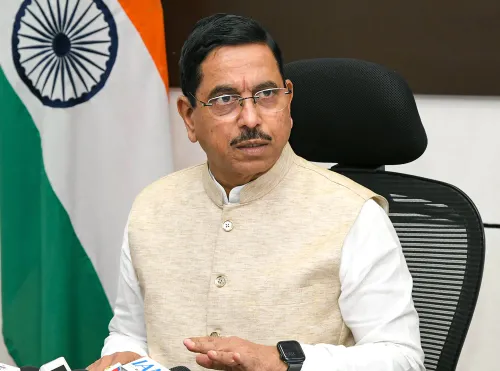
Joshi Inaugurates NTH Mumbai Testing Facilities, Lays Foundation Stone

Synopsis
Union Consumer Affairs Minister Pralhad Joshi inaugurated advanced testing facilities at National Test House Mumbai on June 19, 2026, covering EV batteries, renewable energy, aerospace and drones. He also performed Bhoomi Poojan for a Residential Accommodation Project at the campus, expanding NTH's capacity to serve MSMEs and startups under the Viksit Bharat and Aatmanirbhar Bharat visions.
Key Takeaways
Minister Pralhad Joshi inaugurated new state-of-the-art testing facilities at National Test House (NTH), Mumbai on June 19, 2026 .
New testing verticals include EV batteries, renewable energy, aerospace and drones , expanding beyond NTH's existing microbiological and footwear testing capabilities.
Bhoomi Poojan was performed for a Residential Accommodation Project on the NTH Mumbai campus.
The expansion is positioned under the government's Viksit Bharat and Aatmanirbhar Bharat policy frameworks championed by Prime Minister Narendra Modi .
MSMEs and startups in advanced technology sectors are the primary intended beneficiaries, gaining access to domestic accredited testing.
NTH functions under the Ministry of Consumer Affairs, Food and Public Distribution and serves as a government quality-certification body.
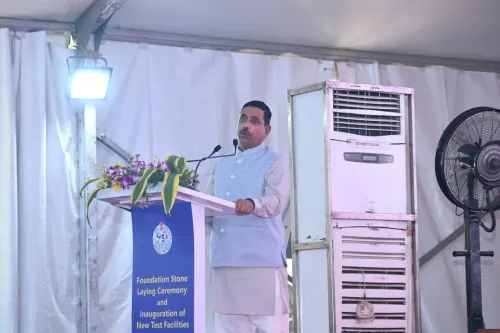
Union Consumer Affairs Minister Pralhad Joshi on Friday, June 19, 2026, inaugurated new state-of-the-art testing facilities and performed the Bhoomi Poojan for a Residential Accommodation Project at the National Test House (NTH), Mumbai, marking a significant expansion of India's public quality-assurance infrastructure.
Context
The inauguration adds advanced testing capabilities to the NTH Mumbai campus, extending its existing portfolio — which includes microbiological and footwear testing — into high-priority domains such as EV batteries, renewable energy, aerospace, and drones. Minister Joshi framed the expansion as integral to the government's twin visions of Viksit Bharat and Aatmanirbhar Bharat, both championed under Prime Minister Narendra Modi.
The Bhoomi Poojan for the Residential Accommodation Project signals further investment in the NTH campus's physical infrastructure, providing dedicated housing that could improve operational continuity for the facility's technical workforce.
Policy Backdrop
The National Test House functions under the Ministry of Consumer Affairs, Food and Public Distribution and serves as a government-mandated body for testing and quality certification across industrial and consumer goods. Its role has grown considerably as India pursues domestic manufacturing ambitions across strategic technology sectors.
The Aatmanirbhar Bharat Abhiyan, launched in May 2020, set the policy direction for reducing import dependence and building domestic capability in electronics, automobiles, and renewable energy — sectors that now fall squarely within NTH's expanded testing mandate. Complementary measures such as Production Linked Incentive (PLI) schemes and amendments to the Bureau of Indian Standards Act (2016) have further reinforced the push for robust quality infrastructure.
India's accelerating adoption of electric vehicles and its ambitions in drone manufacturing and aerospace components have created urgent demand for credible, government-backed testing ecosystems that domestic industry and exporters can rely on to meet international standards.
Stakeholders and Impact
MSMEs, startups, and larger industrial players in the EV battery, renewable energy, aerospace, and drone segments stand to benefit most directly. Access to accredited domestic testing reduces costs and turnaround times that companies currently incur by sending products to private or overseas laboratories.
For MSMEs in particular — which often lack the resources to navigate expensive third-party certification — a government facility with expanded capacity can lower barriers to quality compliance and, by extension, to export markets. Minister Joshi specifically cited empowering 'industries, MSMEs and startups to meet the highest standards of quality and innovation' as a core objective of the expansion.
The Residential Accommodation Project, once complete, will also address a longstanding logistical need for NTH's technical staff posted in Mumbai, one of India's highest-cost cities.
What's Next
Attention will now turn to the utilisation rates of the newly inaugurated facilities, particularly uptake by EV battery manufacturers and drone startups seeking domestic certification pathways. Industry bodies and MSME associations are expected to engage with NTH on onboarding procedures for the new testing verticals.
The government may also announce similar upgrades at other NTH branches across the country, as the broader quality-infrastructure push under Viksit Bharat targets a developed-economy standard by 2047. Sustained investment in institutions like NTH will be a key indicator of whether India's self-reliance agenda translates into globally competitive domestic manufacturing.
Point of View
Drones and aerospace — sectors where domestic certification gaps have historically pushed companies toward costly overseas testing. By anchoring the event within Viksit Bharat and Aatmanirbhar Bharat, Minister Joshi is reinforcing the BJP government's narrative that self-reliance requires not just manufacturing capacity but also the standards ecosystem to validate it. The simultaneous Bhoomi Poojan for residential accommodation signals a longer-term institutional commitment to NTH rather than a one-off upgrade. Whether the new facilities achieve meaningful utilisation — particularly among MSMEs and startups who are the stated beneficiaries — will be the real test of whether this investment translates into competitive gains.
NationPress
19 Sept 2026
Frequently Asked Questions
What new facilities were inaugurated at National Test House Mumbai?
Minister Pralhad Joshi inaugurated advanced testing facilities at NTH Mumbai covering EV batteries, renewable energy, aerospace and drones, adding to existing microbiological and footwear testing capabilities.
What is the National Test House and which ministry controls it?
The National Test House is a government testing and quality certification body that functions under the Ministry of Consumer Affairs, Food and Public Distribution.
What is the Residential Accommodation Project at NTH Mumbai?
The Bhoomi Poojan for the Residential Accommodation Project was performed at the NTH Mumbai campus on June 19, 2026, marking the start of construction of housing facilities for NTH's technical staff.
How does the NTH expansion relate to Aatmanirbhar Bharat?
The expansion supports the Aatmanirbhar Bharat vision by providing domestic testing and certification infrastructure for strategic sectors like EV batteries, drones and aerospace, reducing dependence on overseas testing labs.
Who benefits from the new NTH Mumbai testing facilities?
MSMEs, startups and larger industrial players in the EV, renewable energy, drone and aerospace sectors benefit by gaining access to government-backed domestic testing, lowering certification costs and enabling compliance with global quality standards.