Joshi Flags UP's Record Rooftop Solar Run Under PM Surya Ghar
Synopsis
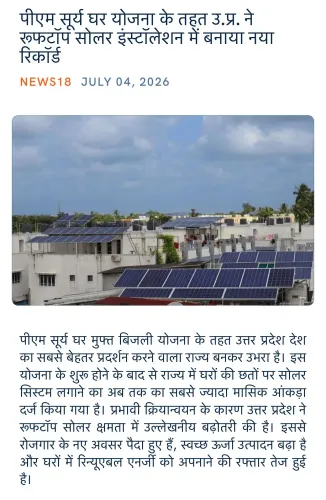
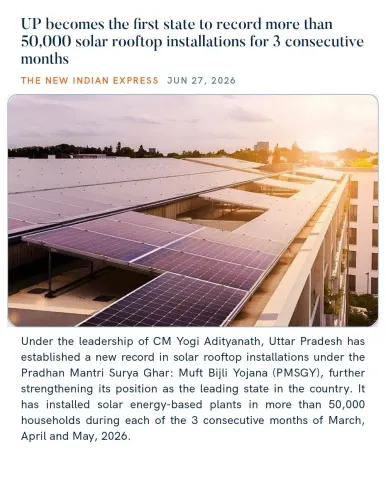
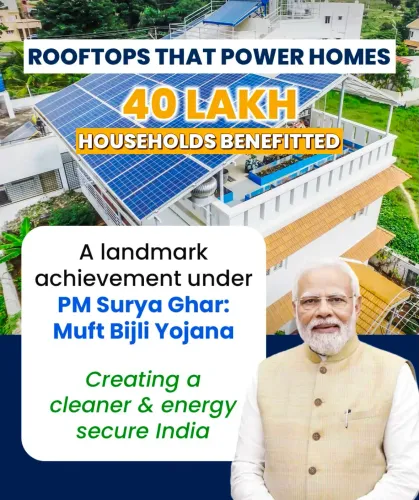
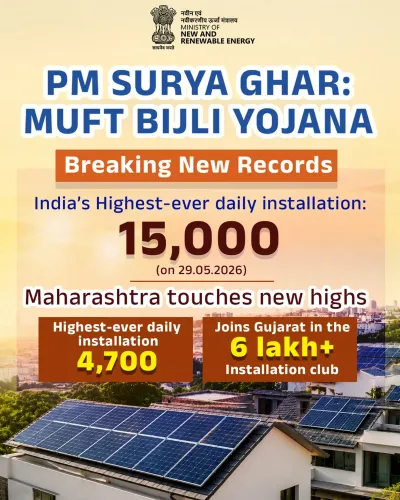
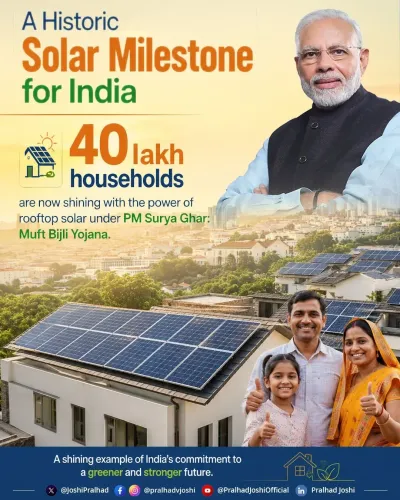
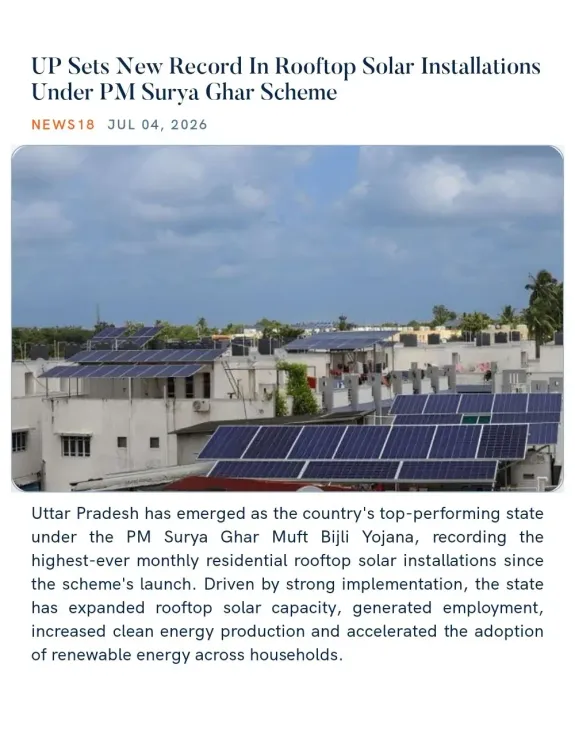
Union Minister Pralhad Joshi on 4 July 2026 highlighted Uttar Pradesh setting a new record in rooftop solar installations under PM Surya Ghar Muft Bijli Yojana, the central scheme targeting one crore households and up to 300 units of free monthly power.
Key Takeaways
Uttar Pradesh has set a new record in rooftop solar installations under the PM Surya Ghar Muft Bijli Yojana as of July 2026 .
Union Minister Pralhad Joshi flagged the milestone on X on 4 July 2026 via the NaMo App.
The scheme, launched in February 2024 , targets one crore household installations nationally with up to 300 units of free electricity per month .
The programme supports India's 500 GW non-fossil fuel capacity target by 2030 , first announced at COP26 in 2021 .
The Ministry of New and Renewable Energy is the nodal agency coordinating state-level implementation and subsidy disbursement.
UP's performance sets a benchmark in the competitive inter-state race to maximise central solar subsidy uptake.
Union Consumer Affairs and New and Renewable Energy Minister Pralhad Joshi on Saturday, 4 July 2026, highlighted Uttar Pradesh's record-breaking performance in rooftop solar installations under the PM Surya Ghar Muft Bijli Yojana, sharing the development via the NaMo App on his official X account.
Context
Uttar Pradesh, India's most populous state, has emerged as a front-runner in the central government's flagship rooftop solar subsidy programme. The minister's post amplified a report noting that the state had set a new benchmark in installations under the scheme, underscoring the momentum building in distributed solar adoption across the country's largest electorate.
The PM Surya Ghar Muft Bijli Yojana was launched in February 2024 with the twin goals of subsidising rooftop solar systems for households and delivering up to 300 units of free electricity per month to beneficiaries. The programme targets one crore household installations nationally.
Policy Backdrop
The scheme sits at the intersection of two major policy commitments: reducing household electricity costs and advancing India's 500 GW non-fossil fuel capacity target by 2030, a goal first articulated at COP26 in 2021 and consistently reinforced in subsequent Union Budgets. The Ministry of New and Renewable Energy, which Joshi heads alongside the Consumer Affairs portfolio, is the nodal agency overseeing subsidies, state coordination, and progress tracking.
The strategic pivot toward rooftop solar — as distinct from large-scale ground-mounted projects — reflects a broader policy logic: distributed generation reduces transmission losses and brings renewable energy directly to the consumer, lowering bills while contributing to national grid decarbonisation targets.
Stakeholders and Impact
For Uttar Pradesh households, a record installation pace translates into faster access to central financial assistance and the prospect of sharply lower monthly electricity bills. The state government's coordination with the Ministry of New and Renewable Energy has been a key enabler, as implementation speed depends heavily on state-level administrative capacity and local distribution company cooperation.
The domestic solar industry — including panel manufacturers, installers, and financing intermediaries — stands to benefit from sustained high-volume demand. Competitive implementation across states has created a de facto race to the top, with each milestone report serving as both a performance benchmark and a political signal ahead of future budget allocations.
What's Next
Attention will now turn to quarterly progress reports from the Ministry of New and Renewable Energy on cumulative national installation figures and how far the programme has advanced toward its one-crore household target. Any supplementary allocations in the next Union Budget could accelerate the pace further, particularly if states like Uttar Pradesh demonstrate the administrative capacity to absorb additional central funds efficiently.
With India's net-zero 2070 commitment requiring a steep ramp-up in renewable capacity, the rooftop solar programme's state-level performance data will be critical in shaping both domestic policy and India's international climate credibility in the years ahead.
Point of View
Making its success under PM Surya Ghar a doubly useful data point — both as policy evidence and as electoral messaging. The post also reinforces Joshi's dual-portfolio identity, bridging consumer welfare and clean energy in a single communication. Broader, it signals that the distributed rooftop model is gaining traction as a complement to utility-scale solar, which will matter as India seeks to demonstrate credible progress on its 2030 renewable targets.
NationPress
4 Jul 2026
Frequently Asked Questions
What is PM Surya Ghar Muft Bijli Yojana?
PM Surya Ghar Muft Bijli Yojana is a central government scheme launched in February 2024 that subsidises rooftop solar installations for households, aiming for one crore installations and providing up to 300 units of free electricity per month to beneficiaries.
Why has Uttar Pradesh set a record under PM Surya Ghar scheme?
Uttar Pradesh has recorded the highest rooftop solar installations under the PM Surya Ghar scheme as of July 2026, driven by state-level administrative coordination with the Ministry of New and Renewable Energy and strong household uptake of central subsidies.
Who is Pralhad Joshi and what ministry does he head?
Pralhad Joshi is a senior BJP leader from Karnataka and Union Minister holding the portfolios of Consumer Affairs, Food and Public Distribution, and New and Renewable Energy in the central government.
What is India's rooftop solar target under PM Surya Ghar?
The PM Surya Ghar Muft Bijli Yojana targets one crore household rooftop solar installations nationally, forming part of India's broader 500 GW non-fossil fuel capacity goal by 2030.
How does PM Surya Ghar scheme benefit households?
Under the PM Surya Ghar scheme, eligible households receive central financial assistance to install rooftop solar panels and can avail up to 300 units of free electricity per month, directly reducing their monthly power bills.