Joshi Revises Onion MAPP to ₹1,650/Quintal for Farmers

Synopsis
Union Consumer Affairs Minister Pralhad Joshi has revised the Minimum Assured Procurement Price for onions to ₹1,650 per quintal, effective 11 June 2026, after a meeting with food department officials. The pricing methodology has also been refined to better track mandi conditions.
Key Takeaways
Union Consumer Affairs Minister Pralhad Joshi chaired a meeting with Department of Food and Public Distribution officials on onion procurement.
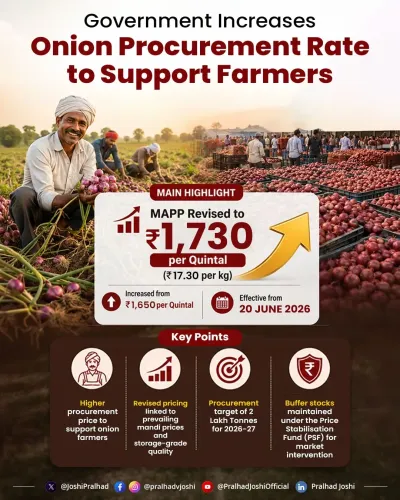
The Minimum Assured Procurement Price (MAPP) for onions has been revised to ₹1,650 per quintal , effective 11 June 2026 .
The revision is based on prevailing mandi prices and quality requirements for storage-grade onions .
The pricing methodology has been refined to make procurement more responsive to market conditions.
The measure operates within the Price Stabilisation Fund framework established in 2014-15 , with NAFED and NCCF as the procuring agencies.
The move aims to protect onion farmers from distress sales during harvest gluts while supporting retail price stability for consumers.
Union Consumer Affairs Minister Pralhad Joshi on Friday, 12 June 2026 announced a revision to the Minimum Assured Procurement Price (MAPP) for onions, raising it to ₹1,650 per quintal with effect from 11 June 2026, following a meeting with officials from the Department of Food and Public Distribution.
Context
Minister Joshi stated that the revised MAPP was determined 'based on prevailing mandi prices and quality requirements for storage-grade onions.' He added that the pricing methodology has been 'refined to make procurement more responsive to market conditions,' signalling a structural adjustment rather than a one-time price fix.
The announcement was made via a post on X, where Joshi tagged both the Department of Food and Public Distribution (@fooddeptgoi) and the consumer awareness handle @jagograhakjago, underscoring the dual focus on farmer welfare and consumer price stability.
Policy Backdrop
The MAPP is a government pricing mechanism designed to guarantee minimum returns to farmers through procurement by central agencies during periods of low mandi prices. It operates within the broader framework of the Price Stabilisation Fund, established in 2014-15, which enables procurement and buffer stocking of onions and other perishables to counter seasonal price volatility.
Central agencies NAFED and NCCF carry out physical procurement under such schemes, building buffer stocks that can be released into the market when retail prices spike. The latest revision links the support price more directly to prevailing mandi signals, a refinement that officials say will make the mechanism more dynamic.
Onion price management has historically been a politically sensitive issue in India, with sharp price swings affecting both farming communities in producing states such as Maharashtra, Karnataka, and Madhya Pradesh, and urban consumers across the country.
Stakeholders and Impact
The primary beneficiaries of the revised MAPP are onion farmers, particularly those in major producing belts who face distress during harvest gluts when mandi prices fall below the cost of cultivation. The assured price of ₹1,650 per quintal is intended to provide a floor that prevents farmers from selling at a loss.
Mandi traders and aggregators will also be affected, as government procurement at a defined floor price influences the broader price discovery process at wholesale markets. For consumers, effective buffer stocking can moderate retail price spikes during lean supply periods.
What's Next
The key variable to watch is actual procurement volumes under the revised MAPP and the level of farmer participation following the 11 June 2026 effective date. Whether the refined pricing methodology translates into faster, more responsive procurement on the ground will determine its real-world impact on farmer incomes.
Any subsequent movement in wholesale and retail onion prices across major consumption centres will serve as an early indicator of how effectively the revised mechanism is working. Further adjustments to the MAPP or procurement targets cannot be ruled out as the kharif harvest season approaches.
Point of View
650 per quintal is a targeted intervention in one of India's most politically charged agricultural commodities, where price crashes can devastate farming households and price spikes can trigger urban discontent. By explicitly linking the revised price to prevailing mandi rates and storage-grade quality, the ministry is attempting to move beyond static support prices toward a more market-responsive model — a meaningful design shift if implemented consistently. The tagging of @jagograhakjago alongside the food department signals an awareness that onion policy must simultaneously reassure producers and consumers. Whether the mechanism delivers depends on procurement speed and volumes, which have historically been the weak link in India's buffer-stocking architecture.
NationPress
26 Oct 2026
Frequently Asked Questions
What is the new onion MAPP announced by Pralhad Joshi?
The Minimum Assured Procurement Price for onions has been revised to ₹1,650 per quintal, effective 11 June 2026, based on prevailing mandi prices and quality requirements for storage-grade onions.
What is the Minimum Assured Procurement Price (MAPP) for onions?
The MAPP is a government-set floor price at which central agencies procure onions from farmers when mandi prices fall below viable levels, ensuring minimum returns and preventing distress sales.
Which agencies procure onions under the MAPP scheme?
Central agencies NAFED and NCCF carry out onion procurement under the MAPP framework, building buffer stocks that can later be released to moderate retail price spikes.
Why does the government intervene in onion prices?
Onion prices are highly volatile due to seasonal supply swings. Sharp price crashes hurt farmers in producing states like Maharashtra and Karnataka, while sudden spikes affect consumers nationwide, making it a politically sensitive commodity.
What is the Price Stabilisation Fund and how does it relate to onion procurement?
The Price Stabilisation Fund, established in 2014-15, is the central mechanism that finances procurement and buffer stocking of onions and other perishables to counter seasonal price volatility in India.