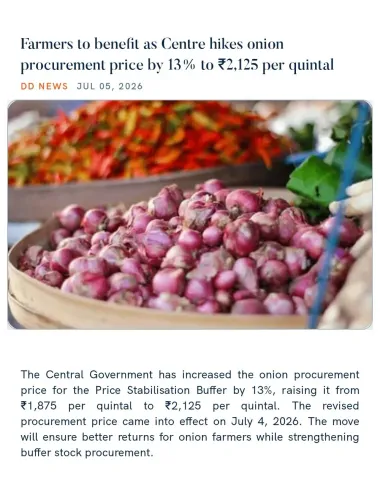
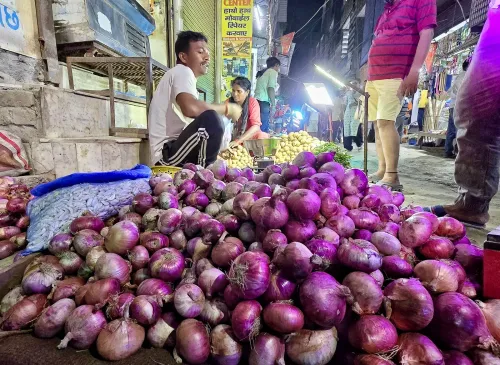
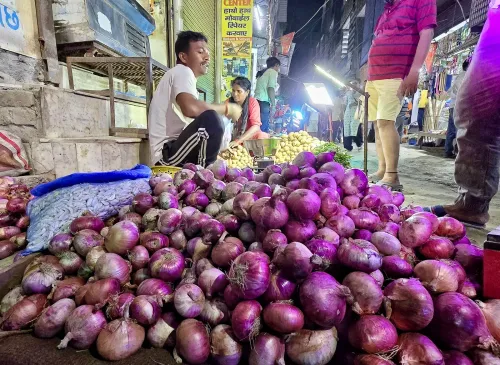
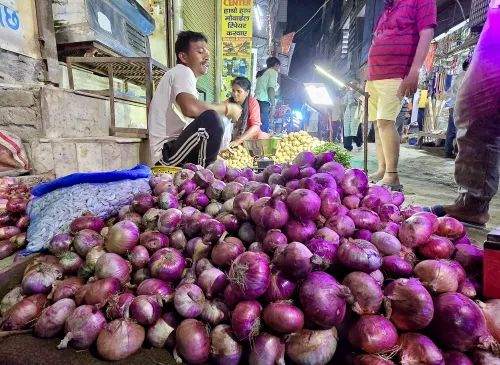
Joshi raises onion buffer stock rate to ₹1,730/quintal
Synopsis
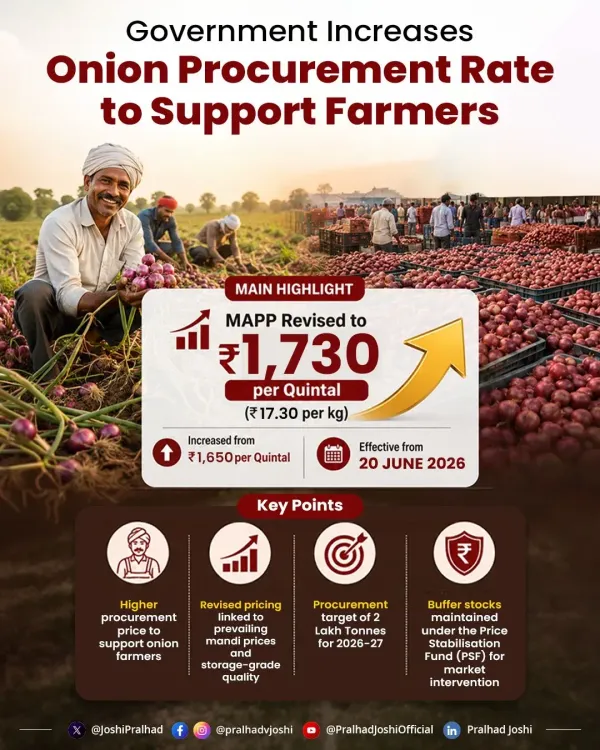
Union Consumer Affairs Minister Pralhad Joshi announced a hike in the onion buffer stock procurement rate to ₹1,730 per quintal effective June 2026, under the government's Price Stabilisation Fund framework, to boost farmer returns and curb retail price volatility.
Key Takeaways
The government has raised the onion buffer stock procurement rate to ₹1,730 per quintal (₹17.30 per kg) , effective June 2026 .
The revision was announced by Union Consumer Affairs Minister Pralhad Joshi on 19 June 2026 .
The buffer stock programme is managed by the Department of Consumer Affairs to stabilise both farmer incomes and consumer prices.
The programme operates under the Price Stabilisation Fund , established in 2014 , which covers essential commodities including onions.
Onion farmers in states such as Maharashtra , Karnataka and Madhya Pradesh are the primary beneficiaries of the revised procurement rate.
Actual programme impact will hinge on procurement volumes achieved during the 2026 season and subsequent retail price trends.
Union Consumer Affairs Minister Pralhad Joshi announced on Friday, 19 June 2026 that the government has revised the onion procurement rate under the buffer stock programme to ₹1,730 per quintal (₹17.30 per kg), effective from June 2026, aiming to improve returns for onion farmers while stabilising retail prices.
Context
Posting on X, Minister Joshi stated: 'To strengthen farmer welfare, the Government has increased the onion procurement rate to ₹1,730 per quintal (₹17.30 per kg) under the buffer stock programme, effective from June 2026. The revised rate will ensure better returns for onion farmers while supporting price stabilisation efforts.' The announcement was tagged #FarmersFirst, signalling the government's framing of the move as a farmer-welfare measure.
The buffer stock programme is managed by the Department of Consumer Affairs under Joshi's ministry. It involves procuring onions directly from farmers during periods of surplus production and releasing stocks into the market when retail prices spike — a dual mechanism intended to protect both grower incomes and consumer interests.
Policy Backdrop
The buffer stock intervention for onions sits within a broader market-management architecture that the central government has built over more than a decade. The Price Stabilisation Fund (PSF), established in 2014, provides the financial backbone for procurement and storage of essential agricultural commodities, including onions, potatoes and pulses.
Onions have historically been among the most politically sensitive agricultural commodities in India, with sharp seasonal price swings driven by weather disruptions, limited cold-storage infrastructure and supply-chain bottlenecks. Successive governments have used procurement-price revisions and buffer-stock releases as the primary levers to manage this volatility. The revision to ₹1,730 per quintal represents the government's latest calibration of that lever ahead of the 2026 procurement season.
Stakeholders and Impact
Onion farmers — concentrated in states such as Maharashtra, Karnataka, Madhya Pradesh and Rajasthan — stand to benefit directly from a higher floor price when they sell into the buffer stock. For smallholder growers, who are vulnerable to distress sales during glut periods, a government-backed procurement rate provides income certainty that open-market prices often cannot.
On the consumer side, a well-stocked buffer allows the government to release supplies when wholesale prices surge, dampening retail inflation. The Department of Consumer Affairs has in past seasons distributed buffer-stock onions through state agencies and cooperative outlets to moderate mandi prices in major urban centres. Whether the revised procurement rate translates into adequate stock volumes will depend on actual farmer participation and logistical capacity this season.
What's Next
Analysts and farmer groups will watch the volume of onion procurement achieved under the revised rate during the 2026 season as the key indicator of programme effectiveness. Utilisation reports and budget allocations for buffer-stock operations are typically presented during parliamentary sessions, giving legislators and the public a clearer picture of fiscal outlay and market impact.
If procurement volumes are robust and retail prices remain stable through the lean season, the revised rate could become a benchmark for future revisions. The move also sets a precedent for how the government may approach price-support interventions for other high-volatility horticultural crops in the months ahead.
Point of View
730 per quintal fits squarely into the BJP-led government's pattern of using procurement-price adjustments as a visible, farmer-facing signal ahead of election cycles and during periods of agrarian stress. By framing the move under the #FarmersFirst banner, Minister Joshi is reinforcing the government's narrative of active market intervention on behalf of growers — a politically salient message in onion-producing states like Maharashtra and Karnataka. The real test, however, lies not in the announced rate but in procurement volumes: past buffer-stock operations have sometimes fallen short of targets due to logistical and funding constraints. If the 2026 season delivers strong uptake, the revised rate could anchor a more durable price-support architecture for horticultural crops.
NationPress
19 Sept 2026
Frequently Asked Questions
What is the new onion procurement rate under the buffer stock programme?
The government has set the onion buffer stock procurement rate at ₹1,730 per quintal (₹17.30 per kg) , effective from June 2026 , as announced by Union Consumer Affairs Minister Pralhad Joshi.
What is India's onion buffer stock programme?
The buffer stock programme is a government initiative managed by the Department of Consumer Affairs that procures onions from farmers during surplus periods and releases them into the market when retail prices rise sharply, stabilising prices at both ends of the supply chain.
Who announced the onion procurement rate hike in June 2026?
Union Consumer Affairs, Food and Public Distribution Minister Pralhad Joshi announced the revised rate on 19 June 2026 via a post on X.
How does the Price Stabilisation Fund relate to onion procurement?
The Price Stabilisation Fund (PSF) , established in 2014 , provides the financial framework for procuring and storing essential commodities including onions. Buffer stock operations for onions are funded and governed under this scheme.
Which states benefit most from the onion buffer stock procurement rate revision?
Onion farmers in major producing states such as Maharashtra , Karnataka , Madhya Pradesh and Rajasthan are the primary beneficiaries, as the revised rate offers them a higher government-backed floor price during the procurement season.