Joshi raises onion MAPP to ₹1,580/quintal for farmers
Synopsis
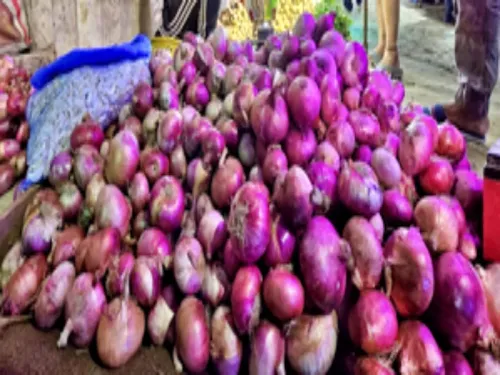
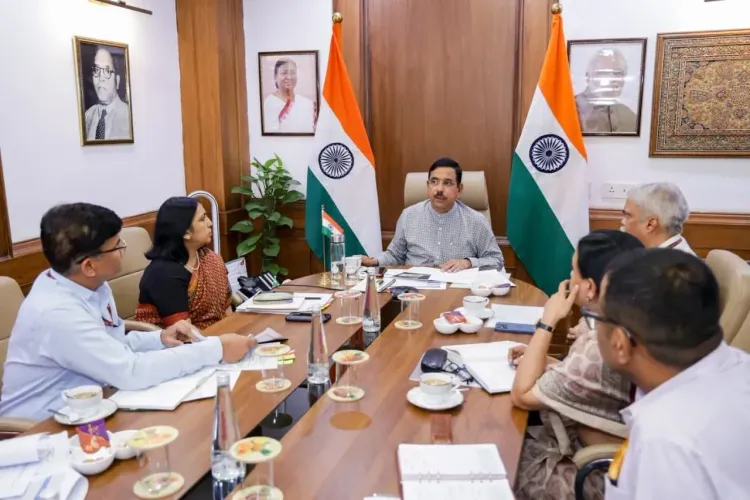
Union Consumer Affairs Minister Pralhad Joshi chaired a meeting with NAFED, NCCF, and Jago Grahak Jago officials on 26 May 2026 and announced a revision in the onion Minimum Assured Procurement Price from ₹1,270 to ₹1,580 per quintal, effective immediately, following a state government request.
Key Takeaways
Union Consumer Affairs Minister Pralhad Joshi chaired an inter-agency meeting on 26 May 2026 focused on onion procurement.
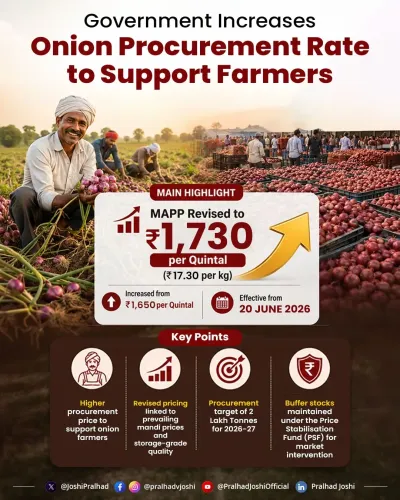
The Minimum Assured Procurement Price (MAPP) for onions has been raised from ₹1,270 to ₹1,580 per quintal — an increase of ₹310 per quintal .
The revision is effective from 26 May 2026 and was made at the request of the state government.
Agencies involved include NAFED , NCCF , and the Jago Grahak Jago campaign under the Department of Consumer Affairs.
The procurement drive aims to ensure better returns for onion farmers while building buffer stocks to stabilise consumer prices.
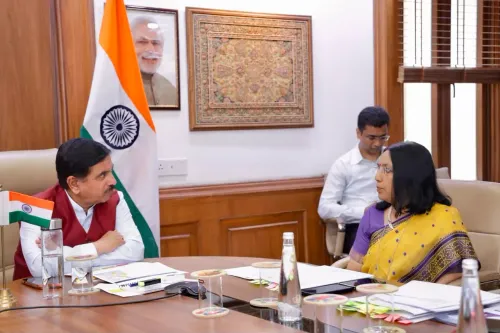
Union Consumer Affairs Minister Pralhad Joshi on Tuesday, 26 May 2026 chaired a meeting with officials from Jago Grahak Jago, NAFED, and NCCF to streamline the procurement of quality onion stocks and improve returns to growers. The Minimum Assured Procurement Price (MAPP) for onions has been revised upward from ₹1,270 to ₹1,580 per quintal, effective 26 May 2026, following a request from the state government.
Context
Minister Joshi stated that the meeting was convened to 'facilitate effective procurement of quality onion stocks and ensure better returns to farmers.' The revision of ₹310 per quintal — a nearly 24 per cent increase over the previous assured price — was made at the request of the concerned state government and takes effect from the same day as the announcement. The move signals a direct response to farmer-level concerns over onion price realisations in the current season.
Policy Backdrop
NAFED (National Agricultural Cooperative Marketing Federation of India) has been the central government's primary instrument for onion procurement and buffer stock operations during periods of market surplus, a practice that has evolved over successive seasons since the 2010s. NCCF (National Cooperative Consumers' Federation of India) works alongside NAFED in procurement and consumer-end distribution, forming a cooperative chain that links farm-gate prices with retail market supply. The Jago Grahak Jago campaign, run by the Department of Consumer Affairs, contributes to market information and consumer grievance redressal in this ecosystem.
Onion price volatility has historically been a politically sensitive issue in India, with sharp swings affecting both farmer incomes and urban household budgets. Central intervention through assured procurement prices is designed to provide a floor to farmers while simultaneously building buffer stocks that can be released when retail prices spike.
Stakeholders and Impact
Onion farmers, particularly in major producing states, stand to benefit directly from the revised MAPP, which guarantees a higher floor price for produce sold through central cooperative agencies. For consumers, the buffer stock mechanism associated with such procurement operations has historically helped moderate retail price spikes during lean supply months. The coordination between NAFED, NCCF, and the Consumer Affairs Ministry represents an integrated approach to managing both ends of the onion supply chain simultaneously.
The involvement of all three agencies — Jago Grahak Jago, NAFED, and NCCF — under a single ministerial review underscores the government's intent to align procurement efficiency with consumer-price stability rather than treating them as separate mandates.
What's Next
Attention will now turn to the actual volumes procured under the revised ₹1,580 per quintal MAPP and whether the enhanced price floor translates into meaningful on-ground uptake by farmers. Any follow-up adjustments — either further upward revisions or state-level operational notifications — will be closely watched by agricultural marketing stakeholders. If procurement volumes are substantial, the resulting buffer stocks could play a key role in keeping retail onion prices in check during the coming months.
Point of View
Suggesting the state government's request carried urgency — likely tied to distress signals from farming communities during the current harvest cycle. For Minister Joshi, who oversees both consumer affairs and renewable energy, deploying cooperative federations as price-stabilisation instruments reflects a continuation of the central government's preference for market-intervention through institutional channels rather than open-market procurement. The simultaneous presence of NAFED, NCCF, and Jago Grahak Jago at the same table signals an attempt to close the loop between producer-side price support and consumer-side price monitoring. Whether the revised floor price is sufficient to attract meaningful farmer participation — or whether procurement logistics become the next bottleneck — will determine the real-world impact of this policy adjustment.
NationPress
21 Oct 2026
Frequently Asked Questions
What is the new onion MAPP announced by the government in May 2026?
The Minimum Assured Procurement Price (MAPP) for onions has been revised to ₹1,580 per quintal , up from the earlier rate of ₹1,270 per quintal , effective 26 May 2026 .
Which agencies are involved in onion procurement under the Consumer Affairs Ministry?
NAFED (National Agricultural Cooperative Marketing Federation of India) and NCCF (National Cooperative Consumers' Federation of India) are the two central agencies conducting onion procurement, with the Jago Grahak Jago campaign supporting consumer-side awareness.
Why was the onion MAPP revised in May 2026?
The revision was made at the request of the state government, as announced by Union Minister Pralhad Joshi , to ensure better price realisations for onion farmers and facilitate effective procurement of quality stocks.
What is MAPP in the context of onion procurement in India?
MAPP, or Minimum Assured Procurement Price, is a floor price at which central cooperative agencies like NAFED and NCCF purchase onions directly from farmers, protecting growers from market price crashes.
How does central onion procurement help consumers?
When central agencies procure onions at assured prices and build buffer stocks, those stocks can be released into the market during periods of supply shortage, helping to moderate retail onion prices for consumers.