Onion procurement price hiked to ₹16.50/kg under buffer stock programme
Synopsis
The Centre has raised the onion buffer stock procurement price to ₹16.50 per kg — the second hike in quick succession and a cumulative 30% jump from ₹12.70 — even as it cuts the annual procurement target by a third to 2 lakh tonnes. The tension between a higher floor price and a lower volume target is the real story for India's onion farmers.
Key Takeaways
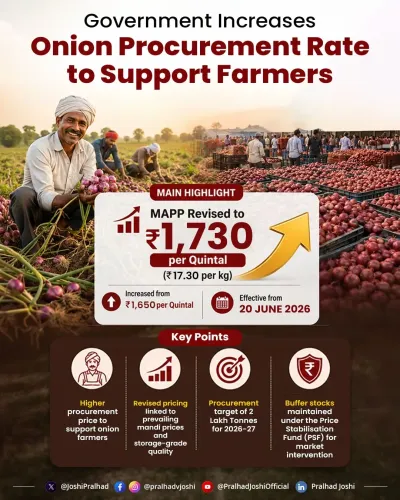
The Minimum Assured Procurement Price (MAPP) for onions raised to ₹1,650 per quintal (₹16.50/kg) , effective 13 June 2026 .
Previous MAPP was ₹15.80/kg ; the Centre had earlier raised it from ₹12.70/kg — a cumulative rise of nearly 30% .
Annual procurement target set at 2 lakh tonnes , down from 3 lakh tonnes in 2025-26 .
Buffer stocks maintained under the Price Stabilisation Fund (PSF) for retail market intervention.
Onion output estimated at 307.37 lakh tonnes in 2025-26, nearly flat versus 307.67 lakh tonnes in 2024-25.
MIS mechanism covers price-difference payments to farmers, split 50:50 between Centre and states.
The Centre has raised the Minimum Assured Procurement Price (MAPP) for onions to ₹1,650 per quintal (₹16.50 per kg) from ₹15.80 per kg, effective Saturday, 13 June 2026, under the government's buffer stock programme aimed at securing better returns for farmers. The revision was announced by Union Food and Consumer Affairs Minister Pralhad Joshi via a post on X.
Key Developments
Minister Joshi stated that the revised MAPP reflects prevailing mandi prices and quality requirements for storage-grade onions. 'The pricing methodology has also been refined to make procurement more responsive to market conditions,' he posted. He had chaired a meeting on Thursday with officials from the Department of Consumer Affairs (DoCA) to strengthen onion procurement operations.
This is the second upward revision in recent months. The Centre had earlier raised the procurement price to ₹15.80 per kg from ₹12.70 per kg, citing market dynamics — a cumulative increase of nearly 30% over two revisions.
Procurement Target and Buffer Stock
The government has set an onion procurement target of 2 lakh tonnes for the current year, down from 3 lakh tonnes procured in 2025-26. Buffer stocks are maintained annually under the Price Stabilisation Fund (PSF) and are deployed for market intervention to check price volatility at the retail level.
According to government data, onion output is estimated at 307.37 lakh tonnes in 2025-26, marginally lower than 307.67 lakh tonnes in 2024-25 — a near-flat production trend that underscores the importance of procurement pricing in sustaining farmer income.
Broader Policy Context
Union Agriculture and Farmers' Welfare Minister Shivraj Singh Chouhan recently noted that crops like potato, onion, and tomato are particularly vulnerable to price crashes driven by international factors. He highlighted the Management Information System (MIS) mechanism, under which the difference between model rates and market prices is paid directly to farmers — with the cost shared equally between the Centre (50%) and the state government (50%).
Chouhan also referenced a decision to extend a transport subsidy to state agencies that move farmers' produce from production centres to major urban markets, easing logistical barriers for growers in surplus regions.
What This Means for Farmers and Markets
The price hike is designed to incentivise farmers to sell through official procurement channels rather than distress-selling at mandis during harvest-season gluts. However, the reduced procurement target of 2 lakh tonnes — down by a third from last year — could limit the scheme's reach. Analysts note that buffer stock drawdowns during price spikes have historically helped moderate retail onion prices, which have at times crossed ₹80 per kg in urban markets.
With the revised MAPP now in effect, the government's next test will be whether procurement agencies can absorb the targeted volume efficiently and whether the refined pricing methodology delivers the market responsiveness that officials have promised.
Point of View
Effectively making the headline number more symbolic than structural. India's onion price cycle — boom, crash, political crisis, intervention, repeat — has played out too many times for incremental MAPP tweaks to count as a durable fix. The real test is whether the refined pricing methodology and the MIS mechanism together can break that cycle, or whether they merely soften its edges.
NationPress
22 Sept 2026
Frequently Asked Questions
What is the new onion procurement price announced by the government?
The government has revised the Minimum Assured Procurement Price (MAPP) for onions to ₹1,650 per quintal (₹16.50 per kg), effective 13 June 2026. This is an increase from the previous rate of ₹15.80 per kg under the buffer stock programme.
What is the government's onion procurement target for 2026?
The Centre has set a procurement target of 2 lakh tonnes for the current year, down from 3 lakh tonnes procured in 2025-26. Buffer stocks are maintained under the Price Stabilisation Fund (PSF) for market intervention.
Why has the onion procurement price been hiked?
The revision is aimed at ensuring better returns for farmers and aligning the procurement price with prevailing mandi rates and quality requirements for storage-grade onions. The pricing methodology has also been refined to make it more responsive to market conditions, according to Union Food Minister Pralhad Joshi.
What is the Management Information System (MIS) mechanism for farmers?
The MIS mechanism allows direct payment to farmers for the difference between model rates and actual market prices when crops like onion, potato, and tomato fall below viable levels. The cost is shared equally — 50% by the Centre and 50% by the respective state government.
How does the buffer stock programme help control onion prices?
The government procures onions and holds them as buffer stocks under the Price Stabilisation Fund (PSF). These stocks are released into the market during periods of sharp price spikes to moderate retail prices, which have historically surged well above ₹80 per kg in urban centres during supply shortfalls.