Pralhad Joshi Revises Onion MAPP to ₹1,650/Quintal

Synopsis
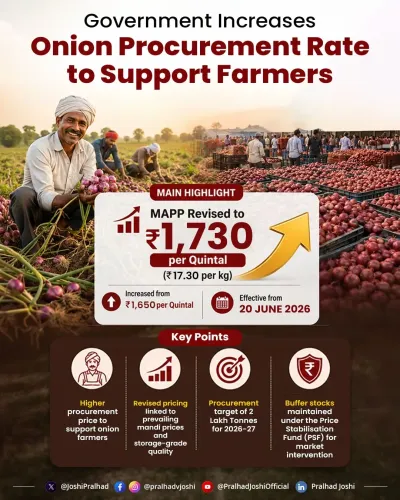
Union Consumer Affairs Minister Pralhad Joshi has revised the Minimum Assured Procurement Price for storage-grade onions to ₹1,650 per quintal, effective 13 June 2026, after a DoCA review meeting aimed at strengthening farmer returns and aligning procurement with prevailing mandi prices.
Key Takeaways
Union Consumer Affairs Minister Pralhad Joshi chaired a meeting with Department of Consumer Affairs (DoCA) officials to review onion procurement policy.
The Minimum Assured Procurement Price (MAPP) for storage-grade onions has been revised to ₹1,650 per quintal , effective 13 June 2026 .
The revision is based on prevailing mandi prices and quality requirements specific to storage-grade onions.
The pricing methodology has been refined to make procurement more responsive to market conditions.
The intervention is framed as protecting both farmer returns and retail consumer price stability through buffer-stock operations.
The move fits within a longer policy lineage that includes the Price Stabilisation Fund (2014) and Operation Greens (2018) .
Union Consumer Affairs Minister Pralhad Joshi on Friday, 13 June 2026 announced a revision of the Minimum Assured Procurement Price (MAPP) for storage-grade onions to ₹1,650 per quintal, effective 13 June 2026, following a review meeting with officials of the Department of Consumer Affairs (DoCA). The minister said the revision was based on prevailing mandi prices and quality requirements for storage-grade onions, and that the pricing methodology had been refined to make procurement more responsive to market conditions.
Context
Posting on X, Joshi said he 'chaired a meeting yesterday with officials from DoCA to strengthen onion procurement and ensure better returns for our farmers.' He added that the MAPP had been revised to ₹1,650 per quintal with effect from 13 June 2026, and that the pricing methodology had also been refined. The post was tagged to @jagograhakjago, the government's consumer awareness handle, signalling that the intervention is framed as protecting both farmer incomes and consumer interests.
The MAPP is the rate at which central government agencies procure storage-grade onions from farmers, typically during periods of market glut when mandi prices fall sharply. Procurement under this mechanism feeds into buffer stocks that are later released to cool retail prices during supply crunches.
Policy Backdrop
India's onion price management framework has evolved over more than a decade. The Price Stabilisation Fund, created in 2014, was designed to counter volatility in horticultural commodities including onions, while Operation Greens, launched in 2018, targeted supply-chain interventions for tomatoes, onions, and potatoes specifically. The MAPP mechanism sits within this broader architecture, serving as a direct price-floor instrument for farmers.
Periodic revisions to the MAPP have historically been triggered by production surges in key onion-growing states such as Maharashtra and Karnataka, where seasonal output can overwhelm local mandis and depress farm-gate prices. The current revision's explicit linkage to 'prevailing mandi prices' suggests a more dynamic calibration than earlier fixed-rate approaches.
Stakeholders and Impact
The primary beneficiaries of a higher MAPP are onion farmers, particularly smallholders in Maharashtra's Nashik belt and parts of Karnataka and Madhya Pradesh, who are most exposed to price crashes during the rabi and kharif harvest windows. An assured procurement floor reduces the risk of distress sales at below-cost prices.
For retail consumers, the buffer-stock logic cuts the other way: government procurement during gluts preserves stocks that can be offloaded when retail prices spike, a cycle that has played out repeatedly in recent years. The DoCA's dual mandate — protecting farmer returns and keeping retail prices stable — means the revised MAPP is as much a consumer-price management tool as an agricultural support measure.
What's Next
Attention will now turn to procurement volumes and offtake figures that DoCA is expected to release after the 13 June 2026 rollout. The scale of actual purchases at the revised ₹1,650 per quintal rate will determine how effective the price floor proves in practice. Any follow-up revisions are likely to be considered ahead of the kharif harvest, when fresh onion arrivals could again test market stability.
The refinement to the pricing methodology — making it more responsive to mandi rates — may also set a precedent for how the government calibrates procurement prices for other horticultural commodities under the Price Stabilisation Fund framework going forward.
Point of View
650 per quintal is a calibrated price-floor move that reflects the government's recurring challenge of balancing farmer distress during harvest gluts against the political sensitivity of retail onion prices. By explicitly anchoring the new rate to 'prevailing mandi prices,' the ministry is signalling a shift toward a more market-linked procurement trigger — a refinement that, if institutionalised, could reduce the lag between price crashes and government intervention. The tagging of the consumer awareness handle @jagograhakjago also underscores the dual-audience framing: the announcement is simultaneously a farmer-support signal and a consumer-reassurance message. Coming ahead of the kharif season, the timing suggests the government is moving proactively rather than reactively — a departure from the crisis-driven pattern that has historically characterised onion policy.
NationPress
29 Jul 2026
Frequently Asked Questions
What is the new onion MAPP set by the government in June 2026?
The government has revised the Minimum Assured Procurement Price (MAPP) for storage-grade onions to ₹1,650 per quintal, effective 13 June 2026, as announced by Union Consumer Affairs Minister Pralhad Joshi.
What is the Minimum Assured Procurement Price for onions?
The MAPP is the rate at which central government agencies procure storage-grade onions from farmers during market gluts, providing a price floor that protects farmers from distress sales. Procured stocks are later released to stabilise retail prices during supply shortages.
Why did the government revise the onion procurement price?
The revision was based on prevailing mandi prices and quality requirements for storage-grade onions, and was aimed at ensuring better returns for farmers while making procurement more responsive to market conditions.
Which states benefit most from onion MAPP revisions?
Onion farmers in Maharashtra, particularly the Nashik belt, as well as parts of Karnataka and Madhya Pradesh, are the primary beneficiaries, as these states account for the bulk of India's onion production and are most exposed to seasonal price crashes.
How does onion procurement help control retail prices?
Government agencies buy onions at the MAPP during periods of excess supply and build buffer stocks. These stocks are released into the market when retail prices spike, helping to moderate price volatility for consumers.