SIR row: Karnataka BJP says police stations have become 'Congress stations'
Synopsis
Karnataka's opposition isn't just crying foul — it's alleging a direct misuse of police machinery to suppress electoral participation. By claiming that police are filing suo motu BNS cases against Form-7 applicants on Congress's direction, the BJP has put both the Governor's office and the Election Commission on notice. The SIR row has quickly become a test of whether Karnataka's law enforcement can stay above partisan lines.
Key Takeaways
Ashoka , Leader of Opposition in the Karnataka Assembly, alleged on 6 October that police stations have become 'Congress stations,' targeting BJP and JD(S) workers.
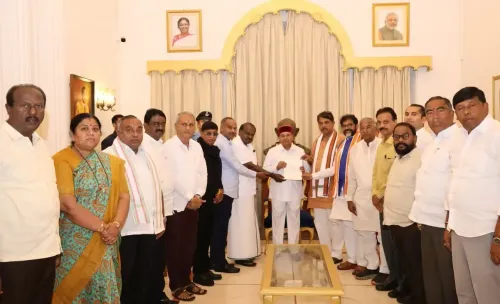
A delegation of NDA leaders, including Union Minister H.D.
Kumaraswamy and Bengaluru MP P.C.
Mohan , met Governor Thaawarchand Gehlot to register a formal complaint.
The row centres on Form-7 applications under electoral law; the Chief Electoral Officer clarified the Election Commission did not direct police to file cases.
Chalavadi Narayanaswamy alleged police were filing suo motu cases under the Bharatiya Nyaya Sanhita against Form-7 applicants under government pressure.
The Governor reportedly assured the delegation that action will be taken in accordance with the law.
No voter's name has been deleted from the electoral roll solely due to a Form-7 submission, according to the Chief Electoral Officer .
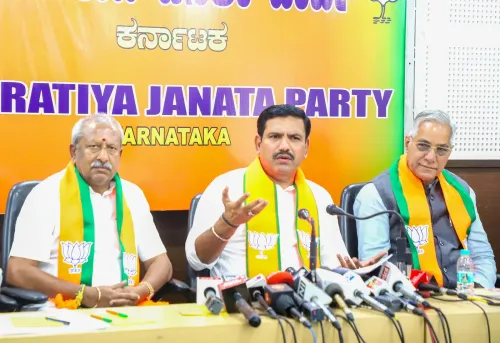
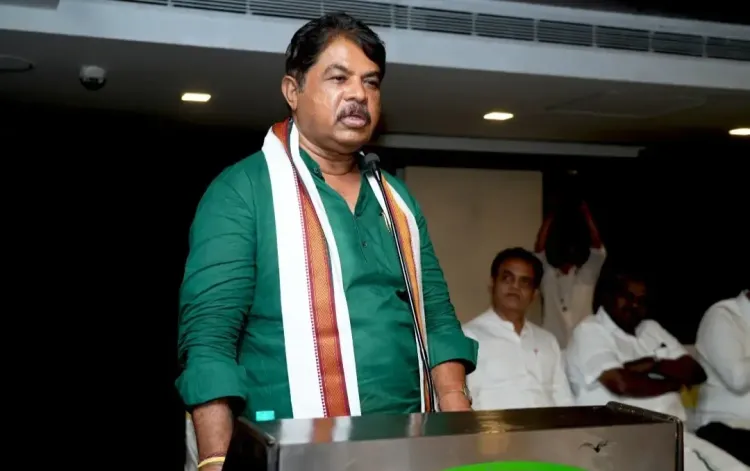
Leader of Opposition in the Karnataka Assembly R. Ashoka on Tuesday, 6 October alleged that police stations across the state have been reduced to 'Congress stations,' accusing the Siddaramaiah-Shivkumar government of systematically targeting BJP and JD(S) workers through fabricated criminal cases. The allegation came after a delegation of National Democratic Alliance (NDA) leaders met Governor Thaawarchand Gehlot in Bengaluru to register their protest.
The Governor Meeting and Who Was Present
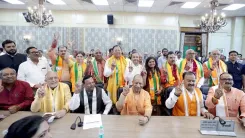
The NDA delegation that called on the Governor included Union Minister H.D. Kumaraswamy, former Home Minister and MLA Araga Jnanendra, Bengaluru MP P.C. Mohan, MLCs C.T. Ravi, Bhoje Gowda, and Muniraju, as well as Leader of the Opposition in the Council Chalavadi Narayanaswamy. Ashoka said he had brought the issue formally to the Governor's attention and urged the constitutional head to direct action against the state government. According to the opposition leaders, the Governor assured them that action would be taken in accordance with the law.
The Form-7 Controversy at the Centre of the Row
The immediate flashpoint is the controversy surrounding Form-7 applications — a mechanism under electoral law through which a voter's name can be challenged for deletion from the electoral roll. The opposition leaders had also met the Chief Electoral Officer on Monday to seek clarification on whether the Election Commission of India (ECI) had directed police to register cases against those submitting such applications.
'Anyone can submit Form-7, and they can submit as many as they want. This is the law. When we asked the Election Commission for clarification... they made it clear that the Commission had not asked anyone to do so,' Ashoka said. He alleged that despite this, police were registering criminal cases against BJP and JD(S) workers who had filed such applications, calling it targeted harassment. A complaint had also reportedly been filed against the BJP MLA from Jayanagar, according to Ashoka.
Opposition Alleges Illegal Use of Police Machinery
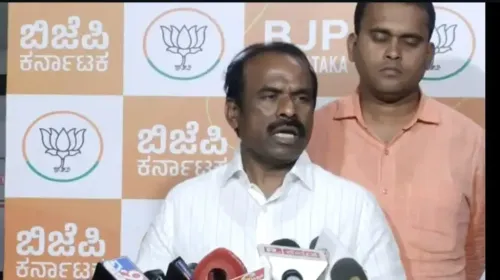
Chalavadi Narayanaswamy alleged that police were registering suo motu cases under the Bharatiya Nyaya Sanhita (BNS) against individuals who had submitted Form-7 applications — even though no voter's name had been deleted from the electoral roll solely on the basis of such a submission. 'After Form-7 is submitted, not even a single name has been deleted. If any decision has to be taken, the Election Commission will scrutinise the applications,' he said.
Narayanaswamy further argued that under the Representation of the People Act, only the Election Commission can act on electoral irregularities, and police can register an FIR only upon receipt of a formal complaint — not on their own initiative. He alleged that the state's Home Department was acting under political pressure. 'The Home Department is behaving as though it is holding an umbrella even in broad daylight,' he alleged, adding that the Home Minister was 'involved in various activities instead of looking after the Home Department.'
BJP's Broader Political Allegation
Ashoka claimed that the BJP and NDA had been gaining ground in Karnataka and alleged that the ruling Congress was resorting to intimidation because it could not tolerate the opposition's growing strength. 'This shows Congress' goonda culture,' he alleged. He also criticised the state government for staging a protest outside the Election Commission office, describing it as unprecedented. 'No government has ever sat on the streets in this manner. They postponed a Cabinet meeting and went to sit in front of the Election Commission office,' Narayanaswamy alleged.
This is not the first time the Karnataka opposition has accused the Congress-led state government of using law enforcement as a political instrument — similar allegations have surfaced periodically since the Congress returned to power in May 2023. The latest row, however, has an electoral dimension, placing the Election Commission squarely in the middle of a dispute between the ruling party and the opposition.
What Happens Next
The Governor has reportedly assured the delegation that the matter will be examined as per the law. The Chief Electoral Officer has, meanwhile, clarified that Form-7 applications are a matter between the Commission and individual citizens — not the state government. With both the Governor's office and the Election Commission now in the picture, the row is likely to intensify, especially as the SIR (Summary Revision of Electoral Rolls) process remains ongoing across the state.
Point of View
If confirmed, would represent a serious overreach, because electoral disputes are explicitly within the Election Commission's domain, not the police's. The broader pattern — opposition alleging political use of Karnataka Police since May 2023 — suggests this is a structural problem the state has not addressed. With the Governor now formally seized of the matter, the ruling Congress faces reputational risk beyond the immediate row.
NationPress
6 Oct 2026
Frequently Asked Questions
What is the SIR row in Karnataka?
The SIR (Summary Revision of Electoral Rolls) row in Karnataka refers to a controversy over Form-7 applications, a legal mechanism that allows voters to challenge another voter's inclusion on the electoral roll. The BJP has alleged that the Congress-led state government directed police to file criminal cases against BJP and JD(S) workers who submitted such applications, which the opposition calls targeted harassment.
What is Form-7 and why is it controversial?
Form-7 is a statutory form under electoral law through which a person can apply to have a voter's name removed from the electoral roll. It is controversial in Karnataka because opposition leaders allege that police have been registering suo motu cases under the Bharatiya Nyaya Sanhita against those who submitted Form-7 applications, even though the Chief Electoral Officer clarified that the Election Commission did not direct any such action.
Why did NDA leaders meet the Karnataka Governor?
NDA leaders, led by R. Ashoka , met Governor Thaawarchand Gehlot on 6 October to formally protest against what they described as the state government's use of police machinery to target BJP and JD(S) workers through criminal cases linked to the Form-7 controversy. They urged the Governor to take action against the Siddaramaiah-Shivkumar government.
Has any voter been removed from the electoral roll due to Form-7 applications?
No. According to the Chief Electoral Officer, not a single voter's name has been deleted from the electoral roll solely because a Form-7 application was submitted. The Election Commission scrutinises each application and retains a name if documents are in order, or rejects the application otherwise.
What action can the Governor take in this matter?
The Governor, as the constitutional head of the state, can direct the state government to respond to the allegations and, if warranted, refer the matter to appropriate authorities. Governor Thaawarchand Gehlot reportedly assured the NDA delegation that action will be taken in accordance with the law, though no specific directive has been issued yet.