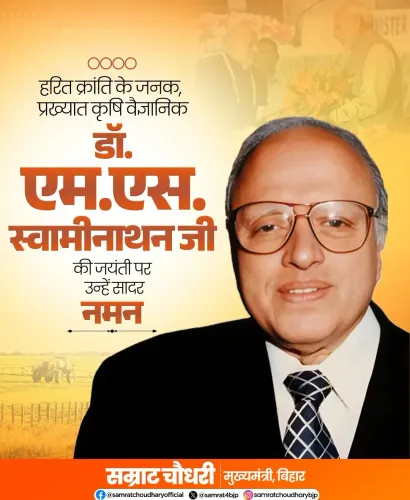
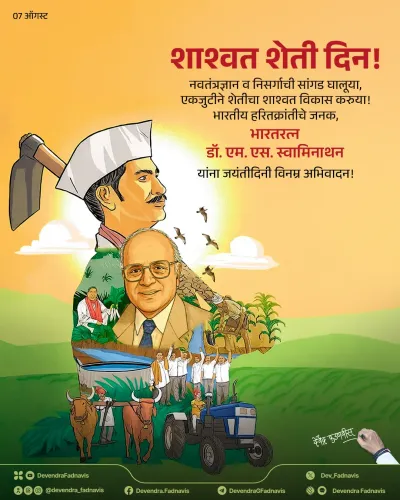
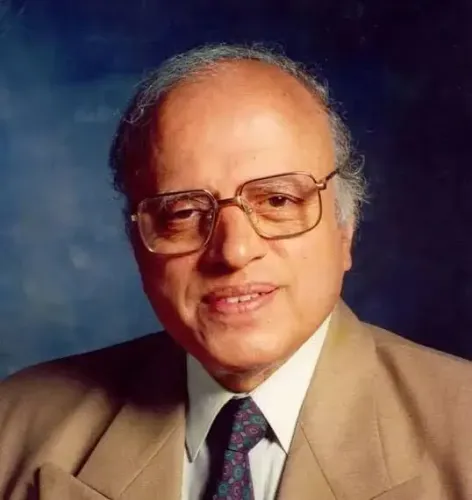
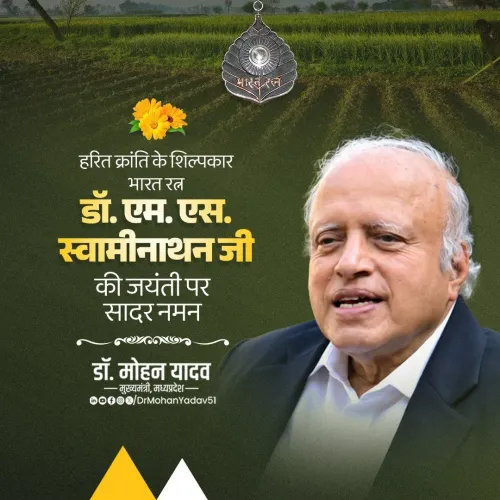
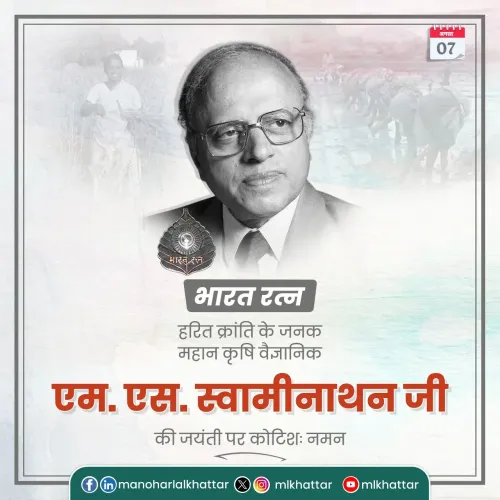
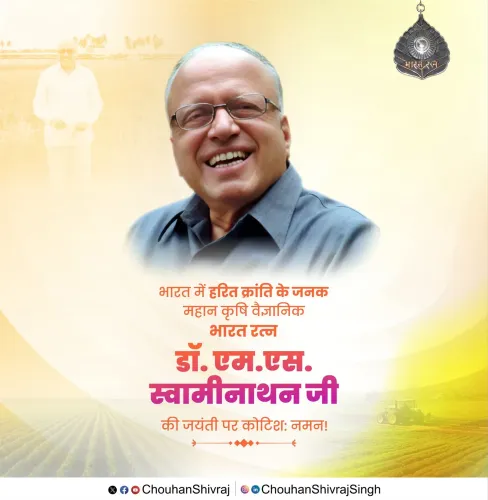
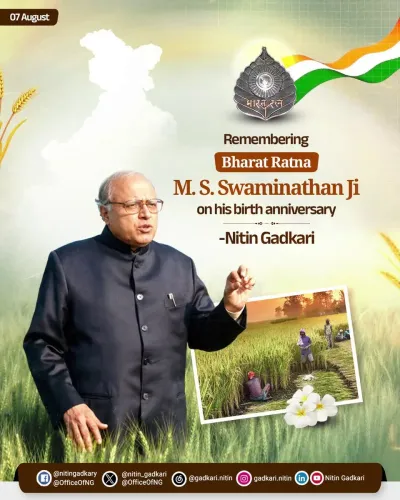
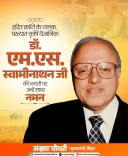
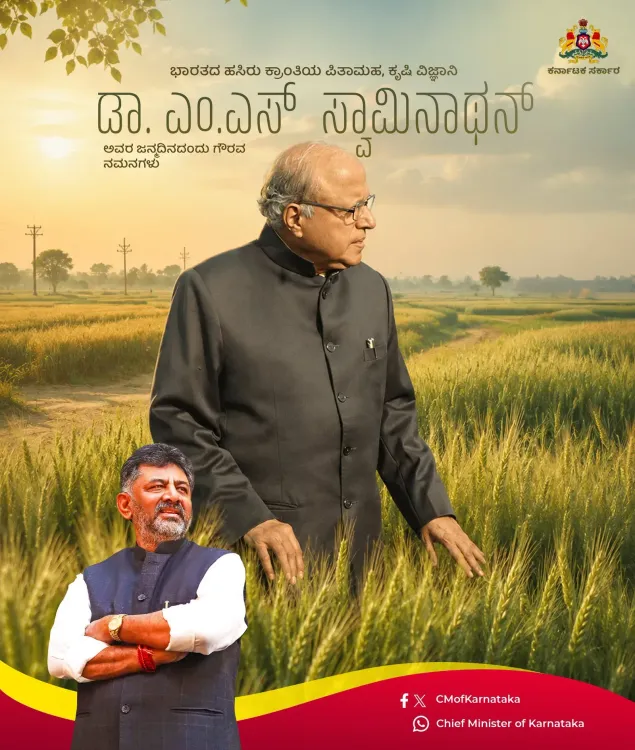
Karnataka CM Office Pays Tribute to Dr. M.S. Swaminathan on Birth Anniversary
Synopsis
The Chief Minister's Office of Karnataka marked Dr. M.S. Swaminathan's birth anniversary with a Kannada tribute, honouring the agricultural scientist credited with ending India's chronic foodgrain shortages through the Green Revolution and high-yielding crop varieties.
Key Takeaways
The Chief Minister's Office of Karnataka posted a tribute to Dr.
Swaminathan on his birth anniversary on 7 August .
The post, in Kannada, called Swaminathan 'hasiru krantiya harikara' — pioneer of the Green Revolution.
Swaminathan is credited with introducing high-yielding wheat and rice varieties in the 1960s that ended India's dependence on food imports.
The Green Revolution transformed India from a famine-prone, food-importing nation to a foodgrain-self-sufficient one within a generation.
State-level commemorations reflect the enduring political and agricultural relevance of Swaminathan's legacy to India's farming communities.
When India was on its knees — ravaged by famine and unable to feed its own people — one agricultural scientist changed the equation permanently. On his birth anniversary, the Chief Minister's Office of Karnataka paid tribute to Dr. M.S. Swaminathan, honouring the man who transformed a hunger-stricken nation into a foodgrain-self-sufficient one.
The CMO's post, written in Kannada, saluted Swaminathan as 'hasiru krantiya harikara' — 'the pioneer of the Green Revolution' — crediting him with laying the very foundation of India's nutritional and food security. 'At a time when the country was reeling from acute famine and food scarcity,' the tribute reads, 'it is Swaminathan who deserves credit for making India self-reliant in foodgrain production by introducing new agricultural science technologies and high-yielding crop varieties.'
From Famine to Self-Sufficiency: What Swaminathan Actually Did
In the 1960s, India was importing wheat to stave off mass starvation. Dr. Swaminathan, working alongside international researchers, introduced semi-dwarf, high-yielding varieties of wheat and rice that could produce multiples of what traditional varieties yielded. The results were staggering — India's foodgrain output surged, and the spectre of routine famine receded within a generation.
The Karnataka tribute captures this scale precisely: Swaminathan was 'a towering personality who, through the Green Revolution, became a lifeline for millions of farmers and filled the stomachs of crores of countrymen who were suffering from hunger.' These are not rhetorical flourishes — they describe a documented shift in India's agricultural baseline that endures today.
Why State Governments Keep Marking This Day
Annual commemorations of Swaminathan's birth anniversary by state governments reflect a broader pattern: his legacy is not merely historical but politically and agriculturally live. India's food security architecture — public-sector crop research, extension services, minimum support price frameworks — traces a direct line back to the institutional momentum the Green Revolution generated. For a state like Karnataka, with a significant agrarian economy, invoking Swaminathan is also a signal about where the government's agricultural priorities sit.
The man who once said a nation's food security is its first sovereignty left behind not just better seeds, but a blueprint for how science and state can move together. That blueprint is still being written.
Point of View
A state with a large and vocal farming constituency, the tribute signals continuity with a pro-farmer, pro-research governance narrative. Swaminathan's work also sits at the intersection of a live national debate: how India's agricultural productivity model must evolve — from the yield-maximisation paradigm of the Green Revolution toward sustainability and nutritional diversity — a tension his own later writings acknowledged.
NationPress
7 Aug 2026
Frequently Asked Questions
Who was Dr. M.S. Swaminathan?
Dr. M.S. Swaminathan was an Indian agricultural scientist widely regarded as the father of India's Green Revolution. He introduced high-yielding varieties of wheat and rice in the 1960s that enabled India to achieve foodgrain self-sufficiency and overcome chronic famine.
What was the Green Revolution in India?
The Green Revolution was an agricultural transformation beginning in the 1960s in which semi-dwarf, high-yielding varieties of wheat and rice — promoted by scientists including Dr. Swaminathan — dramatically increased India's foodgrain production and ended the country's dependence on food imports.
Why did Karnataka's Chief Minister's Office tribute Dr. Swaminathan?
The Chief Minister's Office of Karnataka posted a tribute on Dr. Swaminathan's birth anniversary, honouring his contribution to India's food security and his legacy as the pioneer of the Green Revolution, which benefited millions of Indian farmers.
When is Dr. M.S. Swaminathan's birth anniversary?
Dr. M.S. Swaminathan was born on 7 August. His birth anniversary is marked annually by government bodies, agricultural institutions, and farming organisations across India.
What is Dr. Swaminathan's contribution to Indian agriculture?
Dr. Swaminathan introduced high-yielding, disease-resistant crop varieties and modern agricultural science techniques that transformed India from a food-deficit nation into one capable of producing surplus foodgrains, providing a lifeline to millions of farmers and ending mass hunger.