Karnataka CMO hails Jyotiba Phule's equality ideals
Synopsis
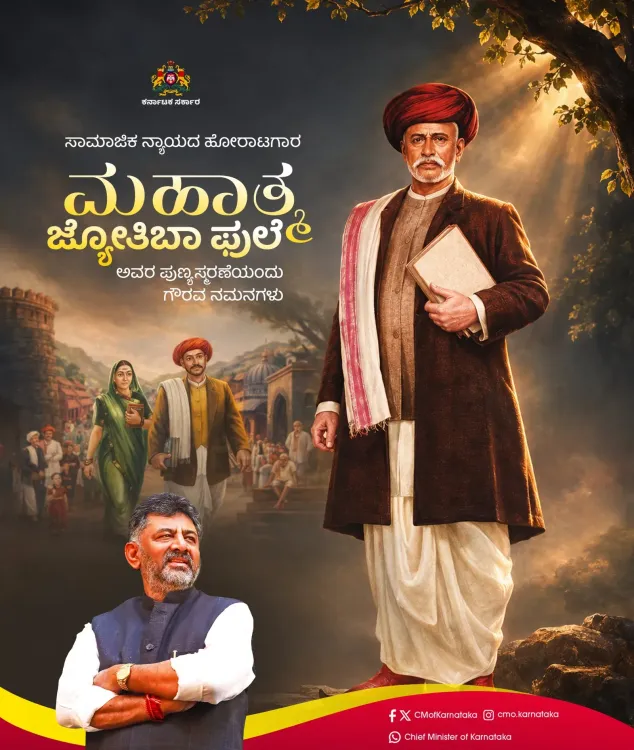
The Chief Minister's Office of Karnataka on 28 November 2026 paid tribute to Mahatma Jyotiba Phule, calling his fight against caste discrimination immortal and urging that equality, education and social justice remain the foundation of a progressive society.
Key Takeaways
The Chief Minister's Office of Karnataka posted a Kannada tribute to Mahatma Jyotiba Phule on 28 November 2026 .
The office called his ideals immortal and named equality, education and social justice as the foundation of a progressive society.
Phule was a 19th-century Maharashtra reformer who fought caste discrimination and promoted education for women and lower-caste communities.
He founded the Satyashodhak Samaj in 1873 to challenge caste hierarchies.
The post did not announce a new government scheme.
28 November is widely observed as the anniversary of Phule's death in 1890 .
A Saturday morning tribute from the Chief Minister's Office of Karnataka put a 19th-century anti-caste campaigner back at the centre of the state's social-justice vocabulary. On 28 November 2026, the office said Mahatma Jyotiba Phule's ideals are immortal, and that equality, education and social justice remain the foundation of a progressive society.
In Kannada, the office described Phule as the reformer who 'wrote a preface to social transformation through education' and fought without pause against caste discrimination and inequality. His ideals, it said, are ಚಿರಸ್ಮರಣೀಯ (immortal). Realising his message — that equality, education and social justice are the bedrock of a progressive society — is, the post added, 'the responsibility of all of us'.
The Pune reformer who treated the classroom as a weapon
Jyotirao Govindrao Phule, remembered as Mahatma Jyotiba Phule, was a 19th-century social reformer from Maharashtra who attacked caste hierarchy and untouchability at their roots. He treated schooling as the first blow against an order that locked women and lower-caste communities out of knowledge, opening schools as the practical front of that fight.
In 1873 he founded the Satyashodhak Samaj, built to challenge caste monopoly and organise for social equality. That lineage — schools first, then a movement against hierarchy — is the arc the Karnataka post invoked: education as the preface to social transformation, not an afterthought.
An anniversary vocabulary, and an unfinished classroom test
Indian governments routinely invoke Phule on commemorative dates to reaffirm commitments to social justice and education. 28 November is widely observed as the anniversary of his death in 1890. The Karnataka message named no new scheme. It named a duty: to turn those three pillars into the actual foundation of a progressive society, especially for backward classes and other marginalised communities.
What follows such tributes is the only measure that matters. Watch whether later state announcements tie this language to classrooms, scholarships, or welfare desks that still decide who moves and who does not.
Words on an anniversary are easy. The reformer measured progress by who was allowed to sit in the classroom. That remains the only test that counts.
Point of View
Or whether it remains a commemorative register. Anniversary posts set the tone; delivery in schools is what gives the tone meaning.
NationPress
28 Nov 2026
Frequently Asked Questions
Who was Mahatma Jyotiba Phule?
Mahatma Jyotiba Phule was a 19th-century social reformer from Maharashtra who fought caste discrimination and promoted education for women and lower-caste communities. He founded the Satyashodhak Samaj in 1873 to advance social equality.
What did the Karnataka CMO say about Jyotiba Phule?
The Chief Minister's Office of Karnataka said Phule's ideals are immortal and that realising his message of equality, education and social justice is everyone's responsibility. The Kannada post described him as having written a preface to social change through education while fighting caste discrimination and inequality.
When is Jyotiba Phule's death anniversary?
Jyotiba Phule's death anniversary is observed on 28 November; he died in 1890. The Karnataka CMO tribute was posted on that date in 2026.
What is the Satyashodhak Samaj?
The Satyashodhak Samaj is a social reform organisation Jyotiba Phule established in 1873. It was created to promote social equality and to challenge caste hierarchies.
Did Karnataka announce a new scheme in the Phule tribute?
No new scheme was named in the 28 November 2026 post. The message was a tribute calling on everyone to realise Phule's ideals of equality, education and social justice.