Karnataka CMO simplifies Permanent Residence Certificate process
Synopsis
The Chief Minister's Office of Karnataka has announced a simplified process for obtaining Permanent Residence Certificates, enabling citizens to apply through Grama One and Karnataka One centres within a stipulated timeframe, reinforcing the state's commitment to transparent and efficient public service delivery.
Key Takeaways
The Chief Minister's Office of Karnataka announced on 22 July 2026 that the Permanent Residence Certificate application process has been further simplified.
Citizens can now apply through Grama One (rural) and Karnataka One (urban) centres and receive certificates within a stipulated period.
Grama One was rolled out from 2021 to bring digital services to gram panchayat level; Karnataka One has been operational since 2004-05 .
The reform is grounded in the Karnataka Sakala Services Act, 2011 , which mandates time-bound delivery of over 400 citizen services.
Primary beneficiaries include rural citizens , students seeking state-quota admissions, and job seekers applying for state government posts.
The government has stated its commitment to 'transparent, smooth and effective service delivery' through this initiative.
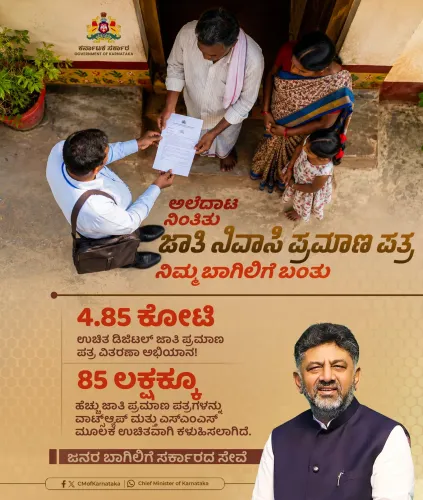
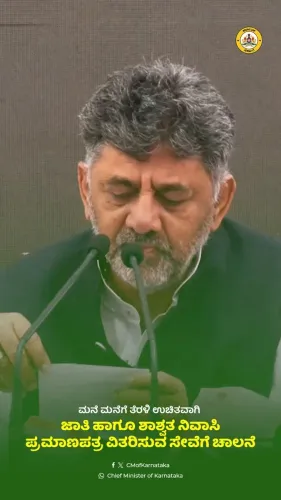
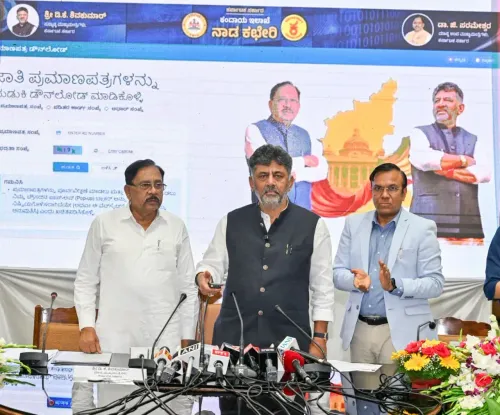
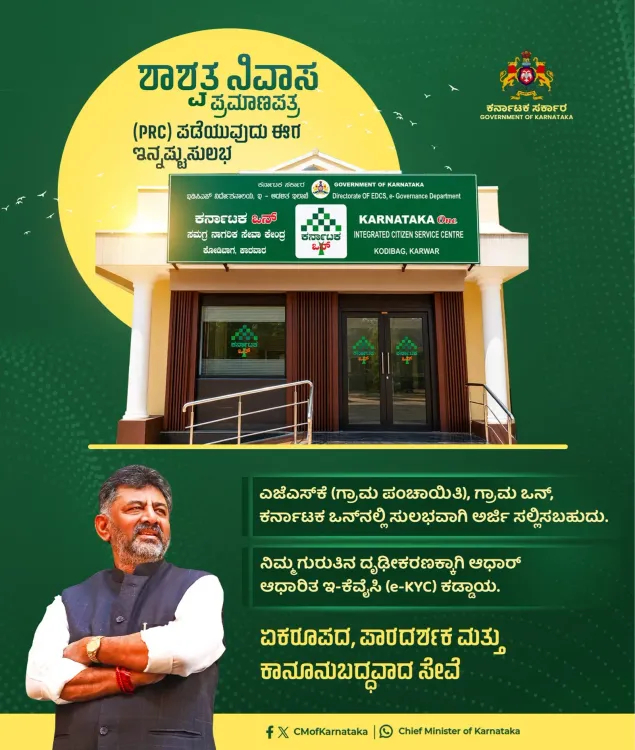
The Chief Minister's Office of Karnataka announced on Wednesday, 22 July 2026 that the process for obtaining a Permanent Residence Certificate has been further simplified, with the stated aim of saving citizens' time and effort. Applications can now be submitted easily through Grama One and Karnataka One centres, with certificates to be delivered within a stipulated period.
The post, published in Kannada, states: 'ನಾಗರಿಕರ ಸಮಯ ಮತ್ತು ಶ್ರಮ ಉಳಿಸುವ ಉದ್ದೇಶದಿಂದ ಶಾಶ್ವತ ನಿವಾಸ ಪ್ರಮಾಣಪತ್ರ ಪಡೆಯುವ ಪ್ರಕ್ರಿಯೆಯನ್ನು ಇನ್ನಷ್ಟು ಸರಳಗೊಳಿಸಲಾಗಿದೆ' ['With the aim of saving citizens' time and effort, the process for obtaining a Permanent Residence Certificate has been further simplified']. The office added that 'transparent, smooth and effective service delivery is our government's commitment.'
Context
A Permanent Residence Certificate — also known as a domicile certificate — is a document issued by Karnataka's revenue department that establishes a person's residency in the state. It is a key document for students seeking admission to state quota seats in educational institutions, for applicants to state government jobs, and for accessing a range of welfare benefits linked to Karnataka domicile.
The certificate has historically required multiple visits to revenue offices or taluk headquarters, making the process burdensome, particularly for rural residents and daily-wage earners for whom each visit represents lost income.
Policy Backdrop
The announcement builds on a layered architecture of e-governance reform in Karnataka. The Karnataka Sakala Services Act, 2011 established statutory, time-bound delivery for over 400 citizen services, including revenue certificates, creating legal accountability for delays. The Karnataka One project, launched in 2004-05, consolidated multiple departmental services at common urban service centres.
The Grama One initiative, rolled out from 2021, extended this model to rural gram panchayats, bringing digital service access to village-level centres. The current simplification of the Permanent Residence Certificate process sits within this continuum, pushing further integration of a high-demand document into the single-window framework already in place.
Stakeholders and Impact
Rural citizens stand to benefit most directly, as Grama One centres are designed to serve populations that would otherwise travel to taluk or district headquarters. Students preparing applications for state-quota admissions and job seekers applying for state government posts are among the most frequent users of the Permanent Residence Certificate.
By routing applications through established Grama One and Karnataka One networks, the government also reduces the scope for intermediaries who have historically charged informal fees to navigate paperwork on behalf of applicants. The emphasis on a 'stipulated period' for delivery aligns with the Sakala Act's mandate of time-bound service.
What's Next
The key measure of this reform's effectiveness will be its uniform rollout across all taluks in Karnataka and a demonstrable reduction in average processing time for applicants. Observers will watch whether the simplified procedure is accompanied by backend revenue department integration to ensure that Grama One and Karnataka One operators can process and verify applications without manual forwarding to district offices.
The broader pattern of state-level digitisation of domicile-linked services mirrors similar single-window models in other states and aligns with the national Common Services Centres framework, signalling that Karnataka's model could serve as a reference point for comparable reforms elsewhere.
Point of View
Rather than a structural overhaul. It signals an intent to extract greater utility from networks already built under prior administrations, which lends the reform cross-party institutional continuity. For the ruling dispensation, the announcement also carries political value ahead of any electoral cycle, as domicile certificates directly affect students and rural job seekers — constituencies that respond sharply to administrative friction. The real test, as with previous Sakala-era reforms, will be backend integration and whether the stipulated timelines hold in practice across all taluks.
NationPress
22 Jul 2026
Frequently Asked Questions
How can I apply for a Permanent Residence Certificate in Karnataka now?
You can now apply for a Permanent Residence Certificate in Karnataka through your nearest Grama One centre (for rural areas) or Karnataka One centre (for urban areas), where the process has been simplified for time-bound delivery.
What is a Permanent Residence Certificate in Karnataka used for?
A Permanent Residence Certificate in Karnataka is a domicile document issued by the revenue department. It is used to claim state-quota seats in educational institutions, apply for state government jobs, and access welfare benefits linked to Karnataka residency.
What is Grama One in Karnataka?
Grama One is a network of digital citizen service centres launched in Karnataka from 2021 to provide government documents and services at the gram panchayat level, reducing the need for rural residents to travel to taluk or district offices.
What is Karnataka One?
Karnataka One is a network of integrated urban service centres launched in 2004-05 that consolidates multiple government department services — including certificate issuance — at single locations across Karnataka's cities and towns.
What is the Karnataka Sakala Act and how does it relate to this?
The Karnataka Sakala Services Act, 2011 mandates time-bound delivery of over 400 citizen services, including revenue certificates. The latest simplification of the Permanent Residence Certificate process aligns with Sakala's framework of statutory deadlines for service delivery.