CM Shivakumar Backs Zero-Tolerance Drive on Rowdyism in Karnataka
Synopsis
The Chief Minister's Office of Karnataka declared a zero-tolerance stance on rowdyism, extortion, and intimidation on 8 June 2026, citing special enforcement drives, anti-rowdy squads, and continuous surveillance as the tools to strengthen the rule of law statewide under CM D K Shivakumar.
Key Takeaways
The Chief Minister's Office of Karnataka announced a zero-tolerance policy against rowdyism, intimidation, and extortion on 8 June 2026 .
CM D K Shivakumar is credited with leading the enforcement push, which deploys special enforcement drives and anti-rowdy squads .
The approach combines continuous surveillance with swift legal action to reinforce the rule of law across Karnataka .
The state has a prior history of anti-rowdy operations, including dedicated squad deployments dating to 2019–2020 .
Quarterly crime statistics from Karnataka Police will be a key measure of the drive's effectiveness.
Possible legislative action to strengthen anti-extortion laws may follow in the next assembly session.
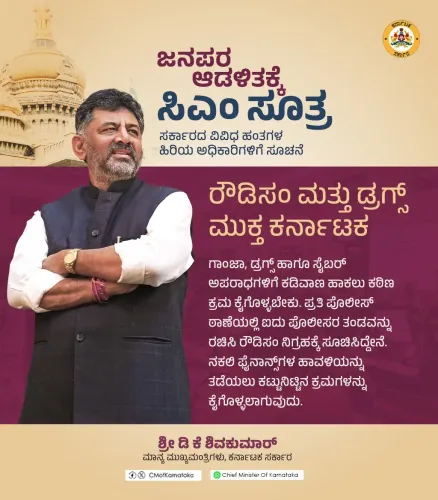
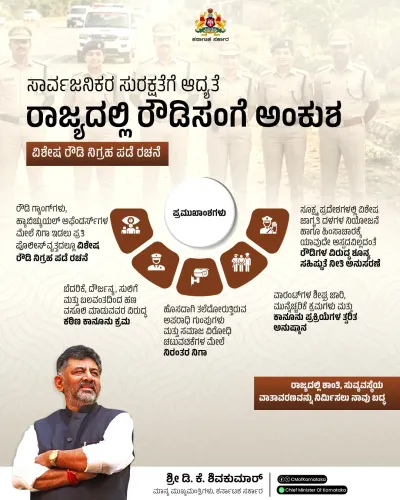
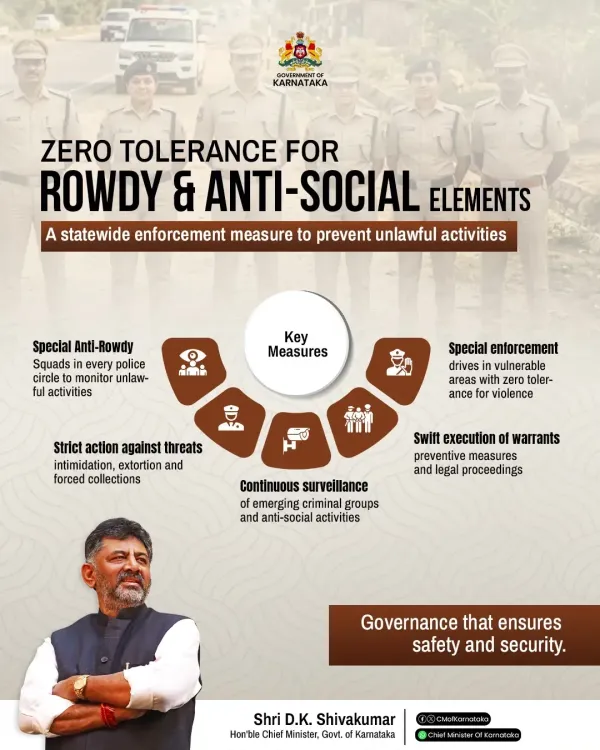
The Chief Minister's Office of Karnataka announced on Monday, 8 June 2026 that the state government, under the leadership of Chief Minister D K Shivakumar, has adopted a zero-tolerance policy against rowdyism, intimidation, extortion, and anti-social activities across the state.
Context
The official post declared that 'every citizen deserves to live without fear' and that 'every family deserves the assurance of safety.' It outlined a multi-pronged enforcement framework comprising special enforcement drives, anti-rowdy squads, continuous surveillance, and swift legal action as the pillars of the government's law-and-order push.
The message, shared under the hashtags #SafeKarnataka, #StrongerKarnataka, and #RuleOfLaw, positions the administration's approach as a structural commitment rather than a one-off operation.
Policy Backdrop
Karnataka has a documented history of state-directed anti-rowdy initiatives. As far back as 2019–2020, earlier administrations deployed dedicated anti-rowdy squads and launched targeted drives — sometimes branded as 'Operation Checkmate'-style campaigns — against organised gangs operating in urban centres.
Following the 2023 assembly elections, the Congress government renewed focus on policing rowdy networks and extortion rackets, particularly in Bengaluru and other major cities. The current announcement signals a continuation and formalisation of that approach under Karnataka Police, the state's primary law-enforcement agency.
Indian state governments routinely use official social-media channels to project administrative resolve on law and order, and such messaging often coincides with periodic reviews of police performance or upcoming budgetary discussions on internal security.
Stakeholders and Impact
The policy directly affects Karnataka's residents, particularly those in urban localities where rowdyism and extortion networks have historically been most active. Small business owners, traders, and residents of densely populated neighbourhoods are among the primary beneficiaries of sustained anti-extortion enforcement.
For Karnataka Police, the announcement reinforces operational mandates and may translate into expanded resource allocation for surveillance infrastructure and specialised squads. Civil-society groups tracking crime trends will be watching whether the stated zero-tolerance posture is reflected in quarterly crime statistics.
What's Next
The government's pledge to build 'a Karnataka where safety, justice and opportunity go hand in hand' sets an implicit benchmark against which enforcement outcomes will be measured. Analysts will look to the next release of Karnataka Police quarterly crime data to assess whether incidents of extortion and rowdy-related offences are declining.
Any legislative proposals in the upcoming assembly session aimed at strengthening anti-extortion statutes would serve as a concrete follow-through to the administrative messaging. The sustained deployment of anti-rowdy squads and the pace of legal proceedings against detained individuals will be key indicators of the drive's depth beyond its public communication.
Point of View
The Congress-led government is building a law-and-order credential that has traditionally been contested terrain between ruling and opposition parties in Karnataka. The emphasis on structural tools — squads, surveillance, legal action — rather than a single named operation suggests the administration wants this framed as durable policy rather than a headline drive. Whether the messaging translates into measurable crime reduction will ultimately determine its long-term political dividend.
NationPress
22 Oct 2026
Frequently Asked Questions
What is the Karnataka government's zero-tolerance policy on rowdyism?
The Karnataka government under CM D K Shivakumar has adopted a zero-tolerance approach towards rowdyism, intimidation, extortion, and anti-social activities, deploying anti-rowdy squads, special enforcement drives, continuous surveillance, and swift legal action across the state.
What are anti-rowdy squads in Karnataka?
Anti-rowdy squads are dedicated units within Karnataka Police tasked with identifying, monitoring, and taking legal action against individuals involved in rowdyism, extortion, and organised criminal activity, particularly in urban areas.
Has Karnataka launched such drives before?
Yes. Karnataka has a history of anti-rowdy operations, including dedicated squad deployments and targeted drives — sometimes called 'Operation Checkmate'-style campaigns — that were conducted as far back as 2019–2020 under earlier administrations.
What is the Safe Karnataka initiative?
Safe Karnataka is a policy messaging framework promoted by the Chief Minister's Office emphasising zero-tolerance enforcement against crime, with the goal of ensuring every citizen lives without fear and every family has an assurance of safety.
How will the success of Karnataka's anti-rowdy drive be measured?
The effectiveness of the drive is expected to be assessed through Karnataka Police's quarterly crime statistics, particularly trends in extortion and rowdy-related offences, as well as any legislative steps to strengthen anti-extortion laws in the state assembly.