CM Shivakumar Plans 15-Lakh Sapling Drive on Kempegowda Jayanthi

Synopsis
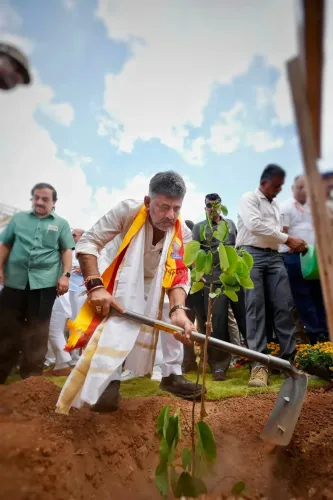
The Chief Minister's Office of Karnataka announced a drive to plant 15 lakh saplings across Bengaluru in a single day during Nadaprabhu Kempegowda Jayanthi celebrations, with 5 lakh earmarked for Kempegowda Layout and 10 lakh for other localities and roadsides under the Greater Bengaluru Authority.
Key Takeaways
The Karnataka government plans to plant 15 lakh saplings across Bengaluru in a single day on Kempegowda Jayanthi .
5 lakh saplings will be planted in the newly developed Kempegowda Layout , with 10 lakh going to other localities and roadsides.
The drive falls under the jurisdiction of the Greater Bengaluru Authority .
Chief Minister D K Shivakumar framed the initiative as fulfilling Kempegowda's vision of a 'beautiful, sustainable, and green Bengaluru.' The plantation drive is positioned as both a cultural tribute and a large-scale environmental action, combining civic commemoration with urban greening.
Long-term sapling survival and integration into the Greater Bengaluru Authority 's master plan remain key factors to watch.
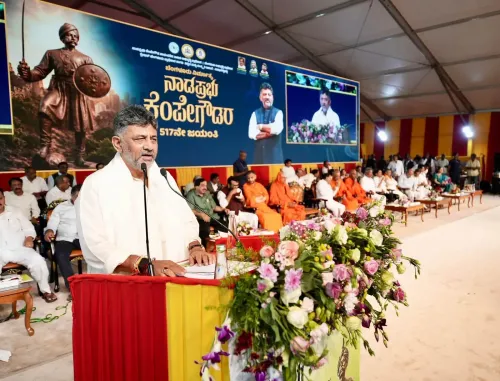
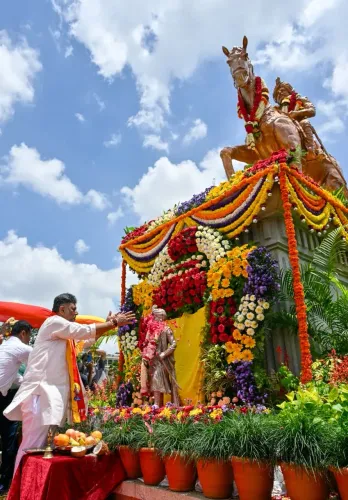
The Chief Minister's Office of Karnataka announced on Friday, 27 June 2026 that this year's Nadaprabhu Kempegowda Jayanthi celebrations will be marked by a single-day plantation drive targeting 15 lakh saplings across Bengaluru, combining civic tribute with large-scale environmental action.
Context
Chief Minister D K Shivakumar stated in the post: 'ಈ ಬಾರಿಯ ನಾಡಪ್ರಭು ಕೆಂಪೇಗೌಡರ ಜಯಂತಿಯ ಆಚರಣೆಯು ಅದ್ಧೂರಿಯಾಗಿ ಮಾತ್ರವಲ್ಲದೆ ಪರಿಸರ ಸಂರಕ್ಷಣೆಯ ನಿಟ್ಟಿನಲ್ಲಿ ಸಹ ಹೊಸ ಇತಿಹಾಸ ಸೃಷ್ಟಿಸಲಿದೆ' — 'This year's Kempegowda Jayanthi celebrations will not only be grand but will also create new history in the direction of environmental conservation.' The announcement frames the occasion as both a cultural milestone and an ecological commitment by the Karnataka government.
Nadaprabhu Kempegowda was a 16th-century chieftain widely regarded as the founder of Bengaluru, whose vision of a planned, liveable city continues to shape the civic identity of the state capital. Invoking his legacy of a 'beautiful, sustainable, and green Bengaluru' — ಸುಂದರ, ಸುಸ್ಥಿರ ಹಾಗೂ ಹಸಿರು ಬೆಂಗಳೂರು — the government has positioned the plantation drive as a meaningful, purpose-driven tribute rather than a ceremonial one.
Policy Backdrop
The plan allocates 5 lakh saplings to the newly developed Kempegowda Layout — a residential township in Bengaluru named after the city's founder — while the remaining 10 lakh saplings are to be planted across other localities and roadsides within the city. The combined target of 15 lakh saplings in a single day falls under the jurisdiction of the Greater Bengaluru Authority, the statutory body overseeing planning and infrastructure across the metropolitan region.
Karnataka governments have in previous years used Kempegowda Jayanthi as an occasion to combine cultural programmes with civic projects. This year's scale, however, represents a significantly larger stated ambition. Bengaluru has faced sustained pressure on its green cover due to rapid urbanisation, infrastructure expansion, and rising urban temperatures, making plantation drives a recurring policy response across successive administrations.
Stakeholders and Impact
For Bengaluru's residents, the drive holds direct relevance: urban heat, reduced canopy cover, and stormwater management have been persistent quality-of-life concerns. A successful single-day drive of this scale could contribute meaningfully to the city's green index if the saplings are maintained beyond the planting event itself.
Across Indian metros, state governments have increasingly linked tributes to historical figures with large-scale environmental actions to build public participation in urban sustainability. The Karnataka government's framing of the drive as fulfilling Kempegowda's dream serves both as civic mobilisation and as green-city branding — a pattern seen in comparable initiatives in other major Indian cities.
What's Next
The critical test for any single-day mass plantation drive lies in survival rates and long-term maintenance arrangements for the saplings after the event. Observers and civic groups in Bengaluru are likely to track whether the Greater Bengaluru Authority integrates this initiative into its broader urban master plan and future budget allocations for horticulture and green infrastructure.
If the 15-lakh sapling target is achieved and followed through with sustained care, it could set a benchmark for how Indian cities commemorate historical figures — moving from symbolic gestures to measurable environmental outcomes tied to urban planning commitments.
Point of View
But the real measure of success will be post-event maintenance, a phase where past urban plantation drives across Indian cities have repeatedly faltered. For CM Shivakumar, the announcement also carries political utility: it reinforces the government's green-city credentials in a metropolis where urban heat and shrinking canopy cover are increasingly salient voter concerns. Whether this drive translates into lasting ecological gain or remains a well-intentioned commemorative spectacle will depend on institutional follow-through by the Greater Bengaluru Authority.
NationPress
25 Sept 2026
Frequently Asked Questions
How many saplings will be planted on Kempegowda Jayanthi 2026 in Bengaluru?
The Karnataka government has set a target of planting 15 lakh saplings across Bengaluru in a single day on Kempegowda Jayanthi, with 5 lakh in Kempegowda Layout and 10 lakh in other localities and roadsides.
Who announced the Kempegowda Jayanthi tree plantation drive?
Chief Minister D K Shivakumar announced the drive through the official Chief Minister's Office of Karnataka account on X.
What is Kempegowda Layout in Bengaluru?
Kempegowda Layout is a newly developed residential township in Bengaluru named after Nadaprabhu Kempegowda , the 16th-century founder of the city.
What is the Greater Bengaluru Authority and what role does it play in this drive?
The Greater Bengaluru Authority is the statutory urban development body overseeing planning and infrastructure across the Bengaluru metropolitan region; the entire 15-lakh sapling drive falls within its jurisdiction.
Why is tree plantation being linked to Kempegowda Jayanthi?
The Karnataka government has linked the plantation drive to Kempegowda Jayanthi to honour the city founder's vision of a 'beautiful, sustainable, and green Bengaluru,' combining cultural commemoration with environmental action — a broader pattern seen across Indian state governments.