Karnataka CM Office Pays Tribute to Indira Gandhi on Death Anniversary
Synopsis
On Indira Gandhi's death anniversary, Karnataka's Chief Minister's Office pays tribute, recalling her 1971 war leadership, bank nationalisation, the 20-point programme, and her historic Chikmagalur victory and land-reform partnership with Chief Minister D. Devaraj Urs.
Key Takeaways
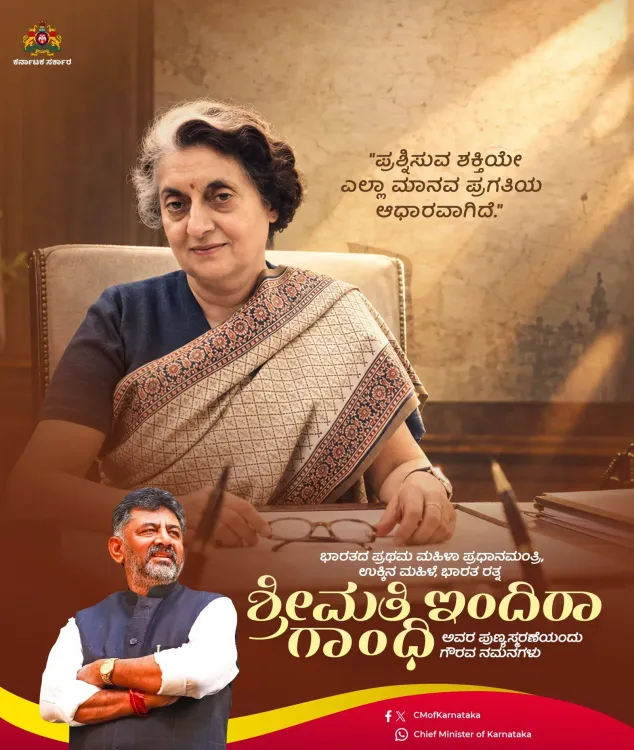
31 October 2026 : Karnataka's CMO marks Indira Gandhi's death anniversary with a Kannada tribute on X.
The post cites India's 1971 military victory , bank nationalisation (1969) , privy purse abolition, and the 20-point programme (1975) as pillars of her legacy.
Indira Gandhi contested and won a by-election from Chikmagalur in 1978 , cementing her ties to Karnataka.
Her collaboration with Karnataka CM D.
Devaraj Urs produced the 'Land to the Tiller' reform, redistributing agricultural land to actual cultivators.
The tribute frames her economic and social policies as defining a path of self-reliance and welfare for the poor.
Every drop of her blood, she once declared, was dedicated to the unity and progress of India — and on her death anniversary this 31 October 2026, the Chief Minister's Office of Karnataka invoked that very pledge to remember one of India's most consequential leaders.
The post, written in Kannada, honours Indira Gandhi as an unmatched leader — 'apratima nayaki' (peerless leader) — who lived up to her own words until the very end. It recalls three defining pillars of her governance: the decisive military leadership that delivered India a historic victory in the 1971 Indo-Pakistani War, the 1969 nationalisation of 14 major commercial banks, the abolition of privy purses for former royals, and the 20-point programme launched in July 1975 to drive economic self-reliance and lift the rural poor.
Chikmagalur, Devaraj Urs, and Karnataka's Bond with Indira
The tribute specifically anchors Indira Gandhi within Karnataka's political memory. In 1978, after her party's electoral defeat and her own expulsion from Parliament, she chose Chikmagalur — a scenic hill constituency in the Western Ghats — to stage her political comeback through a by-election, and she won. That contest became a defining moment of her resilience and her connection to Karnataka's voters.
The post also highlights her collaboration with former Karnataka Chief Minister D. Devaraj Urs, who governed the state from 1972 to 1977 and again from 1978 to 1980. Together, they drove the landmark 'Uluva Vanane Bhumiya Oleya' — the 'Land to the Tiller' land reform act, which broke the stranglehold of absentee landlordism and transferred agricultural land rights to those who actually farmed it. The CMO's post says the reform 'shed revolutionary light' on the lives of lakhs of the exploited.
A Legacy Rooted in Redistribution
Taken together, the policies the tribute lists — bank nationalisation, privy purse abolition, the 20-point programme, and Karnataka's land reforms — form a coherent arc of 1970s Congress-era redistributive economics. Bank nationalisation brought credit within reach of farmers and small businesses previously locked out of formal finance. The 20-point programme directed state machinery toward irrigation, rural employment, and housing for the landless. Land reforms in Karnataka gave cultivators legal ownership of holdings they had tilled for generations.
The CMO's closing line frames her path as one 'always worthy of remembrance' — a path defined by the welfare of the poor and the national interest.
Forty-two years after her assassination, the ideas she anchored in policy continue to echo in debates over agrarian rights, public banking, and the role of the state in economic life. Karnataka's tribute today is as much a statement about the present as it is about the past.
Point of View
Bank nationalisation, and land reforms to underscore a legacy of state-led redistribution that the party continues to position itself as the heir to. The Chikmagalur reference is especially pointed: it reminds Karnataka voters of a personal, electoral bond, not merely an ideological one. At a time when agrarian distress and public-banking debates remain live political issues in the state, anchoring the Congress government's identity in Indira Gandhi's 1970s economic vision is as much forward-looking strategy as it is historical remembrance.
NationPress
31 Oct 2026
Frequently Asked Questions
Why is 31 October significant for Indira Gandhi?
31 October is the death anniversary of former Prime Minister Indira Gandhi , who was assassinated on this day in 1984 . It is observed across India as a day of remembrance.
What was Indira Gandhi's connection to Chikmagalur?
Indira Gandhi contested and won a parliamentary by-election from Chikmagalur in Karnataka in 1978 , marking her political comeback after the Congress party's defeat in the 1977 general elections.
What is the 'Land to the Tiller' reform in Karnataka?
The 'Uluva Vanane Bhumiya Oleya' (Land to the Tiller) reform was a landmark land legislation implemented in Karnataka in the mid-1970s under Chief Minister D. Devaraj Urs , with central support from Indira Gandhi. It granted land ownership rights to actual cultivators, benefiting lakhs of landless and marginalised farmers.
What was Indira Gandhi's 20-point programme?
The 20-point programme was an economic and social welfare initiative launched by Indira Gandhi in July 1975 , aimed at poverty alleviation, rural development, unemployment reduction, and economic self-reliance for India.
When did Indira Gandhi nationalise banks?
Indira Gandhi nationalised 14 major commercial banks in 1969 , bringing them under government control to expand access to formal credit for farmers, small businesses, and the rural poor.