CM Siddaramaiah Restarts Safaris at Bandipur, Nagarhole

Synopsis
Karnataka Chief Minister DK Shivakumar has announced the resumption of full-scale jungle safaris at Bandipur and Nagarhole tiger reserves, citing a scientific carrying-capacity assessment by an expert committee and pledging strictly regulated access that prioritises wildlife conservation alongside sustainable eco-tourism.
Key Takeaways
Bandipur and Nagarhole tiger reserves will resume full-scale jungle safaris following an announcement by CM DK Shivakumar on 27 June 2026 .
The decision is based on a scientific carrying-capacity assessment by an expert committee, in line with NTCA guidelines that have governed tiger reserve tourism since 2012 .
Safaris will operate in a strictly regulated manner with wildlife conservation given the first priority.
The government aims to revive local economies in forest-fringe areas and boost state revenue through sustainable eco-tourism.
Visitors are required to comply with all safari regulations; detailed zone-wise quotas and protocols are pending Forest Department notification.
Both reserves were among the original sites designated under Project Tiger in 1973 and form part of a contiguous Western Ghats conservation landscape.
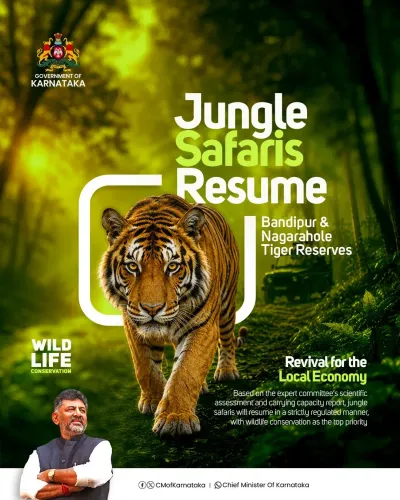
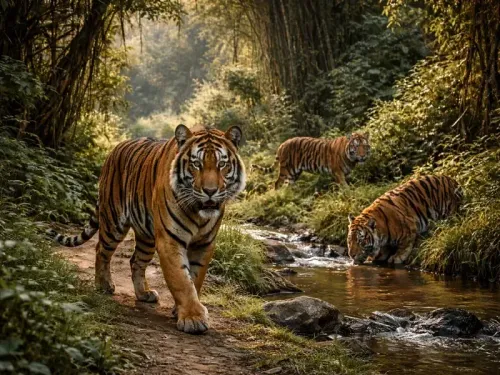
The Chief Minister's Office of Karnataka announced on Saturday, 27 June 2026 that full-scale jungle safaris will be resumed at Bandipur Tiger Reserve and Nagarhole Tiger Reserve, two of the state's most celebrated protected areas, with the decision grounded in a scientific carrying-capacity assessment by an expert committee.
Chief Minister DK Shivakumar shared the announcement directly, stating: 'I bring good news for wildlife and safari enthusiasts. Full-scale jungle safaris will be restarted in the state's proud tiger reserves, Bandipur and Nagarhole.' He added that the government is 'committed to fulfilling the aspirations of nature lovers who wish to roam the forests and enjoy wildlife, while also maintaining natural balance so that no harm comes to biodiversity and the dignity of animal habitats is upheld.'
Context
The resumption follows a scientific evaluation by an expert panel that assessed the carrying capacity — the maximum visitor load these ecosystems can absorb without ecological harm — of both reserves. Shivakumar emphasised that safaris will operate in a 'strictly regulated manner,' with wildlife conservation given the 'first priority.' Visitors, he appealed, must comply with the rules governing safari conduct.
Policy Backdrop
Bandipur and Nagarhole are contiguous reserves within the Western Ghats landscape and were among the original reserves designated under Project Tiger in 1973. The National Tiger Conservation Authority (NTCA), the statutory body under the Union Ministry of Environment, Forest and Climate Change, has since 2012 required states to conduct scientific carrying-capacity studies before permitting tourist access to core zones of tiger reserves. Karnataka's decision to rely on such an assessment before reopening safaris places it squarely within NTCA's prescribed framework.
Indian states have periodically restricted and then reintroduced wildlife tourism, guided by NTCA norms that protect core areas while allowing limited, zone-wise visitor access. Karnataka's approach mirrors that of other tiger-range states where expert panels determine visitor quotas and monitoring protocols.
Stakeholders and Impact
The restart is expected to benefit safari tourists, local tour operators, and hospitality businesses in the buffer zones around both reserves, whose livelihoods are closely tied to visitor footfall. Shivakumar explicitly cited 'reviving the local economy' and 'achieving state economic progress' through sustainable eco-tourism as core objectives alongside biodiversity protection. The Karnataka Forest Department will be responsible for implementing zone-specific quotas and ensuring compliance with safari regulations.
Conservation experts and wildlife advocates will watch closely to ensure that the regulated framework translates into on-ground enforcement, particularly given the high tiger density in both reserves and their ecological sensitivity as part of a connected landscape.
What's Next
Detailed notifications from the Karnataka Forest Department are expected to specify zone-wise safari quotas, booking protocols, and wildlife-disturbance monitoring mechanisms. Periodic reporting on ecological indicators and revenue-sharing arrangements with local communities will be critical to demonstrating that the government's stated commitment to 'sustainable eco-tourism' is being upheld in practice.
Point of View
Shivakumar insulates the decision from criticism that it prioritises visitor revenue over ecological sensitivity — a charge that has dogged safari resumptions in other tiger-range states. The explicit reference to local economic revival also reflects a Congress government calculus: eco-tourism as a visible, tangible benefit for communities that live alongside protected areas. How robustly the Forest Department enforces zone-wise quotas and disturbance monitoring will ultimately determine whether this becomes a model or a cautionary tale.
NationPress
26 Sept 2026
Frequently Asked Questions
When will jungle safaris restart at Bandipur and Nagarhole?
The Karnataka government announced on 27 June 2026 that full-scale jungle safaris will be resumed at Bandipur and Nagarhole tiger reserves, though specific start dates are subject to Forest Department notifications.
Why were safaris at Bandipur and Nagarhole suspended?
The exact reasons and duration of the prior suspension have not been officially detailed in the announcement. The government has indicated the resumption is based on a new scientific carrying-capacity assessment by an expert committee.
What is carrying capacity in the context of tiger reserve safaris?
Carrying capacity refers to the maximum number of visitors and vehicles a protected area can accommodate without causing ecological harm to wildlife or their habitat. The NTCA has required such assessments before permitting safaris in tiger reserve core zones since 2012.
Who announced the Bandipur and Nagarhole safari resumption?
Karnataka Chief Minister DK Shivakumar made the announcement through the official Chief Minister's Office account on 27 June 2026.
Will there be rules for visitors on Bandipur and Nagarhole safaris?
Yes. Chief Minister Shivakumar has appealed to visitors to comply with all regulations governing safari conduct. Detailed zone-specific rules and quotas are expected to be notified by the Karnataka Forest Department.