Karnataka Secures ₹2,821 Cr Textile MoUs at Bharat Tex 2026
Synopsis
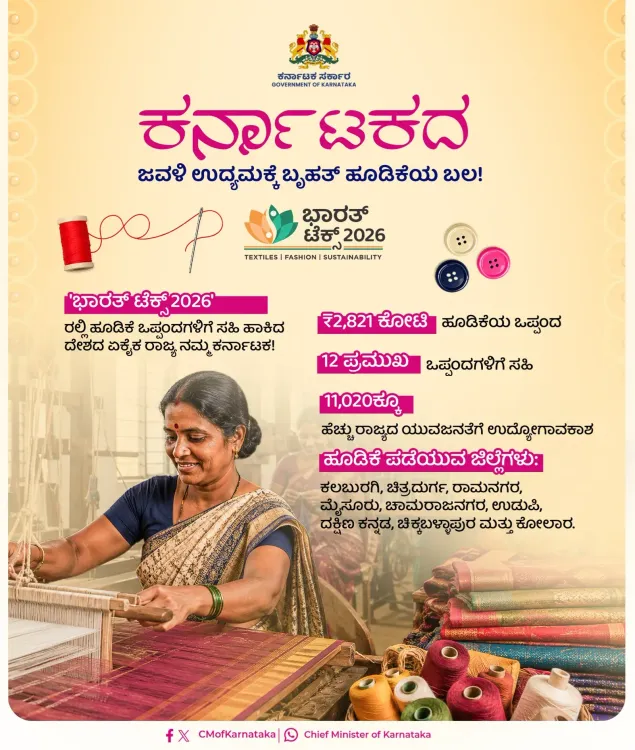
At Bharat Tex 2026, the Karnataka government signed 12 investment MoUs worth ₹2,821 crore in the textile sector. The deals are projected to create over 11,020 direct jobs across multiple districts, reinforcing Karnataka's position as a top destination for textile and apparel investment in India.
Key Takeaways
Karnataka signed 12 investment MoUs at Bharat Tex 2026 , a national textile investment summit organised by the Government of India.
The total investment committed stands at ₹2,821 crore , targeting the state's textile and apparel sector.
The projects are projected to generate over 11,020 direct employment opportunities across multiple districts of Karnataka.
The investments are intended to strengthen Karnataka's full textile value chain, from fibre processing to finished garments.
Karnataka's approach aligns with the central government's PLI scheme for textiles (notified 2021) and the state's own Industrial Policy 2020-25 .
The MoU-to-project conversion rate over the next 24-36 months will determine the real-world employment and industrial impact.
The Chief Minister's Office of Karnataka announced on Friday, 17 July 2026 that the state government has signed 12 investment MoUs worth ₹2,821 crore at Bharat Tex 2026, a national-level textile investment summit, cementing Karnataka's standing as a preferred destination for global textile and apparel capital.
Context
The official post from the Chief Minister's Office declared — 'ಭಾರತ್ ಟೆಕ್ಸ್ 2026: ರಾಜ್ಯದ ಜವಳಿ ವಲಯದಲ್ಲಿ ಜಾಗತಿಕ ಹೂಡಿಕೆಯ ಹೊಸ ಮೈಲಿಗಲ್ಲು!' ('Bharat Tex 2026: A new milestone of global investment in the state's textile sector!'). The agreements are projected to generate over 11,020 direct employment opportunities across multiple districts of Karnataka, according to the official announcement.
Bharat Tex 2026 is a Government of India-organised summit designed to showcase India's textile potential and facilitate investment commitments between states and global industry players. Karnataka's participation and the scale of MoUs signed underline the state's proactive outreach to international and domestic textile investors.
Policy Backdrop
Karnataka's textile push is grounded in its Industrial Policy 2020-25, which prioritised labour-intensive sectors — textiles and apparel foremost among them — by offering incentives spanning land, power tariffs and skill-development support. The state hosts established textile clusters in districts such as Bangalore Rural, Mysore and Belagavi, giving it a ready infrastructure base to absorb new investment.
At the national level, the Production Linked Incentive (PLI) scheme for textiles, notified in 2021, has been a catalyst for states competing to attract man-made fibre apparel and technical textiles manufacturing. Karnataka's 12-MoU haul at Bharat Tex 2026 reflects how effectively it has aligned its state-level policy architecture with central government incentive frameworks.
Stakeholders and Impact
The investments are expected to strengthen Karnataka's textile value chain from fibre processing through to finished garments, spreading industrial activity across multiple districts rather than concentrating it in a single hub. Over 11,020 direct jobs stand to be created, with downstream multiplier effects likely to benefit ancillary suppliers, logistics operators and local communities.
District industries departments, single-window clearance bodies and skill-development agencies within the state will be key institutional actors in translating these MoUs into operational factories. The CMO's framing — 'create new opportunities for the people' — signals that employment generation, not merely investment quantum, is the administration's stated measure of success.
What's Next
The critical test will be the conversion rate of these 12 MoUs into ground-level projects within the next 24 to 36 months — the standard window within which investor commitments are typically expected to reach financial closure and begin construction. Analysts will watch for follow-up state budget allocations, textile park notifications or policy tweaks that signal the government's seriousness in hand-holding investors past the MoU stage.
Karnataka's success at Bharat Tex 2026 adds competitive pressure on peer states also vying for textile investment, potentially spurring a broader race to improve ease-of-doing-business metrics and sector-specific incentives across India's southern and western manufacturing belts.
Point of View
821 crore at Bharat Tex 2026 is a tangible output of the state's deliberate strategy to align its industrial policy with central government PLI incentives — a playbook that several southern states have refined over the past five years. The emphasis on 11,020-plus direct jobs signals that the administration is framing industrial policy in employment terms, which carries political weight ahead of any future electoral cycle. However, MoUs are intent, not outcomes; the administration's credibility will hinge on how quickly single-window clearances and infrastructure support convert signed papers into operating factories. If conversion rates hold, Karnataka could meaningfully raise its share of India's formal textile employment, intensifying competition with established clusters in Tamil Nadu and Gujarat.
NationPress
17 Jul 2026
Frequently Asked Questions
What is Bharat Tex 2026?
Bharat Tex 2026 is a national-level textile investment summit organised by the Government of India to showcase India's textile sector and facilitate investment MoUs between state governments and global industry players.
How much investment did Karnataka secure at Bharat Tex 2026?
Karnataka secured investment commitments worth ₹2,821 crore through 12 MoUs signed at Bharat Tex 2026.
How many jobs will the Karnataka textile MoUs create?
The 12 MoUs are projected to generate over 11,020 direct employment opportunities across multiple districts of Karnataka, according to the Chief Minister's Office.
Which districts in Karnataka will benefit from the textile investments?
The official announcement states the investments will span multiple districts; Karnataka's established textile clusters include Bangalore Rural , Mysore and Belagavi , though a district-wise break-up was not specified in the post.
What is Karnataka's Industrial Policy for the textile sector?
Karnataka's Industrial Policy 2020-25 prioritised labour-intensive sectors including textiles and apparel, offering incentives such as land, power support and skill development to attract domestic and global investors.