Karnataka Achieves Milestone with First Spring Census, Receives Praise from Centre
Synopsis
On March 24, Karnataka's Minor Irrigation and Groundwater Development Department achieved a significant milestone by completing its First Spring Census, earning commendation from the Ministry of Jal Shakti for its timely execution. This landmark initiative is poised to enhance water resource management in the state.
Key Takeaways
The Karnataka Minor Irrigation and Groundwater Development Department executed its first Spring Census.
A total of 274 springs were documented across all 31 districts.
Belagavi district recorded the highest number of springs at 59.
The census data will aid in future water resource management and conservation efforts.
Springs are crucial for maintaining the ecological balance and supporting major river systems.
Bengaluru, March 24 (NationPress) The Government of India's Ministry of Jal Shakti has praised the Karnataka Minor Irrigation and Groundwater Development Department for its efficient and timely execution of the state's inaugural Spring Census.
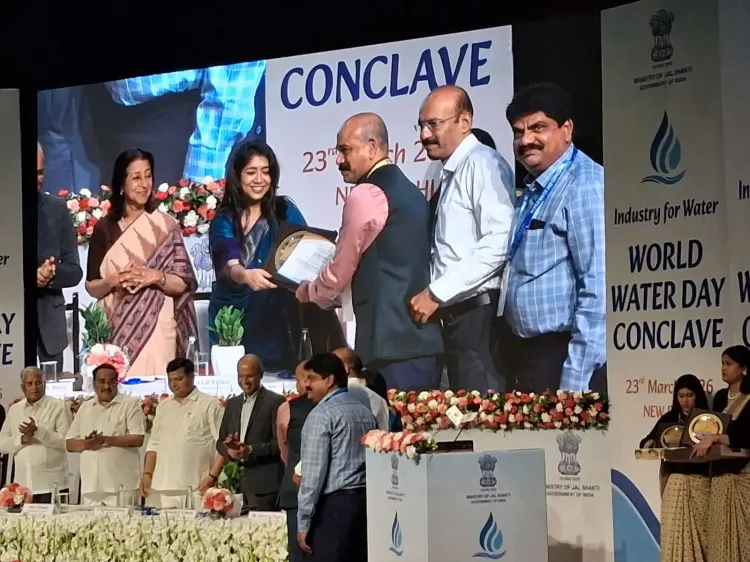
B.K. Pavithra, the Secretary of the Minor Irrigation and Groundwater Development Department, received an official certificate of appreciation on behalf of the department, as noted in a statement from the Ministry of Minor Irrigation released on Tuesday.
This census was carried out under the Irrigation Census Scheme, guided by the Ministry of Jal Shakti, with the Directorate of Groundwater acting as the lead agency for the initiative.
Discussing the finalized digital census report, Secretary Pavithra revealed that, despite the logistical hurdles presented by the monsoon season, field enumerators successfully discovered and recorded a total of 274 springs across all 31 districts of Karnataka.
The report highlights the regional distribution and ecological status of these water bodies, indicating that the Belagavi district has the highest count, featuring 59 springs. A significant portion of these water sources remains functional, with 144 classified as perennial and 114 as seasonal, while 16 have dried up over time.
The detailed report provides insights into the nature and location of these springs, showing a strong concentration in rural areas with 256 springs situated in rural settings compared to only 18 in urban locales.
In terms of geological discharge, 117 springs are categorized as free-flowing, while 157 are seep springs. The census also recorded notable hydrological features, including a hot spring located at Bendru Theertha in the Dakshina Kannada district, as stated by Pavithra.
This census emphasizes the ecological and cultural importance of springs in Karnataka, which play a crucial role in sustaining major river systems. The report traces the origins of key rivers, noting that the River Cauvery begins at Talakaveri in the Kodagu district, the River Hemavathi at Javali in Chikkamagaluru, and the River Sharavathi at Ambutheertha in Shivamogga, according to Pavithra.
She also mentioned that the digitized data will act as a vital database for future spring conservation efforts, rejuvenation projects, groundwater management, and comprehensive water resource planning throughout Karnataka.
Point of View
The completion of Karnataka's First Spring Census stands as a commendable effort in water resource management. It reflects the state's proactive approach towards environmental sustainability and groundwater conservation, setting a precedent for other states to follow.
NationPress
23 Sept 2026
Frequently Asked Questions
What is the significance of the Spring Census?
The Spring Census is vital for understanding and managing water resources in Karnataka, helping to identify and document springs which are crucial for the region's ecology and water supply.
How many springs were documented in the census?
A total of 274 springs were identified and documented across all 31 districts of Karnataka during the Spring Census.
What challenges did the census face?
Field enumerators faced logistical challenges due to the monsoon season while conducting the census.
What will the digitized data be used for?
The digitized data will serve as a foundational database for future spring conservation, groundwater management, and comprehensive water resource planning in Karnataka.
Which district in Karnataka has the highest number of springs?
Belagavi district has the highest number of springs, with a total of 59 recorded.