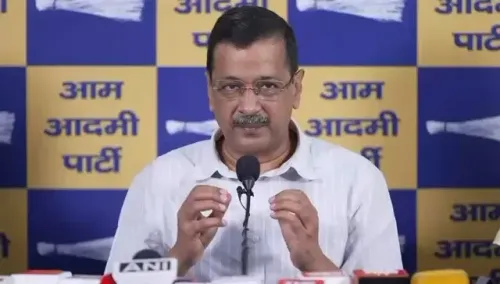
Kejriwal Demands School System Overhaul for Gen Alpha

Synopsis
On the eve of Independence Day 2026, AAP convenor Arvind Kejriwal demanded an urgent national overhaul of India's public school system, arguing that Generation Alpha — digital natives with high expectations — will not accept the old, broken order any longer.
Key Takeaways
AAP convenor Arvind Kejriwal posted on 14 August 2026 , calling for an immediate fix to India's 'dilapidated' government schools.
He invoked Generation Alpha — children born after 2010 — as a cohort that will no longer tolerate a failing public education system.
From 2015 , Kejriwal's AAP government in Delhi raised education budgets and launched classroom construction, teacher training, and accountability programmes in Delhi government schools .
The post extends AAP's school-reform argument from a Delhi model to a national demand, timed to the eve of Independence Day .
Pressure on state education budgets and parliamentary discussions on school infrastructure funding are expected to grow in upcoming fiscal announcements.
India's Generation Alpha — children born after 2010, now entering and filling government school classrooms — will not wait for a system that has long failed them. On Friday, 14 August 2026, AAP convenor Arvind Kejriwal fired a pointed salvo at the state of public education across the country, declaring that broken schools must be fixed and that the old order simply cannot hold.
Posting in Hindi, Kejriwal wrote: 'Ab Gen Alpha nahi rukega. Desh ke badhal schools ko to theek karna hi padega. Purani vyavastha ab nahi chalegi.' ('Gen Alpha will not stop now. The country's dilapidated schools will have to be fixed. The old system will no longer work.') The message is blunt, three sentences, no caveats — and it lands on the eve of Independence Day, a moment when questions of national promise and public delivery carry extra weight.
From Delhi classrooms to a national demand
Kejriwal's credibility on school reform is not rhetorical. From 2015, the AAP-led Delhi government dramatically raised the education budget, launched large-scale classroom construction, overhauled teacher training, and introduced accountability mechanisms in Delhi government schools. The model drew national attention and became a central plank of AAP's political identity — the argument that state governments can transform public schools if they choose to prioritise them.
His post now scales that argument upward. The critique is no longer about one city or one administration — it is a demand directed at the national system, invoking a generation that has grown up with smartphones, global information, and rising expectations, and will measure institutions by results, not by legacy.
Why Gen Alpha changes the equation
Generation Alpha is the first cohort raised entirely in the digital era. Their learning styles, attention spans, and benchmarks are shaped by platforms and content that government school curricula have barely begun to address. Kejriwal's framing taps into a real and growing anxiety among parents, teachers, and policymakers: that the infrastructure and pedagogy of India's public schools — underfunded in many states, understaffed in many districts — is structurally mismatched with the generation now sitting in those classrooms.
Indian states have pursued varying school-improvement initiatives over the decades, but learning outcome data has persistently flagged gaps in foundational literacy and numeracy. The pressure on state education budgets — and on parliamentary discussions around teacher recruitment norms and school infrastructure funding — is expected to intensify in upcoming fiscal cycles.
A political pitch sharpened by timing
Posting on 14 August, the day before Independence Day, is not incidental. The date frames the demand inside a larger national conversation about what seventy-plus years of independence have delivered to ordinary citizens. For AAP, a party that built its brand on public service delivery, keeping education at the centre of its messaging — especially at a moment when it is rebuilding its national footprint — is a deliberate strategic choice.
The question Kejriwal leaves hanging in the air is the one every policymaker will eventually have to answer: if not now, for this generation, then when?
Point of View
He shifts the frame from bureaucratic process to generational justice, a move designed to resonate with urban middle-class parents and young first-time voters alike. The Independence Day timing amplifies the implicit indictment: that the promise of equitable public education remains undelivered. Whether the post precedes a formal policy announcement or functions as sustained political positioning, it signals that AAP intends to contest the education agenda at the national level.
NationPress
14 Aug 2026
Frequently Asked Questions
What did Arvind Kejriwal say about government schools in August 2026?
On 14 August 2026 , Kejriwal posted that India's dilapidated government schools must be fixed and that the old system will no longer work, invoking Generation Alpha as the generation that will demand change.
What is Generation Alpha and why does Kejriwal mention them?
Generation Alpha refers to children born after 2010 , the first cohort raised entirely in the digital era. Kejriwal uses the term to argue that this generation's expectations and learning needs are incompatible with India's current underfunded public school infrastructure.
What did AAP do for schools in Delhi?
From 2015 , the AAP-led Delhi government significantly increased education spending, built new classrooms, reformed teacher training, and introduced accountability measures in Delhi government schools , making it a flagship model for the party.
Why did Kejriwal post about schools on Independence Day eve?
Posting on 14 August — the day before Independence Day — frames the demand within the national conversation about what independence has delivered to ordinary citizens, lending the critique greater symbolic weight.
What should we watch for after Kejriwal's school reform demand?
Key indicators include state education budget announcements in upcoming fiscal cycles and any parliamentary debates on school infrastructure funding or teacher recruitment norms at the national level.