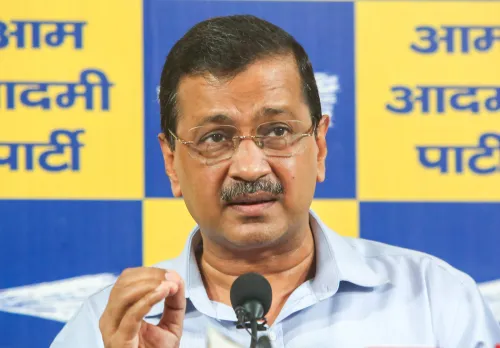
Kejriwal flags alleged rule changes in NTA exam outsourcing
Synopsis
AAP convenor Arvind Kejriwal on 30 May 2026 shared a student-written article alleging the Modi government changed procurement rules to award an exam-operations contract to a dubious company, claiming it damaged the futures of lakhs of students. The specific firm and rule changes remain unverified.
Key Takeaways
AAP convenor Arvind Kejriwal shared a student-researched article on 30 May 2026 alleging procurement rule changes by the Modi government .
The post claims an 'OSM contract' was awarded to a 'shady company' that harmed the futures of lakhs of students ; the named company and specific rule changes are unverified.
The National Testing Agency was created in 2017 to outsource conduct of major exams including NEET and JEE .
General Financial Rules were revised in 2017 and 2021 , relaxing eligibility norms for technical service contracts.
Opposition parties have repeatedly alleged that rule amendments favoured specific private vendors in the exam-services sector.
Parliamentary questions on NTA vendor performance are expected during the upcoming Monsoon Session .
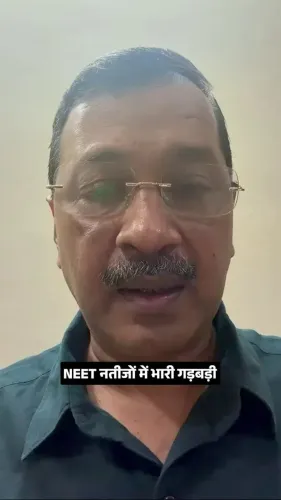
AAP convenor Arvind Kejriwal on Saturday, 30 May 2026 shared what he described as a student-researched article alleging that the Modi government altered procurement rules to award an exam-operations contract to a 'shady company,' with consequences he said had 'ruined the future of lakhs of students.'
Context
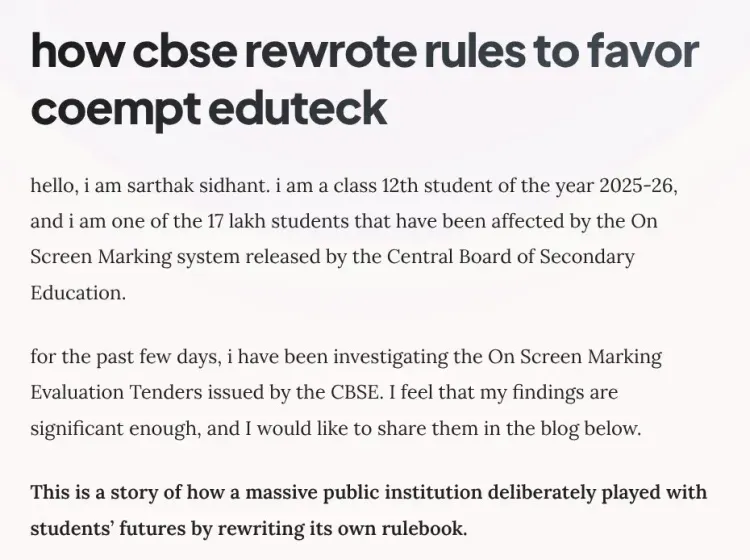
Kejriwal's post urged followers to read the article, writing: 'U must read this article researched n written by a student on how Modi govt changed several rules to give OSM contract to this shady company which ruined the future of lakhs of students.' The post was accompanied by an image, likely of the article in question. The identity of the company and the precise rule changes referenced have not been independently verified.
The post is the latest in a series of interventions by Kejriwal targeting central government decisions on education procurement. As AAP national convenor and former Chief Minister of Delhi, he has consistently positioned his party as a watchdog on public education policy.
Policy Backdrop
The National Testing Agency (NTA) was established in 2017 by the Ministry of Education to centralise and outsource the conduct of high-stakes entrance examinations — including NEET and JEE — previously managed by CBSE. The rationale offered at the time was scale and operational efficiency.
General Financial Rules were updated in 2017 and again in 2021, expanding the use of quality-cum-cost based selection and relaxing eligibility norms for technical service contracts. Opposition parties have argued that successive amendments to these rules progressively lowered the bar for private vendors entering the exam-services ecosystem.
Since 2014, central governments have progressively outsourced exam paper-setting, evaluation, and technology services to private firms. Critics allege this trend has created structural vulnerabilities — including paper leaks and data breaches — that disproportionately harm aspirants from economically weaker sections.
Stakeholders and Impact
The most directly affected group is the vast pool of students who sit competitive entrance examinations each year — numbering in the lakhs across medical, engineering, and civil services streams. Any compromise in exam integrity or logistics translates into delayed results, cancelled tests, or invalidated scores, each of which can cost a student an entire academic year.
Private exam-service providers occupy a critical but under-scrutinised role in this ecosystem. Procurement decisions — including which vendors qualify and under what financial terms — are governed by rules that the research indicates have been revised multiple times, raising questions about transparency and accountability in the tendering process.
What's Next
Parliamentary scrutiny of NTA vendor performance is expected to intensify during the upcoming Monsoon Session, where opposition members are likely to table questions on contract awards and exam-integrity failures. Any fresh tender reforms announced by the Ministry of Education will be closely watched by student groups and civil society organisations.
Kejriwal's amplification of the student article is likely to add political pressure on the government to release detailed procurement records. Whether the claims in the article lead to a formal inquiry or parliamentary committee referral remains to be seen.
Point of View
He lends grassroots credibility to what is an established AAP line of attack on central education procurement. The timing matters: with the Monsoon Session approaching, seeding this narrative now gives opposition MPs a ready hook for parliamentary questions. More broadly, the post reflects a wider pattern in which procurement opacity within the NTA ecosystem has become a durable vulnerability for the ruling dispensation, particularly among the aspirant-class voters both parties court. Whether the underlying allegations hold up to scrutiny will determine whether this remains a social-media moment or escalates into a formal accountability process.
NationPress
15 Oct 2026
Frequently Asked Questions
What is the OSM contract Kejriwal is referring to?
The specific 'OSM contract' mentioned in Kejriwal's post has not been independently verified from public records. His post refers to a student-researched article alleging that the Modi government changed procurement rules to award this contract to a company accused of harming students.
What is the National Testing Agency and why is it controversial?
The National Testing Agency (NTA) is an autonomous body set up in 2017 by the Ministry of Education to conduct major entrance exams like NEET and JEE. It has faced repeated controversy over alleged paper leaks, vendor mismanagement, and lack of transparency in outsourcing decisions.
How did the Modi government change procurement rules for exam contracts?
General Financial Rules were revised in 2017 and 2021 to expand quality-cum-cost based selection and relax eligibility norms for technical service contracts. Opposition parties allege these amendments made it easier for favoured private vendors to win exam-services tenders.
Why is Kejriwal raising this issue?
As AAP national convenor and former Delhi Chief Minister, Kejriwal has consistently challenged central government decisions on education procurement. Sharing the student article is consistent with his party's broader campaign to highlight alleged irregularities in NTA operations.
What happens next after Kejriwal's post on NTA procurement?
Parliamentary scrutiny of NTA vendor performance is expected during the Monsoon Session. Opposition MPs are likely to raise questions on contract awards, and student groups may demand that the Ministry of Education release detailed procurement records.