Kharge slams Centre over anti-paper leak bill, demands Amit Shah's accountability
Synopsis
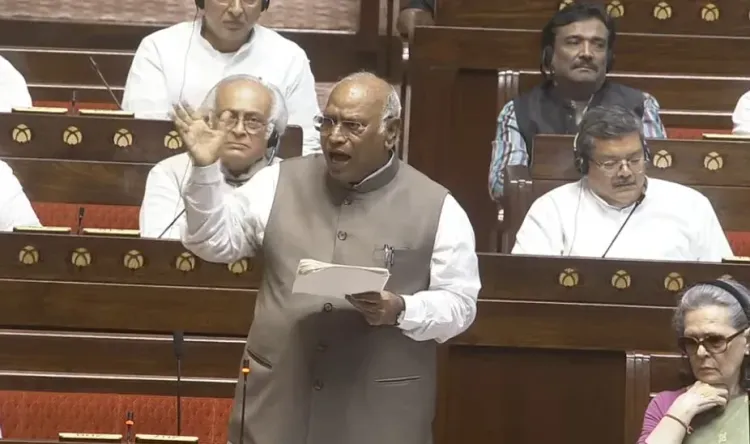
Kharge didn't just debate a bill on Thursday — he put the Home Minister in the dock. Accusing the Centre of introducing the anti-paper leak legislation to quell protests rather than drive genuine reform, the Leader of Opposition demanded Amit Shah answer for alleged police brutality and credited students' street agitation — not government intent — for forcing the bill's passage.
Key Takeaways
Mallikarjun Kharge attacked the Centre on 30 July during the Rajya Sabha debate on the Public Examinations (Prevention of Unfair Means) Amendment Bill 2026 .
He demanded accountability from Home Minister Amit Shah over an alleged lathi charge on protesting students in New Delhi , noting that Delhi Police and CRPF fall under the Home Ministry.
Kharge alleged the bill was introduced to defuse protests, not deliver structural reform, calling it politics-driven rather than student-focused.
He credited students' agitation with forcing the government to act, including the removal of Dharmendra Pradhan .
The bill was passed by the Lok Sabha on Wednesday before being introduced in the Rajya Sabha on Thursday.
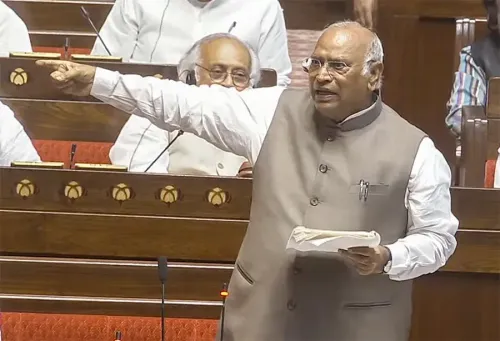
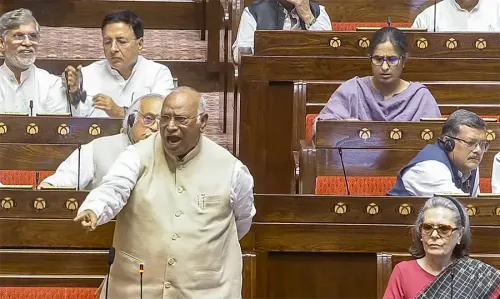
Leader of Opposition in the Rajya Sabha Mallikarjun Kharge on Thursday, 30 July launched a frontal assault on the Central government during the Rajya Sabha debate on the Public Examinations (Prevention of Unfair Means) Amendment Bill 2026, accusing the ruling dispensation of putting politics ahead of students' futures and demanding a direct statement from Union Home Minister Amit Shah over alleged police brutality against protesting students in New Delhi.
Kharge's Core Charges
Kharge alleged that the government had ordered a lathi charge on students who had taken to the streets over repeated examination failures. He pointed out that both the Delhi Police and the Central Reserve Police Force (CRPF) fall under the direct jurisdiction of the Union Home Ministry, arguing that such action could not have been authorised without the Home Minister's knowledge. 'You're sitting inside a room, without being answerable to anything, but we will bring you out,' Kharge said, insisting that Shah could not evade responsibility.
Timing of the Bill Under Scrutiny
The Opposition leader questioned why legislation to curb paper leaks had not been introduced earlier, charging that the government had remained preoccupied with political manoeuvring instead of safeguarding students' futures. 'You brought the Bill to stop the protests in Delhi. You did not bring in the bill for reforms,' he alleged. 'Because of the BJP's politics, the country had to witness paper leaks, protests and police brutality,' Kharge said, adding that all of this could have been prevented had the ruling party not indulged in what he described as petty politics.
What the Opposition Wants
Kharge argued that focusing solely on damage control after leaks occur is insufficient. He stressed the need to strengthen enforcement mechanisms, describing robust systemic reform as the only credible solution. He said the government had not clearly articulated how it planned to prevent future leaks — a gap he called a fundamental flaw in the legislation.
Students' Struggle and Political Fallout
The Leader of Opposition credited students and youth across the country for forcing the government's hand. He said events over the preceding two months had shaken the nation, with young people raising their voices against systemic failures in the examination system. Kharge congratulated them, stating that their struggle had compelled the government to act — including, he claimed, the removal of Dharmendra Pradhan from his portfolio. 'Driven by the fear of losing power, the government conceded to the demands, though its underlying motive was to protect its own position rather than genuinely address the students' grievances,' he said.
Legislative Background
The Public Examinations (Prevention of Unfair Means) Amendment Bill 2026 was passed by the Lok Sabha on Wednesday before being introduced in the Rajya Sabha on Thursday. Kharge's speech set a confrontational tone for the Upper House debate, with the Opposition positioning the bill as a reactive measure extracted through public pressure rather than a proactive reform initiative. He recalled that when examination failures were first flagged, the government had dismissed concerns as politically motivated and failed to engage with protesters for months.
Point of View
Arriving after months of student protests and a high-profile ministerial exit, does raise legitimate questions about whether the Centre is legislating for reform or optics. The demand for Amit Shah to answer for Delhi Police action is a sharper political move: it ties the Home Minister personally to images of lathi charges on students, making the bill's passage a liability rather than a win. What mainstream coverage underplays is Kharge's substantive point — that the bill does not clearly spell out how leaks will be prevented, only how they will be punished after the fact. That is a real gap.
NationPress
13 Sept 2026
Frequently Asked Questions
What is the Public Examinations (Prevention of Unfair Means) Amendment Bill 2026?
It is a legislation aimed at preventing paper leaks and unfair means in public examinations, passed by the Lok Sabha on Wednesday and introduced in the Rajya Sabha on Thursday, 30 July 2026. The Opposition has argued the bill is reactive rather than a structural reform.
Why did Kharge demand accountability from Amit Shah?
Kharge alleged that Delhi Police and the CRPF — both under the Union Home Ministry's jurisdiction — carried out a lathi charge on protesting students, and that such action could not have occurred without the Home Minister's approval. He demanded Shah make a statement in Parliament on the incident.
What is the Opposition's main criticism of the anti-paper leak bill?
The Opposition, led by Kharge, argues the bill was introduced to pacify protesters and stop street agitation rather than to drive genuine reform. They also contend the legislation does not clearly explain how paper leaks will be prevented, focusing only on punishment after the fact.
Who is Dharmendra Pradhan and why was he mentioned?
Dharmendra Pradhan was the Union Education Minister. Kharge cited his removal as evidence that student protests had forced the government's hand, crediting youth agitation rather than government intent for the political fallout.
What happens next with the bill?
Having passed the Lok Sabha, the bill was under debate in the Rajya Sabha on 30 July 2026. Its passage through the Upper House and subsequent implementation — particularly the enforcement mechanisms Kharge says are inadequately defined — will determine its real-world impact on examination integrity.