Khattar targets 'ideological Naxals' on Independence Day
Synopsis
On India's 80th Independence Day, Union Minister Manohar Lal Khattar declared that armed Naxals may be defeated but 'ideological Naxals' who shaped national policy for years remain active and must be identified and isolated.
Key Takeaways
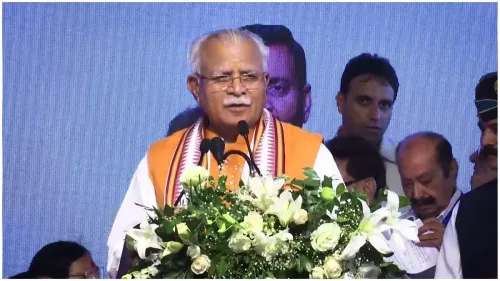
Union Power Minister Manohar Lal Khattar posted on 15 August 2026 , India's 80th Independence Day, warning of a persistent ideological Naxal threat.
He argued that people with 'Maoist thinking' had occupied the corridors of power for years and shaped national policy.
Khattar distinguished between armed Naxals — whom he said are 'gone' — and 'dimagi Naxals' (ideological Naxals) still seeking paths of violence and anarchy.
He called for the public identification and isolation of these ideological actors.
The BJP government has framed this dual threat since 2014, backed by the 2015 National Policy on Left Wing Extremism and the 2017 SAMADHAN doctrine .
Armed Naxal violence has declined over the past decade, but the ideological debate is now being pushed into institutions and policy spaces.
On India's 80th Independence Day, Saturday, 15 August 2026, Union Power Minister Manohar Lal Khattar sharpened a political argument that goes well beyond the battlefield — warning that the armed Naxal threat may be receding, but a subtler, more entrenched danger has taken its place.
Posting in Hindi on the morning of the national holiday, Khattar wrote: 'वर्षों तक माओवादी सोच के लोग सत्ता के गलियारे में अपनी जगह बनाकर बैठे थे' — 'For years, people with Maoist thinking had entrenched themselves in the corridors of power. That same thinking shaped the country's policies.' He then drew a pointed distinction: the gun-carrying Naxals may be gone, but the 'dimagi Naxals' — the ideological ones — are still searching for opportunity, 'looking for paths of violence and anarchy.' His call to action: identify them and isolate them.
Armed insurgency down, ideological battle declared open
The framing is deliberate and not new to the BJP. Since 2014, the party has consistently separated the military defeat of Left Wing Extremism from what it describes as a parallel ideological ecosystem — academics, activists, and policy influencers it alleges gave intellectual cover to the Maoist movement. Government data has shown a sustained decline in Naxal-related violence over the past decade, with the Red Corridor shrinking in geographic spread. But the BJP's argument has always been that winning the jungle war is only half the task.
The Ministry of Home Affairs laid formal groundwork for this dual-track approach: first with the National Policy and Action Plan on Left Wing Extremism in 2015, which combined security operations with development outreach, and then with the SAMADHAN doctrine in 2017, a structured counter-insurgency framework. Khattar's Independence Day post signals that the government sees the next frontier as ideological — not territorial.
The 'dimagi Naxal' framing and what it signals
The phrase 'dimagi Naxal' — literally 'brain Naxal' or ideological Naxal — is a sharp rhetorical instrument. It extends the definition of the threat from those who carry weapons to those who, in the BJP's view, carry and propagate a Maoist worldview through institutions, universities, and policy circles. Khattar's post explicitly links this to past governance, arguing that such thinking 'influenced the country's policies' when Maoist-sympathetic voices held sway in official spaces.
The call to 'identify and isolate' such individuals — posted on a day of national reflection, tagged #IndiaAt80 and #IndependenceDay2026 — is as much a political positioning statement as a security one. It frames the BJP's decade-plus in power as a corrective to ideological infiltration, and it sets up a continuing domestic narrative heading into the next parliamentary session, where Left Wing Extremism statistics and potential new legal designations are expected to feature.
For the tribal communities of the Red Corridor and the security forces who have borne the cost of the insurgency for decades, the ground reality is one of cautious progress. The ideological battle Khattar is now publicly declaring, however, will play out in courtrooms, campuses, and committee rooms — not forests.
Point of View
He is doing political work as much as security work: framing the pre-2014 era as ideologically compromised and the current government as its corrective. The call to 'identify and isolate' is deliberately broad, and it will invite scrutiny over where the line falls between legitimate dissent and the 'ideological Naxalism' the government seeks to target. How that line is drawn — in law, in policy, and in public discourse — will be the real story to watch.
NationPress
15 Aug 2026
Frequently Asked Questions
What did Manohar Lal Khattar say about Naxals on Independence Day 2026?
Khattar posted in Hindi on 15 August 2026 arguing that while armed Naxals have been defeated, 'ideological Naxals' or 'dimagi Naxals' who once influenced national policy from within the corridors of power are still active and must be identified and isolated.
What does 'dimagi Naxal' mean?
'Dimagi Naxal' literally translates to 'brain Naxal' or ideological Naxal — a term used to describe individuals who allegedly hold or propagate Maoist ideology through institutions, academia, and policy circles rather than through armed insurgency.
What is the BJP government's policy on Left Wing Extremism?
The BJP-led government has pursued a dual approach since 2014: the 2015 National Policy and Action Plan on Left Wing Extremism combined security operations with development, while the 2017 SAMADHAN doctrine provided a structured counter-insurgency framework. The government has also consistently argued that an ideological support network exists beyond the armed movement.
Has Naxal violence actually declined in India?
Government data has shown a sustained decline in Naxal-related violence over the past decade, with the geographic spread of the Red Corridor shrinking. However, the government maintains that ideological networks supporting the movement persist.
What is CPI (Maoist)?
CPI (Maoist) is a Maoist insurgent organisation active in central and eastern India, designated as a terrorist organisation by the Government of India. It has been the primary armed group behind Left Wing Extremism, or Naxalism, in the country.