Kishan Reddy: Modi govt sets up 4 lakh+ rural micro-enterprises
Synopsis
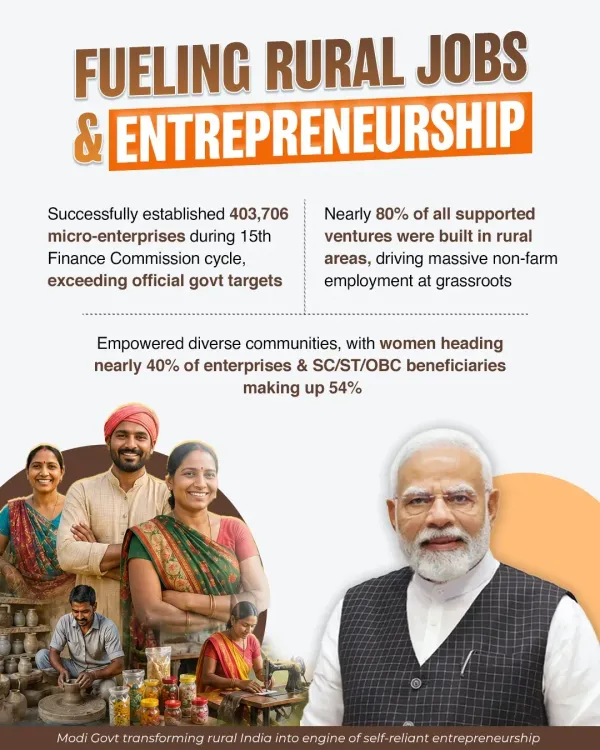
Union Minister G. Kishan Reddy says the Modi government has exceeded targets by establishing over 4,03,706 micro-enterprises, positioning rural India as a hub of non-farm employment under PM Modi's leadership.
Key Takeaways
Kishan Reddy credited PM Narendra Modi 's leadership for surpassing government targets in rural micro-enterprise creation.
Over 4,03,706 micro-enterprises have been established, according to the minister's post dated 27 May 2026 .
The claim aligns with the central government's long-running push to diversify rural incomes through PMEGP , Mudra Yojana and Startup India .
The specific scheme and time period for the 4,03,706 figure were not identified in the post.
Next MSME annual report and monsoon session parliamentary questions are expected to provide further data on rural non-farm job creation.
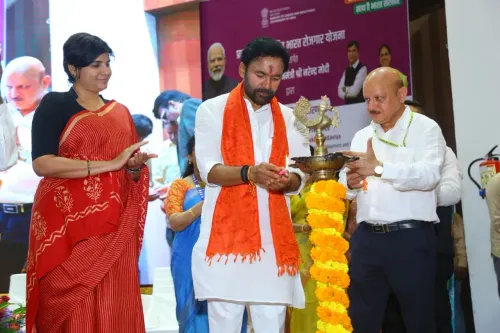
Union Coal and Mines Minister G. Kishan Reddy on Wednesday, 27 May 2026 credited Prime Minister Narendra Modi's leadership for what he described as unprecedented growth in rural entrepreneurship, citing the establishment of over 4,03,706 micro-enterprises that he said have surpassed government targets and are reshaping non-farm employment in rural India.
Context
In his post on X, the minister stated that 'rural entrepreneurship is reaching unprecedented heights' under PM Modi, and that the government has been 'successfully transforming rural India into a powerhouse of non-farm employment.' The figure of 4,03,706 micro-enterprises was cited as evidence of target-beating performance, though the specific scheme and time period were not named in the post.
Kishan Reddy, who also serves as BJP Telangana state president, has consistently used social media to highlight central government economic and rural development achievements, continuing an established pattern of numerical milestone communication ahead of parliamentary sessions and policy reviews.
Policy Backdrop
The claim fits within a broader architecture of central government programmes designed to diversify rural incomes away from agriculture. The Prime Minister's Employment Generation Programme (PMEGP), operational since 2008 under the Ministry of MSME, provides credit-linked subsidies for setting up micro-enterprises in both rural and urban areas and sets annual creation targets that are tracked in official reports.
Complementary schemes include the Pradhan Mantri Mudra Yojana, launched in 2015 to extend collateral-free loans to micro and small non-farm businesses, and the Startup India initiative of January 2016, which simplified registration and offered tax benefits later extended to rural and agri-startups. The Atmanirbhar Bharat package announced in 2020 added further credit guarantees and formalisation support for MSMEs, reinforcing this policy lineage.
Successive Union Budgets since 2014 have set and progressively raised annual targets for new micro-enterprise creation, presenting cumulative figures as a key indicator of employment generation in non-farm rural sectors.
Stakeholders and Impact
The primary beneficiaries of micro-enterprise creation programmes are rural entrepreneurs, non-farm workers and MSME units operating outside the agricultural sector. For rural households, non-farm income sources reduce dependence on monsoon-linked agricultural cycles and provide more stable year-round earnings.
State governments, particularly in agrarian states like Telangana, Uttar Pradesh and Madhya Pradesh, are co-implementers of PMEGP and related schemes, sharing both the credit and the administrative burden of target achievement. Industry bodies representing small and micro enterprises have long advocated for faster credit disbursement and market-linkage support as the real test of enterprise viability beyond registration numbers.
What's Next
The next MSME annual report and quarterly data releases on enterprise registration and employment under PMEGP and the National Rural Livelihoods Mission (NRLM) will be closely watched to verify and contextualise the figures cited by the minister. Parliamentary questions during the upcoming monsoon session are expected to probe rural non-farm job creation numbers in greater detail.
As the government approaches mid-term of its current tenure, the communication of cumulative rural enterprise milestones is likely to intensify, with ministers across portfolios framing these statistics within the broader Viksit Bharat narrative ahead of state assembly cycles and the next general election horizon.
Point of View
Deploying a specific large number to signal policy momentum ahead of parliamentary scrutiny. The figure of over 4,03,706 micro-enterprises anchors the broader 'Viksit Bharat' narrative in tangible ground-level outcomes, making it harder to contest without equivalent counter-data. However, the absence of a named scheme or time period in the post leaves the statistic open to questions of attribution and baseline, which opposition benches are likely to raise in the monsoon session. The post also reflects the minister's dual role — as a Union Cabinet member and as BJP's Telangana state president — where national achievement messaging doubles as electoral ground-preparation in a competitive southern state.
NationPress
19 Sept 2026
Frequently Asked Questions
How many micro-enterprises has the Modi government set up in rural India?
According to Union Minister G. Kishan Reddy's post on 27 May 2026, the Modi government has established over 4,03,706 micro-enterprises, exceeding its own targets for rural entrepreneurship.
What is PMEGP and how does it support rural entrepreneurs?
The Prime Minister's Employment Generation Programme (PMEGP), operational since 2008 under the Ministry of MSME, provides credit-linked subsidies for setting up micro-enterprises in rural and urban areas, with annual targets for new enterprise creation.
What schemes does the Modi government use to promote rural non-farm employment?
Key schemes include PMEGP, Pradhan Mantri Mudra Yojana (launched 2015), Startup India (launched 2016) and the Atmanirbhar Bharat credit guarantee package announced in 2020, all aimed at diversifying rural incomes beyond agriculture.
Who is G. Kishan Reddy?
G. Kishan Reddy is the Union Minister of Coal and Mines in the Modi government and also serves as the BJP's Telangana state president. He frequently highlights central government achievements in economic and rural development.
What is the significance of non-farm employment in rural India?
Non-farm employment reduces rural households' dependence on monsoon-linked agricultural income, providing more stable year-round earnings and is a central goal of multiple central government programmes under the MSME and rural development ministries.