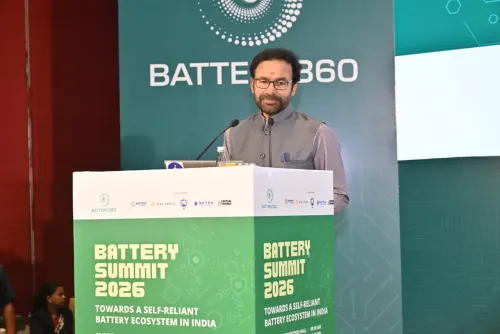
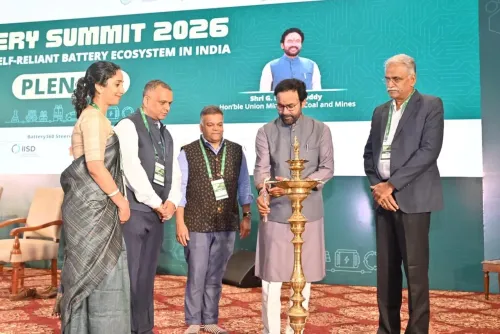
Kishan Reddy backs battery ecosystem for Viksit Bharat 2047
Synopsis
Union Coal and Mines Minister G. Kishan Reddy has stressed that a resilient, self-reliant, and globally competitive battery ecosystem is central to India's Viksit Bharat 2047 vision, linking it to energy security, industrial growth, and technological leadership backed by the Rs 18,100 crore PLI scheme for Advanced Chemistry Cells.
Key Takeaways
Kishan Reddy , Union Minister of Coal and Mines, called a domestic battery ecosystem 'pivotal' to Viksit Bharat 2047 goals on June 16, 2026 .
The PLI scheme for Advanced Chemistry Cells , approved in 2021 with an outlay of Rs 18,100 crore , is the primary policy instrument supporting domestic battery manufacturing.
India's 500 GW non-fossil electricity target by 2030 makes grid-scale battery storage an immediate operational requirement.
Critical minerals — including lithium, cobalt, and nickel — are central to battery supply chains overseen partly by Reddy's ministry.
The National Critical Minerals Mission and upcoming mineral block auctions are the next milestones to watch in India's battery ecosystem push.
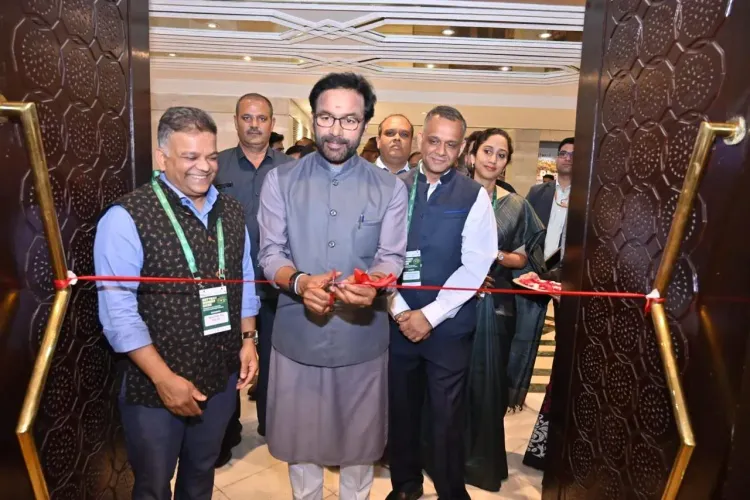
Union Coal and Mines Minister G. Kishan Reddy on Tuesday, June 16, 2026, underlined the strategic importance of a domestic battery ecosystem to India's long-term development goals, stating that a 'resilient, self-reliant, and globally competitive battery ecosystem will play a pivotal role in ensuring energy security, accelerating industrial growth, and driving technological leadership' as the country advances toward Viksit Bharat 2047.
Context
The minister's remarks position battery technology as a cornerstone of India's 2047 development vision, which targets the country's transformation into a fully developed economy by the centenary of its independence. Reddy, who oversees mineral resources critical to battery supply chains in his capacity as Union Minister of Coal and Mines, linked energy security directly to domestic manufacturing capability. The statement comes as India's renewable energy ambitions and electric vehicle adoption continue to accelerate demand for advanced battery storage.
Policy Backdrop
India's push for a domestic battery ecosystem has a defined legislative foundation. In 2021, the Union Cabinet approved the Production Linked Incentive (PLI) scheme for Advanced Chemistry Cells with an outlay of Rs 18,100 crore, aimed at building domestic capacity for battery cell manufacturing and reducing dependence on imports. The scheme is part of the broader Atmanirbhar Bharat framework, which has consistently linked energy security with indigenous production across sectors.
Earlier groundwork was laid by the National Electric Mobility Mission Plan (NEMMP) 2020, first notified in 2013, which set early targets for electric vehicle adoption and created the initial policy demand for advanced battery supply chains. India has since pursued parallel tracks — including auctions of critical mineral blocks and bilateral technology partnerships — to secure upstream supply of materials such as lithium, cobalt, and nickel, which are essential inputs for battery manufacturing.
Stakeholders and Impact
The battery ecosystem vision directly affects a wide set of industries. Domestic battery manufacturers stand to benefit from continued policy support, while the electric vehicle sector and renewable energy developers depend on affordable, locally produced storage solutions to scale operations. Critical mineral miners, including those operating blocks under the Coal and Mines Ministry's purview, are integral to the upstream supply chain that feeds battery production.
India's stated target of 500 GW of non-fossil electricity capacity by 2030 makes grid-scale battery storage a near-term operational requirement, not merely a long-range aspiration. Industrial electrification across manufacturing, logistics, and infrastructure sectors further widens the potential impact of a competitive domestic battery industry.
What's Next
Attention will now turn to the National Critical Minerals Mission, under which new mineral block auctions and downstream processing incentives are anticipated in forthcoming policy updates and budget cycles. Progress on securing reliable domestic supply chains for battery-grade minerals will be a key indicator of how rapidly India can translate its stated battery ecosystem ambitions into industrial reality. Reddy's ministerial portfolio places him at the intersection of mineral supply and energy policy, making his ministry a central actor in the next phase of this agenda.
Point of View
He frames battery ecosystem development not as a sectoral concern but as a national security and sovereignty issue, consistent with the government's Atmanirbhar Bharat messaging. His ministry's control over mineral block auctions gives his words operational weight: the pace of lithium and cobalt block licensing will determine whether the PLI scheme's manufacturing targets are achievable. The broader pattern suggests that energy transition rhetoric is increasingly being institutionalised into the extractive sector's mandate, a shift with significant implications for how India balances coal dependence with green industrial ambition.
NationPress
19 Sept 2026
Frequently Asked Questions
What is Viksit Bharat 2047?
Viksit Bharat 2047 is India's national vision to become a fully developed economy by 2047, the centenary of independence, with goals spanning self-reliance, advanced manufacturing, and technological leadership.
What is the PLI scheme for Advanced Chemistry Cells?
The Production Linked Incentive scheme for Advanced Chemistry Cells, approved by the Union Cabinet in 2021 with an outlay of Rs 18,100 crore, is designed to promote domestic manufacturing of battery storage cells and reduce India's dependence on imported batteries.
Why is G. Kishan Reddy involved in battery ecosystem policy?
As Union Minister of Coal and Mines, Kishan Reddy oversees mineral resources — including critical minerals such as lithium, cobalt, and nickel — that form the essential raw material base for battery manufacturing in India.
What critical minerals does India need for batteries?
India requires lithium, cobalt, and nickel as primary inputs for advanced battery cells; securing domestic and international supply of these minerals is a key focus of the National Critical Minerals Mission.
What is India's electricity target linked to battery storage?
India has set a target of 500 GW of non-fossil electricity capacity by 2030, which requires significant grid-scale battery storage solutions and makes domestic battery production a near-term policy priority.