Kishan Reddy: CCEA Approves NIPU-2026 for Urea Self-Reliance
Synopsis
The CCEA chaired by PM Modi has approved NIPU-2026, a new investment policy targeting gas-based urea manufacturing to reduce India's 30-35% import dependence on fertilizers. Union Minister G. Kishan Reddy called it a major step toward fertilizer security and Atmanirbhar Bharat.
Key Takeaways
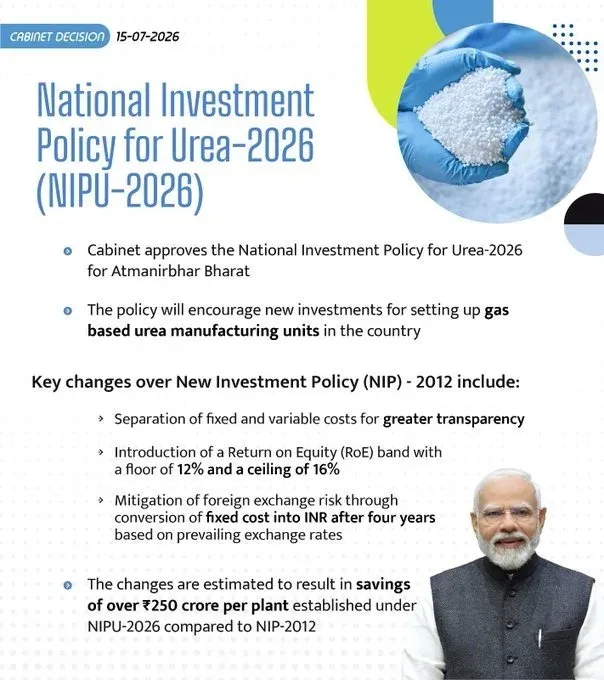
The Cabinet Committee on Economic Affairs (CCEA) , chaired by PM Narendra Modi , approved NIPU-2026 on 15 July 2026 .
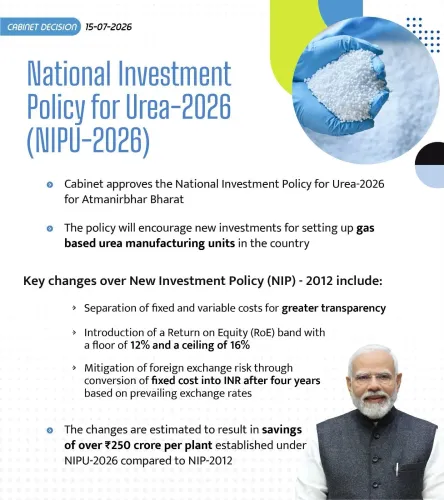
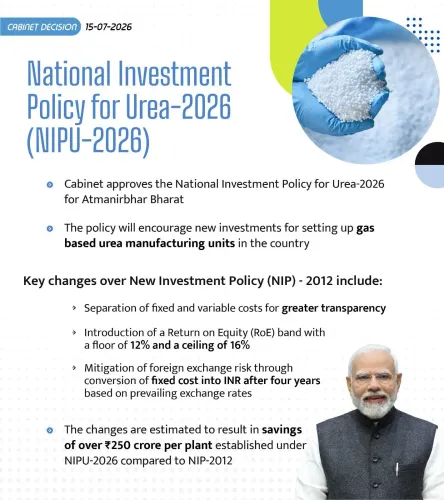
NIPU-2026 is designed to attract investment into gas-based urea manufacturing units across India.
India currently imports an estimated 30–35 per cent of its urea needs, exposing farmers to global supply and price shocks.
The policy builds on earlier reforms including the New Urea Policy 2015 and the revival of plants at Gorakhpur, Sindri , and Talcher under Atmanirbhar Bharat.
Gas allocation linkages and follow-up notifications from relevant ministries are the critical next steps for implementation.
Farmers and domestic fertilizer manufacturers are the primary stakeholders expected to benefit from reduced import reliance.
Union Coal and Mines Minister G. Kishan Reddy announced on Wednesday, 15 July 2026 that the Cabinet Committee on Economic Affairs (CCEA), chaired by Prime Minister Narendra Modi, has approved the National Investment Policy for Urea-2026 (NIPU-2026) — a new framework aimed at attracting private and public investment into gas-based urea manufacturing and reducing India's dependence on imported fertilizers.
Context
In his post on X, Kishan Reddy described NIPU-2026 as 'a significant step towards strengthening fertilizer security for our farmers and advancing the vision of an Atmanirbhar Bharat.' The policy is specifically designed to channel investment into gas-based urea manufacturing units, the technology considered most efficient for large-scale domestic production. The announcement follows an official press release published by the Press Information Bureau on the same day.
India currently imports roughly 30–35 per cent of its urea requirements, leaving its agricultural sector exposed to global price volatility and supply disruptions. The approval of NIPU-2026 marks the government's latest effort to close that gap through a dedicated investment policy rather than piecemeal plant-level interventions.
Policy Backdrop
The new policy sits within a longer arc of urea sector reform. The New Urea Policy 2015 introduced production-linked pricing incentives to improve plant efficiency and nudge manufacturers toward higher output. Then, as part of the Atmanirbhar Bharat package announced in May 2020, the government committed to reviving long-shuttered urea plants at Gorakhpur, Sindri, and Talcher — facilities that had been idle for years due to feedstock and financial constraints.
NIPU-2026 continues this trajectory but introduces a dedicated investment-attraction framework, signalling a shift from revival of old assets to active encouragement of new gas-based capacity. The emphasis on gas-based units reflects the government's broader push to align fertilizer production with its natural gas infrastructure expansion.
Stakeholders and Impact
Farmers stand to benefit most directly: a larger domestic urea supply base would reduce the risk of shortages during peak sowing seasons and could moderate the subsidy burden on the government over time. India's fertilizer subsidy bill has remained one of the largest line items in the Union Budget, driven significantly by the cost of imported urea.
Fertilizer manufacturers — both state-owned enterprises and private players — are the intended investment targets of the policy. By creating a structured policy environment for gas-based units, NIPU-2026 aims to give investors the long-term regulatory certainty needed to commit capital to projects that typically carry long gestation periods. The policy is also expected to generate downstream demand for domestic natural gas, linking it to India's energy sector goals.
What's Next
The immediate focus will shift to follow-up notifications from the Ministry of Chemicals and Fertilizers and the Ministry of Petroleum and Natural Gas on gas allocation linkages for new units — a critical enabler since feedstock availability has historically been the primary bottleneck for gas-based urea projects. Quarterly fertilizer import data will serve as the key metric to track whether the policy translates into measurable import substitution over the coming years.
If investment commitments materialise at scale, NIPU-2026 could represent a structural shift in India's fertilizer security architecture — moving the country closer to the self-sufficiency that successive governments have promised but not yet fully delivered.
Point of View
The government is signalling that it wants private capital, not just public sector balance sheets, to drive capacity expansion. For G. Kishan Reddy, amplifying a CCEA decision that sits outside his own portfolio — coal and mines — underscores the BJP's broader communication strategy of presenting cabinet decisions as a unified government achievement ahead of state election cycles. The real test will be whether gas allocation commitments follow, since feedstock bottlenecks have historically been the graveyard of ambitious urea capacity targets.
NationPress
15 Jul 2026
Frequently Asked Questions
Why does India import urea and what is the share?
India imports roughly 30–35 per cent of its urea requirements because domestic production capacity has not kept pace with agricultural demand, leaving farmers and the government vulnerable to global price and supply fluctuations.
How is NIPU-2026 different from the New Urea Policy 2015?
The New Urea Policy 2015 focused on pricing incentives and efficiency improvements at existing plants, while NIPU-2026 is specifically designed as an investment-attraction framework to encourage new gas-based urea manufacturing capacity.
Who benefits from NIPU-2026?
Farmers benefit from a more stable and affordable domestic urea supply, while fertilizer manufacturers gain a clearer policy environment to invest in new gas-based production units.
What are the next steps after NIPU-2026 approval?
Key next steps include follow-up notifications on gas allocation linkages for new urea units from the relevant ministries, and tracking quarterly fertilizer import data to measure whether domestic production is actually rising.