Kishan Reddy Lists 12-Year Cultural Revival Milestones Under Modi
Synopsis
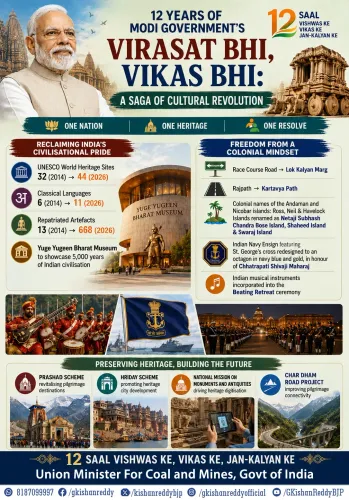
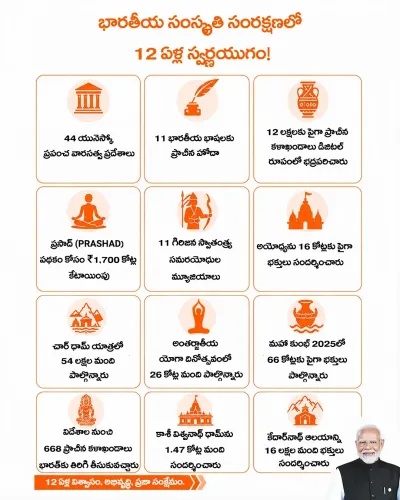
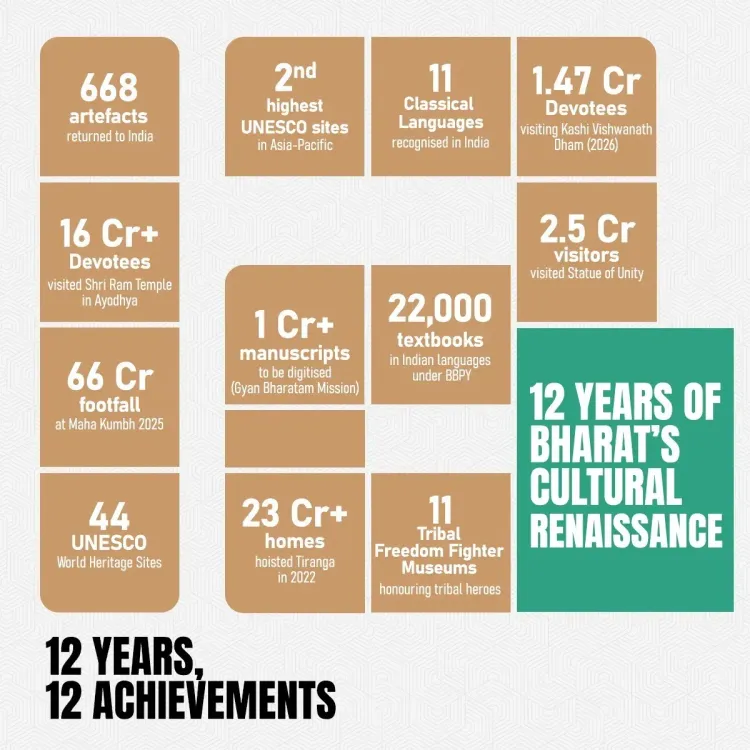
Union Minister G. Kishan Reddy has listed 12 years of cultural milestones under PM Modi, citing 668 artefacts repatriated, UNESCO sites rising from 32 to 44, classical languages expanding from 6 to 11, and over 1 crore manuscripts digitised.
Key Takeaways
668 artefacts have been repatriated to India under the Modi government, according to Kishan Reddy's post.
India's UNESCO World Heritage Sites have grown from 32 to 44 over the 12-year period cited.
The number of officially recognised classical languages has expanded from 6 to 11 , with Odia added as the sixth in 2014.
Over 22,000 textbooks have been developed in Indian languages, aligned with the National Education Policy 2020 .
More than 1 crore manuscripts have been digitised under a revamped National Mission for Manuscripts .
Maha Kumbh 2025 at Prayagraj and the revival of Ayodhya and Kedarnath are cited as flagship cultural achievements.
Union Coal and Mines Minister and BJP Telangana state president G. Kishan Reddy on Thursday, 18 June 2026, posted a detailed account on X citing what he described as a 'remarkable cultural renaissance' under Prime Minister Narendra Modi over the past 12 years, listing artefact repatriations, UNESCO inscriptions, classical language expansions, textbook development and manuscript digitisation as markers of the government's civilisational agenda.
Context
Reddy's post arrives under the hashtag #12YearsOfVikasBhiVirasatBhi — loosely translated as '12 years of both development and heritage' — which frames the ruling party's cultural initiatives as inseparable from its economic development record. The post enumerates several headline figures: 668 artefacts repatriated to India, UNESCO World Heritage Sites rising from 32 to 44, classical languages expanding from 6 to 11, over 22,000 textbooks developed in Indian languages, and more than 1 crore manuscripts digitised.
The minister also highlighted the 'grand success' of Maha Kumbh 2025 held at Prayagraj, the revival of sacred centres at Ayodhya and Kedarnath, and the protection of the Piprahwa Relics as evidence of a 'renewed commitment to preserving, celebrating and strengthening India's civilisational legacy.'
Policy Backdrop
India's UNESCO World Heritage Site tally stood at 32 at the beginning of 2014, and successive nominations have since added to that count. The expansion of classical language status has proceeded in stages: Odia was declared the sixth classical language in 2014, and further additions have followed in subsequent years. The National Education Policy 2020 mandated greater use of Indian languages as mediums of instruction, providing policy grounding for the textbook development figure Reddy cited.
Artefact repatriation has been a recurring diplomatic theme, with the government concluding agreements with several countries to return objects of Indian origin. The National Mission for Manuscripts, originally launched in 2003, received renewed funding and digitisation targets after 2014, underpinning the manuscript figure in the post.
Stakeholders and Impact
Heritage scholars and language educators stand among the primary stakeholders of these initiatives, as classical language status carries implications for funding, academic chairs and curriculum development. Pilgrims and domestic tourists have been direct beneficiaries of infrastructure upgrades at Ayodhya, Kedarnath and Prayagraj, all of which saw significant state and central investment in the period under review.
The protection of the Piprahwa Relics — Buddhist relics from Uttar Pradesh — has also featured in the government's broader outreach to Buddhist communities domestically and internationally. These moves collectively reflect what the government has branded the 'Vikas bhi Virasat bhi' ('development as well as heritage') doctrine, positioning cultural preservation as a parallel track to economic growth.
What's Next
India's next round of UNESCO World Heritage nominations is expected to be watched closely, as is the possibility of further classical language declarations in forthcoming parliamentary sessions. The BJP's use of a dedicated 12-year hashtag campaign suggests the party intends to sustain this cultural-legacy narrative as a political theme heading into the next electoral cycle. Whether independent audits of the cited figures — artefacts, sites, languages, textbooks, manuscripts — will be placed in the public domain remains an open question for heritage researchers and policy analysts.
Point of View
UNESCO inscriptions, language recognitions) into a single 12-year ledger, the party is building a heritage balance sheet ahead of what is likely to be an electorally active period. The invocation of Ayodhya, Kedarnath and Maha Kumbh alongside secular metrics like manuscript digitisation is deliberate: it bridges the party's religious-cultural base with a broader, institution-friendly narrative. The hashtag campaign signals a coordinated messaging push rather than a standalone post, suggesting this framing will be repeated across the party's communication apparatus.
NationPress
22 Sept 2026
Frequently Asked Questions
How many artefacts has India repatriated under the Modi government?
According to Union Minister G. Kishan Reddy's post on 18 June 2026, 668 artefacts have been repatriated to India under Prime Minister Narendra Modi's tenure. These repatriations have been secured through diplomatic agreements with multiple countries.
How many UNESCO World Heritage Sites does India have now?
Kishan Reddy's post states that India's UNESCO World Heritage Sites have increased from 32 to 44 over the 12 years of the Modi government. India continues to submit new nominations in each UNESCO cycle.
How many classical languages are there in India?
India currently recognises 11 classical languages , up from 6 at the start of 2014, according to Reddy's post. Odia was the sixth classical language, declared in 2014, and further languages have been added since.
What is the National Mission for Manuscripts?
The National Mission for Manuscripts is a government initiative originally launched in 2003 to locate, document and digitise India's manuscript heritage. It received renewed funding and expanded digitisation targets after 2014, and Reddy's post credits it with digitising over 1 crore manuscripts .
What does 'Vikas bhi Virasat bhi' mean?
Vikas bhi Virasat bhi translates to 'both development and heritage' in English. It is the BJP government's governing slogan articulating that economic development and cultural-civilisational preservation are complementary goals, not competing ones.