Kishan Reddy Hails 12 Years of 'Vikas Bhi, Virasat Bhi'
Synopsis
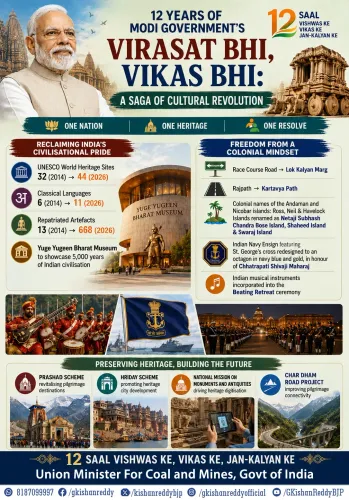
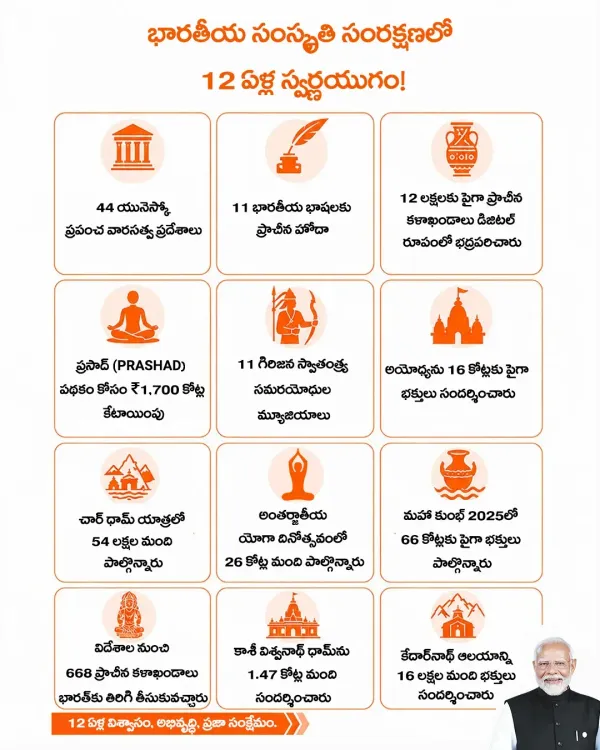
Union Minister G. Kishan Reddy marked 12 years of PM Modi's 'Vikas Bhi, Virasat Bhi' vision on 18 June 2026, highlighting artefact repatriation, UNESCO recognitions, Ayodhya and Kedarnath restoration, and Maha Kumbh Mela 2025 as milestones of India's cultural renaissance.
Key Takeaways
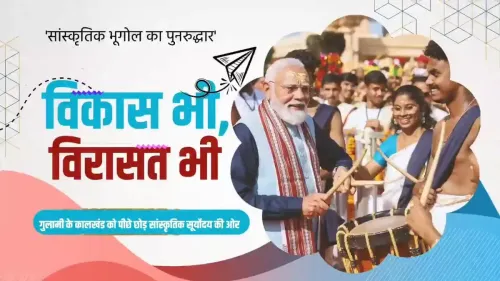
Kishan Reddy , Union Coal and Mines Minister and BJP Telangana president, posted in Telugu on 18 June 2026 praising 12 years of PM Modi's 'Vikas Bhi, Virasat Bhi' policy.
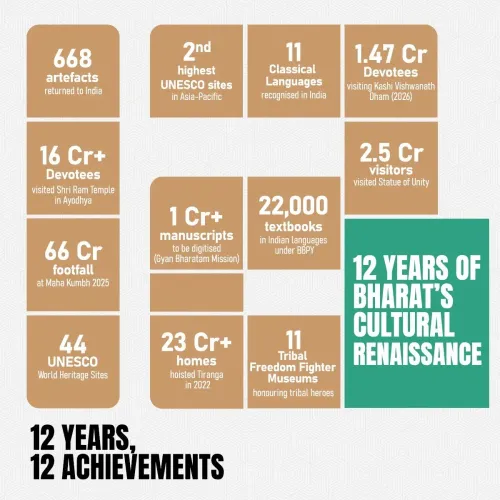
The government has pursued systematic repatriation of ancient artefacts from foreign collections since 2014 .
India secured additional UNESCO World Heritage designations during this period, including the Historic City of Ahmedabad in 2017 .
The Ram Temple at Ayodhya was inaugurated in January 2024 ; Kedarnath was rebuilt following the 2013 floods with central funding.
The PRASAD scheme (launched 2014-15 ) channels central funds to pilgrimage and heritage destinations across India.
Protection of Buddha's sacred relics and digitisation of palm-leaf manuscripts are cited as part of India's cultural diplomacy and knowledge preservation drive.
Union Coal and Mines Minister G. Kishan Reddy on Thursday, 18 June 2026 credited Prime Minister Narendra Modi's 'Vikas Bhi, Virasat Bhi' ('Development as well as Heritage') vision with driving a cultural renaissance across India over the past 12 years, citing the repatriation of ancient artefacts, protection of Buddhist relics, expanded UNESCO heritage recognitions, and the digitisation of palm-leaf manuscripts as tangible achievements.
Context
Posting in Telugu on the occasion of the #12YearsOfVikasBhiVirasatBhi campaign, Reddy argued that a nation draws its true strength not from its economy alone but from its civilisational roots. 'ఒక దేశం కేవలం ఆర్థిక వ్యవస్థ వల్లే కాదు, తన సంస్కృతి, నాగరికత మూలాల నుంచే అసలైన బలాన్ని పొందుతుంది' — ('A country derives its real strength not merely from its economy, but from the roots of its culture and civilisation'), he wrote. He also pointed to the restoration of spiritual centres such as Ayodhya and Kedarnath, and described the Maha Kumbh Mela 2025 as having been conducted with distinction.
Policy Backdrop
The 'Vikas Bhi, Virasat Bhi' slogan has been a recurring BJP government theme since 2014, framing cultural preservation as inseparable from economic development. On the heritage front, the government has pursued systematic repatriation of antiquities from foreign collections and launched the PRASAD scheme in 2014-15 to fund development of pilgrimage and heritage destinations. India also added multiple UNESCO World Heritage Sites during this period, including the Historic City of Ahmedabad in 2017. The Ram Temple at Ayodhya was inaugurated in January 2024 following a Supreme Court order, while Kedarnath in Uttarakhand was rebuilt with central government support after the devastating 2013 floods.
Reddy's post also highlighted the preservation of Buddha's sacred relics as part of India's broader cultural diplomacy, an initiative that has carried significance for India's engagement with Buddhist-majority nations in Asia.
Stakeholders and Impact
The cultural revival agenda touches a wide range of stakeholders: heritage conservationists, the religious tourism sector, diaspora communities, and international bodies such as UNESCO. The Maha Kumbh Mela at Prayagraj, held every 12 years, draws tens of millions of pilgrims and generates significant economic activity for Uttar Pradesh. Digitisation of palm-leaf manuscripts has implications for academic research, cultural institutions, and efforts to preserve India's ancient knowledge systems for future generations. Repatriation of antiquities has resonated strongly with the Indian diaspora and with domestic audiences invested in reclaiming cultural heritage.
What's Next
As the BJP government marks over a decade of this dual-track agenda, attention is likely to turn to fresh UNESCO nomination dossiers and any new repatriation agreements that may be announced through diplomatic channels. The government's framing — that development and heritage are complementary, not competing, priorities — is expected to remain central to its political messaging ahead of forthcoming state and national electoral cycles. Reddy's post, addressed to a Telugu-speaking audience as the BJP's Telangana state president, also signals continued efforts to embed this cultural narrative in the party's regional outreach.
Point of View
A combination the BJP has refined since 2014 to broaden its appeal beyond purely economic metrics. By cataloguing concrete deliverables — repatriation, UNESCO listings, temple restoration — alongside the emotive 'Vikas Bhi, Virasat Bhi' slogan, the party seeks to pre-empt criticism that cultural priorities come at the expense of development. Addressing a Telugu audience as Telangana BJP president, Reddy is also clearly working to entrench this narrative in a state where the party is in opposition and cultural identity politics carry electoral weight. The timing, marking 12 years of the Modi government's cultural agenda, positions heritage revival as an ongoing, institutionalised policy rather than a one-off event.
NationPress
22 Sept 2026
Frequently Asked Questions
What does 'Vikas Bhi, Virasat Bhi' mean?
'Vikas Bhi, Virasat Bhi' is a Hindi slogan meaning 'Development as well as Heritage,' used by PM Narendra Modi's government since 2014 to describe a policy approach that pursues economic growth alongside the preservation and promotion of India's cultural and civilisational identity.
What is the PRASAD scheme in India?
The PRASAD (Pilgrimage Rejuvenation and Spiritual Augmentation Drive) scheme was launched by the central government in 2014-15 to provide funding for the integrated development of pilgrimage and heritage destinations across India.
How many antiquities has India repatriated under Modi government?
The government has repatriated hundreds of ancient artefacts from collections abroad since 2014, though exact verified counts vary; G. Kishan Reddy's post describes the repatriation of 'hundreds of ancient idols' belonging to India from across the world.
When was the Ram Temple at Ayodhya inaugurated?
The Ram Temple at Ayodhya was inaugurated in January 2024, following a Supreme Court order and coordination by the central government, and stands as one of the flagship heritage restoration projects of the Modi era.
What UNESCO heritage sites did India add after 2014?
India added multiple UNESCO World Heritage Sites after 2014, with the Historic City of Ahmedabad being a notable example, designated in 2017; the government has also actively pursued fresh nominations as part of its expanded cultural diplomacy.