Kishan Reddy Distributes Medical Equipment at Secunderabad PHCs
Synopsis
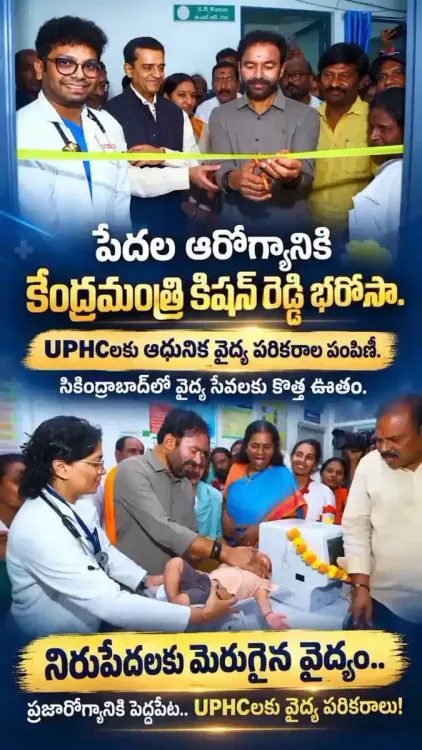
Union Minister and Secunderabad MP G. Kishan Reddy visited multiple Urban Primary Health Centres in his constituency and distributed state-of-the-art medical equipment for patient treatment, sharing visuals from the visits on X on 16 October 2026.
Key Takeaways
Kishan Reddy , Union Minister of Coal and Mines and Secunderabad MP, visited Urban Primary Health Centres in his constituency.
State-of-the-art medical equipment was distributed to facilities for patient treatment.
The visit covered multiple Urban PHCs within the Secunderabad parliamentary constituency in Telangana .
Urban PHCs function as the frontline of formal healthcare for low-income city residents under the National Health Mission framework.
Reddy shared video footage from the visits on X on 16 October 2026 .
Walking the wards rather than the corridors of power, Union Coal and Mines Minister G. Kishan Reddy stepped into several Urban Primary Health Centres within the Secunderabad parliamentary constituency to personally hand over modern medical equipment to staff and patients — a ground-level push to strengthen frontline healthcare in one of Hyderabad's most densely populated urban stretches.
In a post on X on Friday, 16 October 2026, the Minister shared: 'నిన్న సికింద్రాబాద్ పార్లమెంట్ పరిధిలోని పలు పట్టణ ప్రాథమిక ఆరోగ్య కేంద్రాలను సందర్శించి రోగుల చికిత్సకు అవసరమైన అత్యాధునిక వైద్య పరికరాలను పంపిణీ చేయడం జరిగింది.' ('Yesterday, I visited several Urban Primary Health Centres within the Secunderabad parliamentary constituency and distributed state-of-the-art medical equipment necessary for the treatment of patients.') He accompanied the update with video footage of the visits.
Secunderabad's Urban PHCs and What They Serve
Urban Primary Health Centres are the first line of formal medical care for lakhs of low-income city residents, operating under India's National Health Mission framework. In a sprawling urban constituency like Secunderabad — covering densely settled neighbourhoods across Hyderabad — these centres handle outpatient load, maternal and child health, and routine diagnostics that would otherwise overwhelm tertiary hospitals. Equipping them directly accelerates care at the point where most citizens actually seek it.
An MP's Ground-Level Role in Constituency Health
Reddy holds the dual profile of a senior Union Cabinet Minister and the sitting Member of Parliament from Secunderabad — one of the more urbanised and competitive Lok Sabha seats in Telangana. Constituency-level health visits are a standard part of representative duty for Indian MPs, allowing them to bridge national policy and local delivery. Distributing equipment at PHCs is a visible, tangible form of that bridge — and, in urban Telangana, a politically salient one.
The broader pattern is clear: Indian legislators regularly supplement state-run health infrastructure through direct interventions, channelling funds and equipment to facilities that often operate with outdated tools. Whether this round of distribution sparks further infrastructure announcements for the constituency's health network is the detail worth watching next.
Point of View
On one level, routine constituency outreach — but in Telangana, where the BJP is working to consolidate urban gains after the 2024 general election, Reddy's visible presence at public health facilities carries an additional political charge. Urban primary healthcare in Hyderabad remains underfunded relative to its patient load, making direct equipment interventions a meaningful, if partial, remedy. The episode fits a wider BJP pattern of using ministerial-MP dual roles to project both governance credibility and ground-level accessibility ahead of the next electoral cycle.
NationPress
16 Oct 2026
Frequently Asked Questions
Why did G. Kishan Reddy visit Primary Health Centres in Secunderabad?
Reddy visited multiple Urban Primary Health Centres in the Secunderabad parliamentary constituency to distribute modern medical equipment for patient treatment, as part of his duties as the area's elected MP.
What are Urban Primary Health Centres in India?
Urban Primary Health Centres are government-run facilities that deliver frontline healthcare — outpatient care, maternal health, and diagnostics — to low-income urban populations under India's National Health Mission.
Which constituency does G. Kishan Reddy represent?
G. Kishan Reddy is the Member of Parliament from the Secunderabad Lok Sabha constituency in Telangana.
What is G. Kishan Reddy's current ministerial role?
G. Kishan Reddy serves as Union Minister of Coal and Mines and is also the BJP's Telangana state president.
What equipment was distributed at the Secunderabad PHCs?
The post describes the distributed items as 'state-of-the-art medical equipment necessary for patient treatment'; specific equipment items have not been officially detailed.