Kishan Reddy Hails Cabinet Nod for BHAVYA Rasayan Scheme
Synopsis
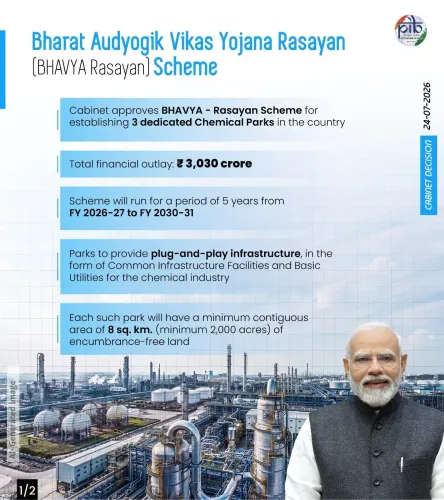
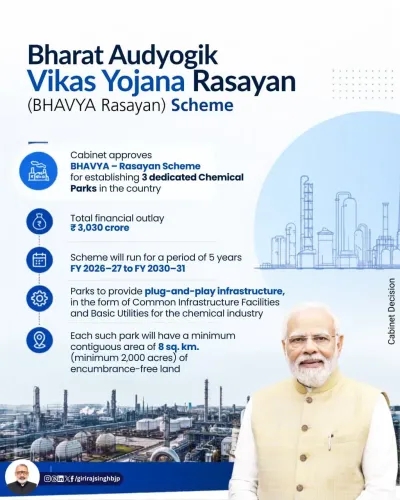
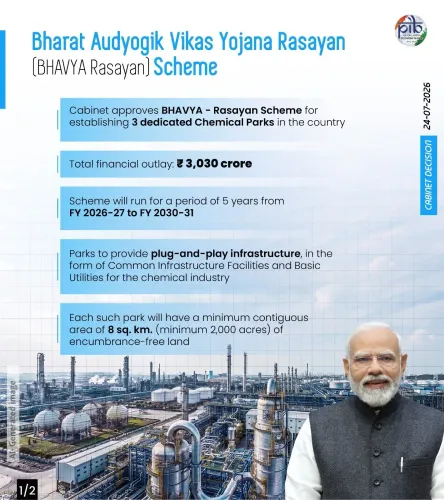
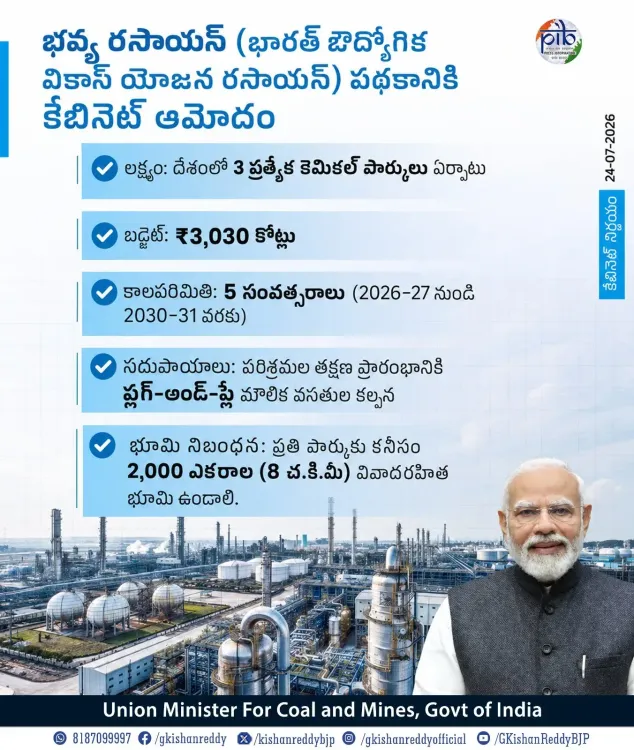
The Union Cabinet has approved the BHAVYA Rasayan Scheme, allocating ₹3,030 crore to build three dedicated chemical parks between 2026–27 and 2030–31. Union Minister G. Kishan Reddy welcomed the decision, citing goals of investment attraction, export growth, job creation, and environmentally responsible industrial development.
Key Takeaways
The Union Cabinet approved the BHAVYA Rasayan Scheme under PM Narendra Modi's leadership on 24 July 2026 .
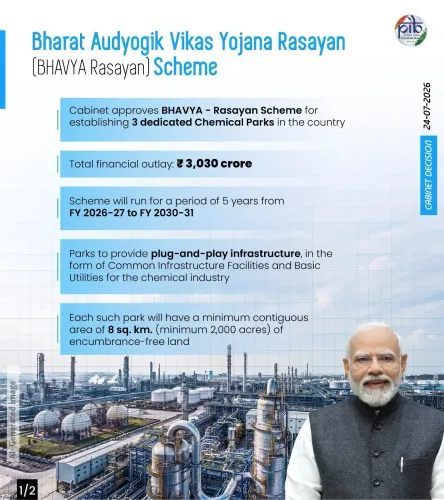
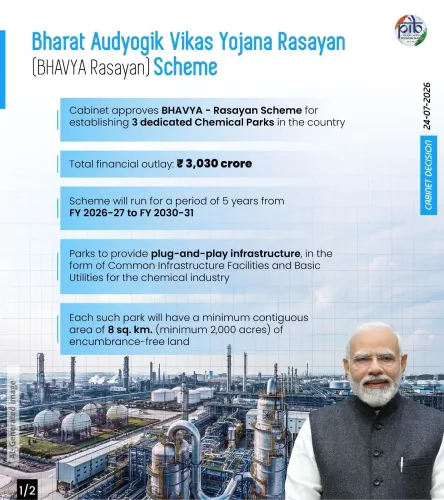
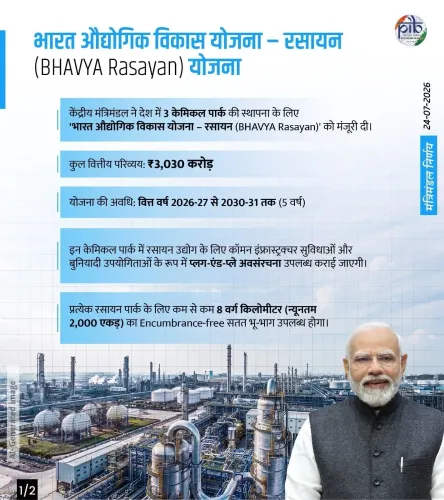
The scheme allocates ₹3,030 crore for the creation of three specialised chemical parks across India.
Implementation is scheduled from 2026–27 to 2030–31 .
Key objectives include boosting chemical manufacturing, attracting large investment, increasing exports, and generating large-scale employment.
Environmental safeguards are explicitly built into the scheme's design, distinguishing it from earlier cluster policies.
Ancillary and small industries linked to chemicals, along with transport infrastructure, are expected to benefit alongside large manufacturers.
Union Coal and Mines Minister G. Kishan Reddy on Friday, 24 July 2026 welcomed the Union Cabinet's approval of the BHAVYA Rasayan Scheme, a dedicated initiative to establish three specialised chemical parks across India. The scheme carries a total outlay of ₹3,030 crore and will be implemented from 2026–27 through 2030–31, according to Reddy's post on X.
Context
Reddy shared the Cabinet decision in Telugu, attributing the move to the leadership of Prime Minister Narendra Modi. In his post, he wrote — translated from Telugu — that 'Gavrava Pradhanamantri Sri Narendramodi gari netrutvamlo' ('Under the leadership of respected Prime Minister Shri Narendra Modi') the Union Cabinet has approved the BHAVYA Rasayan Scheme. He listed five key benefits: strengthening the chemical manufacturing sector, attracting large-scale investment and boosting exports, generating employment at scale, promoting environmentally responsible industrial development, and fostering growth of ancillary and small industries linked to chemicals, along with improved transport infrastructure.
Policy Backdrop
India's approach to building dedicated industrial clusters has a long lineage. The Petroleum, Chemicals and Petrochemicals Investment Regions (PCPIR) policy, notified in 2007, first laid out the framework for integrated chemical industry hubs. Since 2020, Production Linked Incentive (PLI) schemes have been progressively extended to the chemical and petrochemical sectors to deepen domestic value addition and raise export competitiveness. The BHAVYA Rasayan Scheme continues this cluster-based strategy while explicitly incorporating environmental safeguard language — a notable addition that reflects growing regulatory and investor sensitivity around chemical manufacturing.
The initiative fits within the broader Atmanirbhar Bharat manufacturing push, which links infrastructure creation with job generation and reduced import dependence. India has deployed similar cluster models in electronics, textiles, and pharmaceuticals to attract large capital and scale up exports, and the chemicals sector is now receiving comparable institutional support.
Stakeholders and Impact
The three new chemical parks are expected to benefit a wide range of stakeholders. Large chemical manufacturers stand to gain from shared infrastructure and a more predictable regulatory environment within designated zones. MSME suppliers and ancillary units — which form the backbone of India's chemical value chain — are explicitly cited as beneficiaries, with improved transport connectivity expected to reduce logistics costs. Industrial workers are among the primary targets of the employment-generation objective embedded in the scheme's design.
The emphasis on environmentally responsible development signals that the parks will likely be required to meet specific pollution-control and waste-management standards, potentially making them more attractive to export-oriented firms that must comply with international environmental norms.
What's Next
Attention will now turn to the selection of locations for the three chemical parks, the release of detailed operational guidelines by the nodal ministry, and whether corresponding capital outlays appear in the 2027–28 Union Budget. The implementation window runs to 2030–31, giving states a multi-year opportunity to bid for park locations and align their own industrial policies. How quickly land acquisition, environmental clearances, and utility infrastructure can be mobilised will determine whether the scheme delivers on its investment and employment targets within the stipulated timeline.
Point of View
Now extended explicitly to the chemicals sector with a dedicated fund and a five-year implementation horizon. By pairing investment incentives with environmental safeguard language, the government appears to be pre-empting criticism that chemical parks come at an ecological cost — a concern that has dogged earlier PCPIR-era proposals. The scheme's success will hinge on state-level execution: land acquisition timelines and clearance bottlenecks have historically slowed similar cluster projects. That a minister from the coal and mines portfolio is amplifying a chemicals-sector Cabinet decision also signals the BJP's intent to project broad economic momentum ahead of upcoming electoral cycles.
NationPress
24 Jul 2026
Frequently Asked Questions
What is the BHAVYA Rasayan Scheme?
The BHAVYA Rasayan Scheme is a Union Cabinet-approved initiative to establish three dedicated chemical parks in India, backed by a total outlay of ₹3,030 crore and set to run from 2026–27 to 2030–31.
How much money has been allocated to the BHAVYA Rasayan Scheme?
The scheme has been allocated ₹3,030 crore in total funding by the Union Cabinet.
How many chemical parks will be built under the BHAVYA Rasayan Scheme?
Three specialised chemical parks will be established across India under the scheme.
What are the benefits of the BHAVYA Rasayan Scheme?
The scheme aims to strengthen chemical manufacturing, attract large-scale investment, boost exports, generate employment, promote environmentally responsible industrial growth, and support ancillary and small industries linked to the chemicals sector.
When will the BHAVYA Rasayan Scheme be implemented?
The scheme is scheduled for implementation from the financial year 2026–27 through 2030–31.