Kishan Reddy hails MMDR Amendment Act 2026 mining reforms
Synopsis
Union Mines Minister G. Kishan Reddy on 25 September 2026 hailed the MMDR Amendment Act, 2026, saying it strengthens the fiscal framework of India's mining sector — the latest step in a decade-long legislative overhaul that began with mandatory auctions in 2015.
Key Takeaways
Union Coal and Mines Minister G.
Kishan Reddy publicly welcomed the MMDR Amendment Act, 2026 on 25 September 2026 .
The amendment aims to 'strengthen the fiscal framework' of India's mining sector, per Reddy's post.
India's MMDR reform lineage runs from the original 1957 Act through the 2015 auction-mandate amendment and 2020–21 lease-extension changes .
The District Mineral Foundation (DMF) , created in 2015, channels royalty revenues to mining-affected communities and remains central to the reform framework.
Key stakeholders — mining companies, state governments, and local communities — all have distinct fiscal stakes in the amended provisions.
Reducing import dependence on critical minerals such as lithium and cobalt underpins the strategic urgency behind the 2026 revision.
Every home, every industry, every livelihood — Union Coal and Mines Minister G. Kishan Reddy opened with that sweeping frame on Friday, 25 September 2026, as he marked the passage of the MMDR Amendment Act, 2026, calling it a decisive step in strengthening the fiscal architecture of India's mining sector.
What the 2026 amendment sets out to do
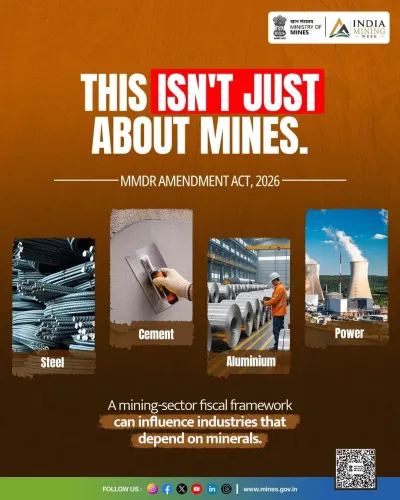
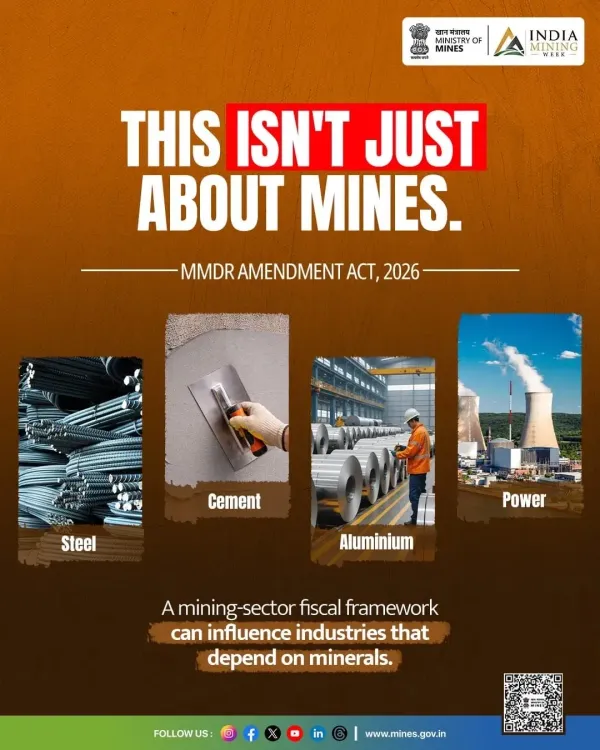
Reddy's post — tagged to the Ministry of Mines — described the legislation as one that 'powers growth across the economy it supports,' positioning the amendment as a backbone reform rather than a sectoral tweak. The mining sector underpins steel, cement, fertilisers, energy, and electronics, meaning a stronger fiscal framework reverberates well beyond the pit-head.
India's mines-and-minerals law traces its roots to the Mines and Minerals (Development and Regulation) Act, 1957, which laid the original legal scaffolding for mining leases and royalties. That framework remained largely intact for nearly six decades before the landmark MMDR Amendment Act, 2015 shook it loose — replacing discretionary block allocations with mandatory, transparent auctions and creating the District Mineral Foundation (DMF) to channel royalty revenues toward affected communities.
A decade of incremental reform — and where 2026 fits
Subsequent amendments around 2020–21 extended lease validity periods, eased exploration norms, and widened the pool of eligible bidders to accelerate domestic production of critical minerals. Each revision has been driven by the same underlying pressure: India imports large volumes of minerals it possesses in the ground, and discretionary allocation had historically throttled both investment and transparency.
The 2026 amendment is framed by Reddy as the next fiscal step in that arc — tightening the revenue-sharing and royalty structure so that state governments, local bodies, and the central exchequer all benefit more predictably from mineral extraction. Specific provisions of the amended act were not detailed in the post.
States, companies, and communities in the frame
The reform's immediate audience spans three intersecting stakeholder rings. Mining companies — from large integrated steelmakers to junior exploration firms — watch for any changes to royalty rates and auction timelines. State governments, which receive the lion's share of mineral royalties, are acutely sensitive to revenue-sharing formula shifts. And local communities in mineral-rich districts track how DMF allocations are structured under the new fiscal rules.
India's ambition to reduce import dependence on critical minerals — lithium, cobalt, nickel — for its electric-vehicle and clean-energy supply chains gives this reform cycle an added strategic dimension that goes beyond coal and iron ore.
What to watch as the amendment takes effect
The immediate signposts will be new auction rounds launched under the amended framework, any revised royalty notifications, and state government responses to changed revenue-sharing mechanisms. How quickly mineral blocks move from allocation to production will be the real measure of whether the fiscal tightening translates into supply-side results.
Reddy's framing — 'every home, every industry, every livelihood' — is a deliberate signal that the government intends to sell this as an economy-wide dividend, not a sectoral fix. The numbers on the ground will decide whether that pitch holds.
Point of View
2026 represents the BJP-led government's latest attempt to convert India's vast mineral endowment into a transparent, revenue-maximising asset — a project that has defined mining policy since 2015. By framing the legislation in 'every home, every livelihood' terms, Reddy is consciously broadening the political constituency for a reform that has historically been contested by states protective of their revenue autonomy. The fiscal tightening angle signals that the Centre wants more predictable royalty flows to fund critical-mineral ambitions tied to the clean-energy transition. Whether state governments — the real power brokers over land and royalties — align with Delhi's vision will determine how quickly the amendment moves from statute to supply chain.
NationPress
25 Sept 2026
Frequently Asked Questions
What is the MMDR Amendment Act 2026?
The MMDR Amendment Act, 2026 is the latest revision to India's Mines and Minerals (Development and Regulation) Act, which Union Mines Minister G. Kishan Reddy says strengthens the fiscal framework governing the country's mining sector.
What did G. Kishan Reddy say about the MMDR 2026 amendment?
Kishan Reddy said the MMDR Amendment Act, 2026 'strengthens the fiscal framework of India's mining sector, powering growth across the economy it supports,' framing it as a broadly beneficial economic reform.
How does MMDR 2026 differ from the 2015 amendment?
The 2015 MMDR amendment introduced mandatory auctions for mineral blocks and created the District Mineral Foundation; the 2026 amendment focuses on further tightening the fiscal and revenue-sharing framework, building on that auction-based architecture.
Who are the key stakeholders affected by MMDR 2026?
Mining companies, state governments that collect mineral royalties, and local communities in mineral-rich districts — whose welfare funds flow through the District Mineral Foundation — are the primary stakeholders affected by the 2026 amendments.
Why is India reforming its mining laws?
India is reforming its mining laws to reduce import dependence on critical minerals, raise state revenues through transparent royalty systems, and attract investment needed to build domestic supply chains for clean energy and manufacturing.