Kishan Reddy Hails PM Modi's Hydrogen Train Flag-Off on Jind-Sonipat Route

Synopsis
Union Minister G. Kishan Reddy announced that PM Modi will flag off India's first hydrogen-powered train between Jind and Sonipat in Haryana, marking a milestone in the country's green mobility push under the National Green Hydrogen Mission and Indian Railways' net-zero roadmap.
Key Takeaways
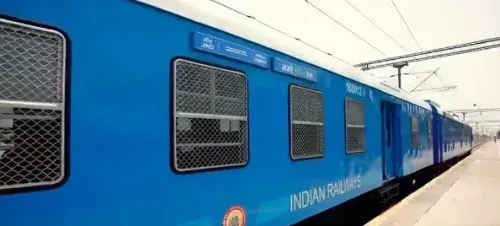
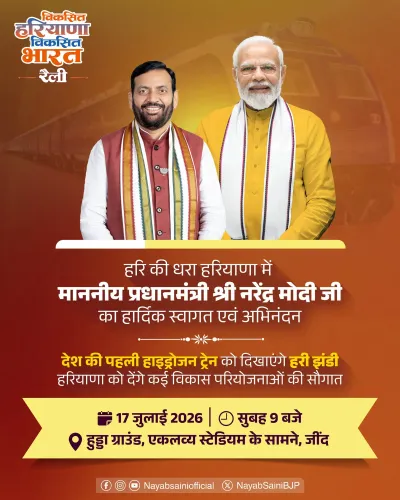
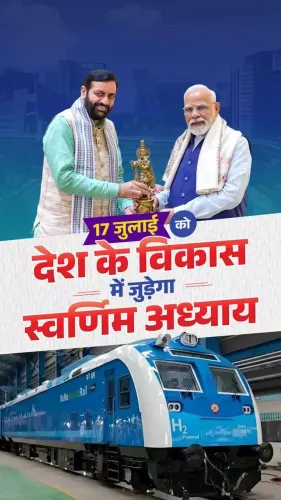
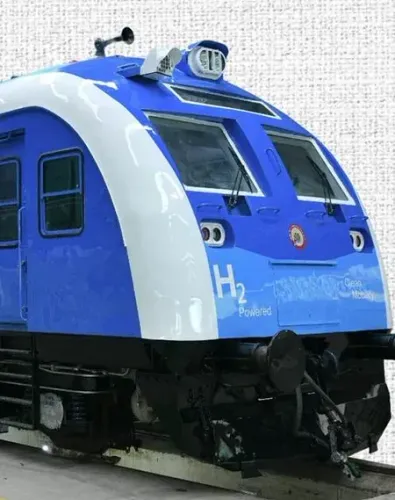
Prime Minister Narendra Modi is set to flag off India's first hydrogen-powered train on the Jind–Sonipat route in Haryana .
Kishan Reddy announced the development on 16 July 2026 , calling it a landmark moment in India's green mobility journey.
The initiative aligns with Indian Railways' net-zero carbon emissions target of 2030 .
The National Green Hydrogen Mission , backed by an outlay of Rs 19,744 crore approved in January 2023 , provides the policy framework for the deployment.
The hydrogen train is positioned as a pillar of the Viksit Bharat 2047 vision and the Atmanirbhar Bharat programme for domestic clean-technology development.
Further route extensions and additional hydrogen train deployments are expected to be announced in future railway budgets.
Union Coal and Mines Minister G. Kishan Reddy on Thursday, 16 July 2026 announced that Prime Minister Narendra Modi will flag off India's first hydrogen-powered train on the Jind–Sonipat route in Haryana, calling it a landmark moment in the country's push for cleaner and greener mobility.
Context
Reddy described the upcoming flag-off as 'a proud milestone that will further strengthen the nation's march towards a Viksit Bharat powered by green technology.' The Jind–Sonipat corridor in Haryana has been identified as the inaugural route for the hydrogen train, marking the first deployment of hydrogen-based rail traction in India's extensive railway network.
The minister, who also serves as BJP Telangana state president, framed the initiative as a reflection of the Prime Minister's vision of a 'self-reliant and environmentally conscious India,' linking it to the broader Atmanirbhar Bharat programme.
Policy Backdrop
Indian Railways has committed to achieving net-zero carbon emissions by 2030, one of the most ambitious decarbonisation targets among major national rail operators globally. The hydrogen train initiative sits within this roadmap alongside accelerated electrification of the rail network and pilot projects on alternative fuels.
The National Green Hydrogen Mission, approved by the Union Cabinet in January 2023 with an outlay of Rs 19,744 crore, provides the policy and financial scaffolding for scaling up green hydrogen use across sectors, including transport. The Jind–Sonipat deployment represents one of the most visible early applications of that mission in the mobility sector.
India's net-zero emissions target of 2070, announced by Prime Minister Modi at COP26 in 2021, provides the longer-term climate framework within which both the railway and hydrogen missions operate.
Stakeholders and Impact
Commuters on the Jind–Sonipat corridor stand to be the immediate beneficiaries, gaining access to a zero-emission rail service. The route connects two significant districts in Haryana, a state with a dense rail commuter base and growing industrial activity.
Green energy firms and domestic manufacturers involved in hydrogen fuel-cell technology are expected to gain visibility and commercial momentum from the flag-off, potentially accelerating private investment in India's nascent hydrogen economy. The Ministry of Railways has been tagged in the post, signalling institutional alignment between the coal-and-mines portfolio and the railway administration on the clean energy transition.
What's Next
The flag-off by Prime Minister Modi is expected to set a precedent for further hydrogen train deployments on other routes, with subsequent railway budgets and state-level green mobility policies likely to determine the pace of expansion. Analysts will watch whether the Jind–Sonipat pilot leads to firm orders for additional hydrogen rake sets and whether the technology is developed domestically under the Atmanirbhar Bharat framework.
The milestone also feeds into the Viksit Bharat 2047 vision, which targets a developed-nation standard of infrastructure and technology by India's centenary of independence, with clean energy corridors forming a core pillar of that roadmap.
Point of View
And positions the Centre as a direct driver of clean infrastructure at the state level. The post's explicit linkage to Viksit Bharat 2047 and Atmanirbhar Bharat suggests the government is weaving the hydrogen train into its long-term national narrative rather than treating it as a standalone pilot. Whether the Jind–Sonipat deployment can be scaled rapidly will determine how substantive this milestone proves to be beyond its symbolic weight.
NationPress
16 Jul 2026
Frequently Asked Questions
What is India's first hydrogen-powered train and where will it run?
India's first hydrogen-powered train is set to run between Jind and Sonipat in Haryana. Prime Minister Narendra Modi is expected to flag it off, marking the debut of hydrogen-based rail traction on the Indian Railways network.
What is the National Green Hydrogen Mission and how does it relate to the hydrogen train?
The National Green Hydrogen Mission was approved by the Union Cabinet in January 2023 with an outlay of Rs 19,744 crore to scale up green hydrogen production and use across sectors including transport. The Jind–Sonipat hydrogen train is one of the first visible mobility applications under this mission.
What is Indian Railways' net-zero carbon target?
Indian Railways has set a target of achieving net-zero carbon emissions by 2030, one of the most ambitious sustainability goals among major national rail operators. The hydrogen train initiative is part of this broader decarbonisation roadmap.
Why did G. Kishan Reddy post about the hydrogen train if he is Coal and Mines Minister?
As a senior BJP minister and Telangana state party president, Kishan Reddy frequently amplifies government flagship initiatives beyond his own portfolio. His post reflects the party's broader communications strategy around Viksit Bharat and green energy milestones.
What is Viksit Bharat 2047 and how does the hydrogen train fit in?
Viksit Bharat 2047 is the government's vision to achieve developed-nation standards of infrastructure and technology by India's centenary of independence. The hydrogen train is cited as part of this roadmap, representing domestic clean-energy innovation in the transport sector.