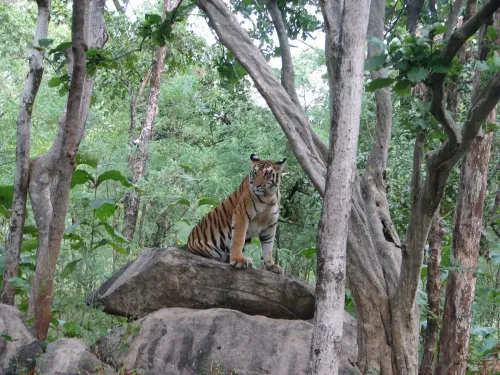
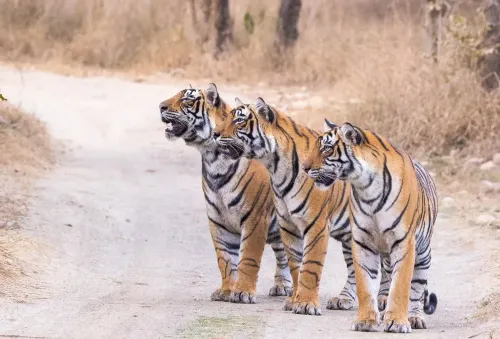
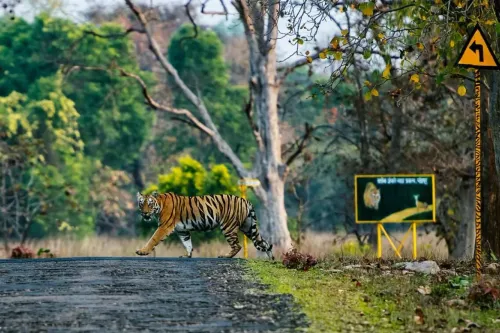
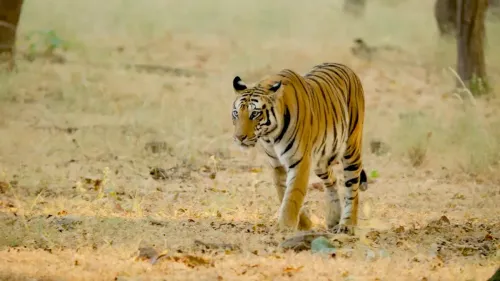
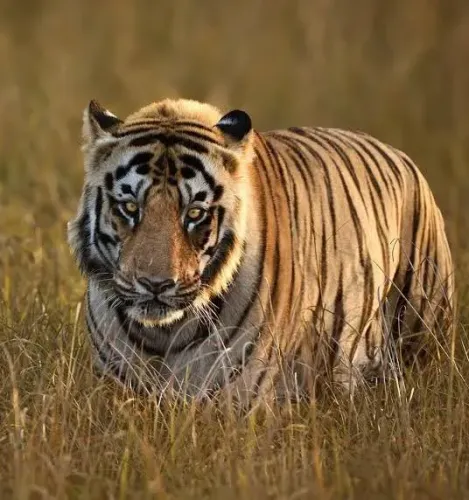
Kishan Reddy: India hosts 70% of world's wild tigers

Synopsis
On International Tiger Day, Union Minister G. Kishan Reddy highlighted that India hosts nearly 70% of the world's wild tigers, crediting the Modi government's science-based conservation efforts, institutional framework, and community participation built on five decades of Project Tiger.
Key Takeaways
Union Coal and Mines Minister G.
Kishan Reddy posted on International Tiger Day, July 29, 2026 , reaffirming India's tiger conservation commitment.
India is home to nearly 70% of the world's wild tigers , according to the post.
Project Tiger , launched in 1973 , remains the institutional backbone of India's tiger conservation programme.
The National Tiger Conservation Authority has maintained the conservation framework across successive governments.
Reddy credited science-based monitoring, anti-poaching measures, and community participation as the three pillars of the achievement.
The next All India Tiger Estimation report will be the key data point to watch for validating continued population growth.
On International Tiger Day, July 29, Union Coal and Mines Minister G. Kishan Reddy invoked India's most potent conservation statistic — that the country is home to nearly 70% of the world's wild tigers — and called it a direct outcome of science-based policy, institutional strength, and community-led stewardship.
Reddy's post credited the Narendra Modi government's approach for sustaining what is, by any global measure, a remarkable turnaround story. 'Today, India is home to nearly 70% of the world's wild tigers,' he wrote, 'a testament to the Modi govt's science-based conservation efforts, strong institutional framework, and community participation.'
Fifty years of Project Tiger — and why the number still shocks
The arc begins in 1973, when Project Tiger was launched as India's flagship in-situ conservation programme, carving out dedicated reserves and giving wildlife managers both legal teeth and federal funding. What followed was one of conservation's most-cited recoveries: a population that had plunged to crisis levels rebuilt, reserve by reserve, across decades of successive governments. The National Tiger Conservation Authority — the institutional spine of the programme — has maintained that framework through political transitions, making tiger protection a rare area of bipartisan continuity. The 70% figure is the headline claim, and it is a striking one. India's repeated national tiger estimations, conducted through camera-trap grids and scientific modelling, have documented steady population growth. Anti-poaching operations, habitat corridor management, and the integration of forest-edge communities into conservation work have all been credited as multiplier factors. Reddy's post explicitly names all three pillars — science, institutions, community — signalling that the government intends to present this not as a single policy win but as a systemic achievement.What the 'national animal' framing signals
Calling the tiger 'one of India's most iconic symbols of biodiversity' and 'the National Animal of India' in the same breath is deliberate political shorthand. It ties conservation to national identity — making the tiger's survival a matter of pride, not just ecology. For a ruling party that has consistently linked environmental stewardship to cultural heritage, the framing reinforces a narrative that conservation and development can coexist under its watch. The next All India Tiger Estimation report, whenever released, will either validate or complicate that narrative. Reserve boundary updates and wildlife budget allocations in upcoming Union Budgets will be the concrete tests of the commitment Reddy reaffirmed today.Point of View
Institutions, and community as co-equal pillars, the BJP signals it wants to own the full conservation narrative, not just the headline number. The 70% claim, if borne out by the next national estimation, would be a powerful data point in the party's broader 'development with ecology' messaging. The real test, however, lies in upcoming budget allocations for wildlife corridors and whether reserve boundary expansions keep pace with a growing tiger population pressing against human-settled land.
NationPress
29 Jul 2026
Frequently Asked Questions
How many wild tigers does India have in 2026?
The exact 2026 figure awaits the next official All India Tiger Estimation report. India's most recent published census documented over 3,000 wild tigers, and the government claims the country holds nearly 70% of the global wild tiger population.
What is International Tiger Day?
International Tiger Day is observed every year on July 29 to raise global awareness about tiger conservation and the threats facing the species, including habitat loss and poaching.
What is Project Tiger in India?
Project Tiger is India's flagship tiger conservation programme, launched in 1973 , which established dedicated tiger reserves and provided legal and financial support for in-situ conservation across the country.
What is the National Tiger Conservation Authority?
The National Tiger Conservation Authority (NTCA) is the statutory body under India's Ministry of Environment that oversees the management of tiger reserves, coordinates anti-poaching efforts, and monitors tiger population data.
Why does India have so many wild tigers compared to other countries?
India's large share of the global wild tiger population is attributed to decades of protected reserve management under Project Tiger, rigorous national census methodology, anti-poaching enforcement, and community-based conservation programmes at forest edges.