Kishan Reddy outlines Coal Ministry's four-pillar energy strategy

Synopsis
Union Coal and Mines Minister G. Kishan Reddy has outlined a four-pillar strategy — production scale-up, coal gasification, mine closure compliance, and the Rs 16,300 crore National Critical Minerals Mission — to advance India's energy security and energy-transition readiness.
Key Takeaways
Union Coal and Mines Minister G.
Kishan Reddy publicly articulated the Ministry of Coal's four-pillar strategic roadmap on November 4, 2026 .
India's commercial coal mining was opened to private players in 2020 to boost domestic output and curb imports.
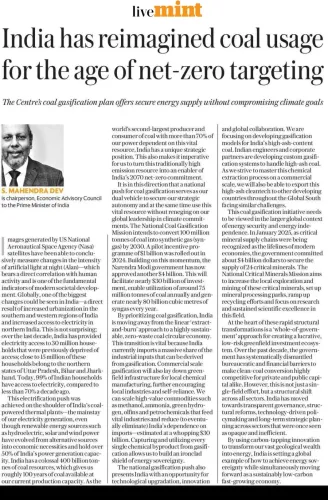
A coal gasification mission targeting 100 MT by 2030 was launched under the Atmanirbhar Bharat framework.
Updated mine closure guidelines require progressive environmental restoration and community development funding.
The National Critical Minerals Mission , backed by a Rs 16,300 crore outlay, targets lithium, cobalt, and rare earths for India's energy-transition supply chain.
The strategy mirrors resource-nationalism approaches in other major coal-producing economies while simultaneously building clean-energy mineral capacity.
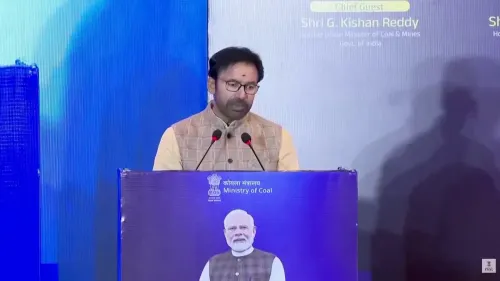
Four priorities, one clear direction. Union Coal and Mines Minister G. Kishan Reddy on Wednesday, November 4, 2026, laid out the Ministry of Coal's comprehensive strategic roadmap — ramping up domestic coal production, advancing coal gasification, completing mine closure activities, and accelerating the National Critical Minerals Mission.
The minister's post named all four pillars in sequence: 'ramping up coal production, promoting coal gasification, completing mine closure activities and advancing the National Critical Minerals Mission.' Together, they form what the ministry frames as a strategy to 'strengthen India's energy security.'
From commercial auctions to 100 MT gasification: the production push
The production acceleration pillar has roots in a structural shift that began in 2020, when commercial coal mining was opened to private players for the first time — a break from decades of near-total state control. The move was designed to close the gap between domestic demand and output, and to reduce India's dependence on coal imports. Running in parallel is an equally ambitious gasification mission. The government set a target of converting 100 million tonnes (MT) of coal into syngas by 2030, framing it under the Atmanirbhar Bharat push as a route to cleaner energy without abandoning India's most abundant fossil fuel.Mine closure rules and the environmental compliance piece
The third pillar — completing mine closure activities — speaks directly to environmental accountability. Updated mine closure guidelines, also issued in 2020, require progressive environmental restoration and the creation of community development funds. It signals that production expansion and ecological responsibility are being pursued simultaneously, not sequentially.Critical Minerals Mission: the energy-transition bet
Perhaps the most forward-looking element of the minister's statement is the National Critical Minerals Mission, formally launched in the Union Budget 2024-25 with an outlay of Rs 16,300 crore. The mission targets domestic exploration, mining, and processing of minerals such as lithium, cobalt, and rare earths — the building blocks of EV batteries and renewable energy infrastructure. The juxtaposition is deliberate. India is simultaneously scaling coal as its dominant baseload fuel and building domestic capacity in the minerals the post-coal energy economy will run on. It is a hedge — and a statement of strategic intent. The combination of production scale, cleaner conversion technology, environmental compliance, and critical mineral supply chains puts the Ministry of Coal at the intersection of India's near-term energy security and its long-term transition calculus. Whether the gasification targets and mineral exploration blocks deliver on schedule will be the real scorecard.Point of View
From maximising fossil-fuel output today to securing the minerals that will power a post-coal grid tomorrow. The bundling of mine closure compliance alongside production ambition is politically significant: it pre-empts environmental criticism by placing accountability within the same frame as growth. The Rs 16,300 crore Critical Minerals Mission is the clearest indicator that the ministry sees its role extending well beyond coal itself. Delivery on gasification timelines and mineral exploration blocks will determine whether the strategy is remembered as vision or aspiration.
NationPress
4 Nov 2026
Frequently Asked Questions
What is the National Critical Minerals Mission in India?
The National Critical Minerals Mission was formally launched in the Union Budget 2024-25 with an outlay of Rs 16,300 crore. It aims to accelerate domestic exploration, mining and processing of critical minerals such as lithium, cobalt and rare earths, which are essential for EV batteries and renewable energy infrastructure.
What is India's coal gasification target?
India announced a coal gasification mission with a target of converting 100 million tonnes of coal into syngas by 2030, as part of the Atmanirbhar Bharat initiative.
When did India open commercial coal mining to private players?
India opened commercial coal mining auctions to private sector companies in 2020, ending decades of near-total state control, with the aim of raising domestic output and reducing coal imports.
What are India's mine closure guidelines?
Updated mine closure guidelines issued in 2020 require coal companies to carry out progressive environmental restoration of mined land and maintain community development funds, linking production expansion with ecological accountability.
What is G. Kishan Reddy's current position?
G. Kishan Reddy is India's Union Minister of Coal and Mines and also serves as the BJP's Telangana state president.