Kishan Reddy slams Rahul Gandhi over foreign criticism of India
Synopsis
BJP minister G. Kishan Reddy targets Rahul Gandhi on October 13, 2026, saying the Congress leader should stop criticising India abroad and face voters at home, while branding opposition losses a near-'century of defeats' and calling attacks on constitutional institutions 'deeply unfortunate.'
Key Takeaways
Kishan Reddy , Union Coal and Mines Minister and BJP Telangana president , posted on October 13, 2026 attacking Congress's electoral record and Rahul Gandhi's foreign appearances.
He accused the opposition of nearing a 'century of defeats' yet refusing to introspect, choosing instead to question constitutional institutions.
Reddy called it 'deeply unfortunate' to attack constitutional bodies after repeated electoral losses rather than reflect on those defeats.
He urged Rahul Gandhi to stay among ordinary citizens and understand their problems rather than criticise India on foreign soil.
The post reaffirmed public faith in PM Narendra Modi's leadership, development agenda, and welfare programmes as the BJP's counter-narrative.
While opposition losses pile up on the electoral map, Union Coal and Mines Minister G. Kishan Reddy sharpened the BJP's attack on Congress leader Rahul Gandhi on Tuesday, October 13, 2026, accusing him of choosing foreign podiums over domestic accountability — and of questioning constitutional institutions rather than reflecting on a string of defeats.
In a post on X, the BJP's Telangana state president wrote in Hindi: 'देश की जनता ने नकारात्मक राजनीति, नफरत और खोखले वादों को पूरी तरह नकार दिया है' — 'The people of this country have completely rejected negative politics, hatred, and hollow promises.' He added that approaching a 'century of defeats' in elections while attacking constitutional institutions instead of introspecting was 'deeply unfortunate.'
The 'century of defeats' charge
Reddy's invocation of a near-'century of defeats' is a well-worn BJP rhetorical frame — pointing to Congress's cumulative losses across state assembly and general elections over the past decade. The research indicates the precise tally cannot be independently verified, but the metaphor has become a standard BJP attack line used to question the Congress party's popular mandate and its credibility as a constitutional watchdog.
By coupling that charge with a reference to 'questioning constitutional institutions,' Reddy is doing something pointed: he is not merely relitigating old results but framing the opposition's current posture as a threat to democratic legitimacy itself. That framing puts Congress on the defensive — either defend the critique of institutions or accept the electoral-loss narrative.
Rahul Gandhi's foreign visits as BJP's favourite target
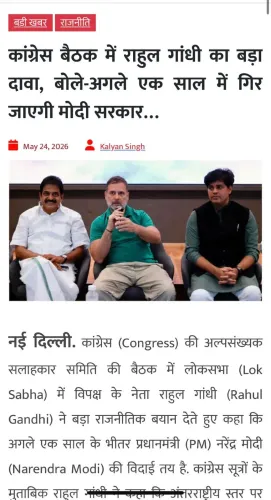
The second half of Reddy's broadside targets Rahul Gandhi's overseas appearances, a line of attack Prime Minister Narendra Modi's party has deployed repeatedly whenever the Congress leader addresses diaspora audiences or speaks at foreign universities. Reddy's post states Gandhi should 'stay among the people and understand their problems instead of going abroad and criticising India.'
The BJP's consistent argument is that criticising the Indian government on foreign soil crosses a line from domestic political opposition into a damaging of national image. Congress, historically, frames such trips as legitimate democratic outreach and accountability exercises. The exchange rarely finds a middle ground — but it reliably fires up base voters on both sides.
Modi's leadership as the counter-narrative
Reddy anchored the BJP's affirmative message in the post: the public's 'unshakeable faith' in development, public welfare, and the leadership of Prime Minister Narendra Modi. That framing is deliberate — it transforms an attack on the opposition into a reaffirmation of the ruling party's mandate, keeping the BJP's own record at the centre of the story rather than ceding the agenda to Congress.
As state assembly and by-election cycles continue through late 2026, expect this dual strategy — electoral-record attacks paired with overseas-criticism broadsides — to intensify. The BJP clearly intends to make the opposition's institutional criticism a liability, not a strength.
Point of View
Then preempt any institutional critique by framing it as sore-loser deflection. The overseas-criticism attack is particularly tactical — it forces Congress to defend foreign-visit optics rather than press its policy challenges. As by-election cycles approach, this kind of high-decibel, social-media-first salvo from state party presidents signals that the BJP intends to keep the opposition perpetually on the back foot, even between major election cycles.
NationPress
13 Oct 2026
Frequently Asked Questions
What did G. Kishan Reddy say about Rahul Gandhi on October 13, 2026?
Reddy accused Rahul Gandhi of criticising India during foreign visits instead of engaging with voters at home, and called it deeply unfortunate that the Congress leader was questioning constitutional institutions rather than reflecting on the party's electoral losses.
What is the BJP's 'century of defeats' claim against Congress?
It is a BJP rhetorical frame pointing to Congress's accumulation of state assembly and general election losses over the past decade. The exact tally has not been independently verified, but BJP leaders use it to argue Congress has lost its popular mandate.
Why does BJP criticise Rahul Gandhi for his foreign visits?
The BJP argues that addressing overseas audiences and commenting on India's governance from foreign soil damages the country's image internationally, and that a responsible opposition leader should focus on domestic issues and engage directly with voters.
Who is G. Kishan Reddy?
G. Kishan Reddy is the Union Minister of Coal and Mines in the Indian government and also serves as the BJP's state president in Telangana.
What elections are expected to influence BJP-Congress rhetoric in late 2026?
State assembly and by-elections are expected through late 2026. Their outcomes are likely to shape the intensity of BJP's attacks on Congress's electoral record and Congress's counter-narrative on governance and institutional integrity.