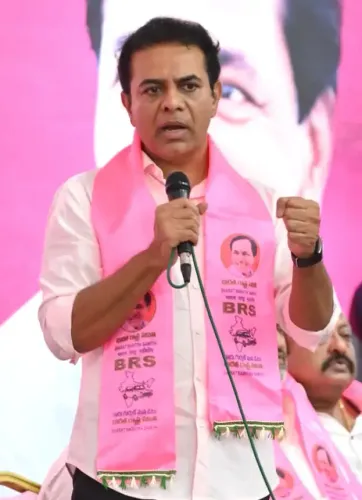
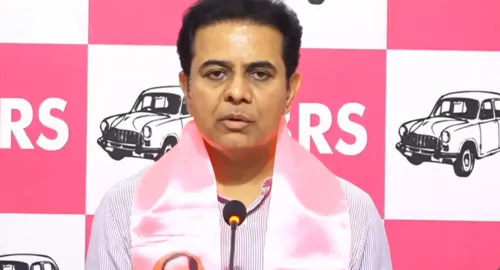
KTR slams CBSE over Globarena contract, demands Education Minister answer
Synopsis
BRS working president K. T. Rama Rao has accused CBSE of knowingly awarding a result-processing contract to Globarena — the vendor blamed for the Telangana Intermediate 2019 fiasco — and demanded the Union Education Minister answer for the resulting chaos affecting lakhs of Class 12 students.
Key Takeaways
Rama Rao backed student protests over alleged CBSE Class 12 result discrepancies in May 2026 .
He alleged Globarena changed its name after the Telangana Intermediate 2019 fiasco and secured a larger CBSE contract.
The then- BRS government in 2019 sacked officials, formed a three-member committee, and took Globarena to court over the earlier failure.
Rama Rao alleged CBSE altered its own rules repeatedly to accommodate the vendor despite its track record.
He demanded the Union Education Minister and the Union Government be held accountable for the current crisis.
Details of Globarena's alleged name change and the specific 2026 CBSE discrepancies are unverified ; NationPress has sought official responses.
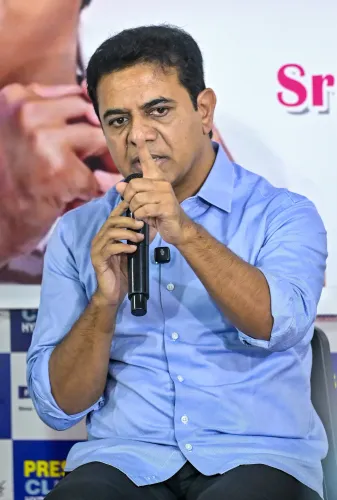
BRS working president K. T. Rama Rao on Saturday, 30 May 2026 publicly backed Class 12 students protesting alleged discrepancies in CBSE examination results, while squarely blaming the Union Government for awarding a major contract to Globarena — a private vendor he accused of having earlier botched the Telangana Intermediate 2019 results. Posting on X, Rama Rao demanded that the Union Education Minister answer for what he called a 'broken and rotten system.'
Context
Rama Rao's post comes amid widespread student protests over reported errors in CBSE Class 12 result processing in 2026. He opened by praising the students: 'the way you are holding people in power accountable is truly inspiring,' framing the protests as a legitimate democratic exercise. The post quickly pivoted to the vendor at the centre of the controversy — Globarena — which Rama Rao alleged had simply changed its name after its earlier failures before securing a fresh, larger contract from CBSE.
The research note flags that the specific details of Globarena's alleged name change and the precise nature of the 2026 CBSE discrepancies remain unverified. NationPress is seeking a response from CBSE and the Union Education Ministry on both points.
Policy Backdrop
The Telangana Intermediate 2019 results crisis is well-documented. After widespread reports of technical errors in result compilation — attributed to the contracted vendor — the then BRS government constituted a three-member committee to investigate. Based on the committee's findings, concerned officials were dismissed and legal proceedings were initiated against Globarena.
Rama Rao cited this record directly: 'when the Globarena fiasco happened, the BRS government took appropriate action.' His argument is that this publicly available history of failure and litigation should have disqualified the firm — or any successor entity — from receiving a national-level contract. He alleged that CBSE 'changed rules repeatedly just to clearly accommodate a very incompetent organisation,' a charge the board has not yet responded to.
Indian examination boards have a long pattern of outsourcing result compilation to private vendors, a practice that has repeatedly produced technical failures, student protests, and inter-governmental blame. Opposition leaders routinely invoke earlier state-level lapses to question central procurement standards and vendor due-diligence processes — a pattern Rama Rao's post fits squarely into.
Stakeholders and Impact
At the immediate centre are lakhs of Class 12 students whose futures — college admissions, scholarship eligibility, career paths — hinge on accurate results. Errors or delays in result processing have historically triggered cascading effects on university counselling timelines and mental health crises among students and families.
CBSE, which oversees one of the world's largest examination systems, faces questions about its vendor-selection and due-diligence processes. The Union Education Ministry, which has policy oversight over CBSE, is the primary political target of Rama Rao's demand for accountability. BRS, currently in opposition in Telangana, has an organisational interest in drawing a contrast between its own 2019 response and what it characterises as the Centre's negligence.
What's Next
All eyes are on the Union Education Ministry and CBSE to respond to the vendor-selection allegations and detail the due-diligence process that led to the contract award. Parliamentary scrutiny — through questions, adjournment motions, or a committee inquiry — is a likely next step if the controversy deepens.
Any judicial or regulatory review of CBSE's contracting procedures could set a precedent for how central boards manage private outsourcing in high-stakes public examinations. As Rama Rao put it: 'the future of this country cannot be built on a broken and rotten system' — a line that signals this issue will remain a political flashpoint well beyond the current result cycle.
Point of View
He simultaneously defends his party's governance record in Telangana — now relevant as BRS sits in opposition — while putting the Union Education Ministry on the back foot. The broader policy arc here is India's unresolved tension between cost-driven outsourcing of high-stakes public services and the accountability vacuum that emerges when private vendors fail. If parliamentary or judicial scrutiny follows, this episode could force a systemic rethink of how central examination boards vet and contract private result-processing firms.
NationPress
15 Oct 2026
Frequently Asked Questions
What is the CBSE Class 12 results controversy in 2026?
Students and opposition leaders have raised concerns about errors in CBSE Class 12 result processing in 2026 , with protests erupting over alleged discrepancies linked to the private vendor contracted for result compilation.
Who is Globarena and what happened in the Telangana 2019 results fiasco?
Globarena is a private firm that was contracted for examination result processing. In 2019 , it was blamed for widespread technical errors in Telangana Intermediate results, after which the state government sacked officials, formed an inquiry committee, and initiated legal action against the company.
What action did the BRS government take after the 2019 Globarena fiasco?
The BRS government constituted a three-member committee to investigate the errors. Based on its findings, concerned officials were dismissed and Globarena was taken to court.
What has KTR demanded from the Union Government over the CBSE issue?
K. T. Rama Rao has demanded that the Union Government and the Union Education Minister answer for awarding a large contract to a vendor with a documented history of failure, calling the current system 'broken and rotten.'
Has CBSE responded to allegations about the Globarena contract?
CBSE and the Union Education Ministry have not publicly responded to the specific allegations about vendor selection and due-diligence processes as of the time of this report.