Indus Waters Treaty abeyance reflects Pakistan's own conduct, says India's envoy to US
Synopsis
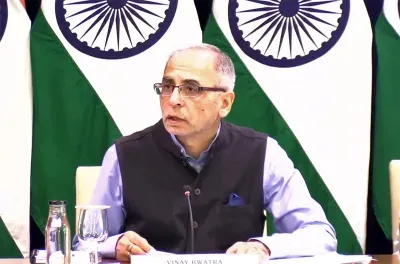
India's Ambassador to the US Vinay Kwatra has reframed the Indus Waters Treaty suspension in a Newsweek op-ed — arguing Pakistan spent 60 years dismantling the treaty's founding goodwill through wars, terror attacks, and project obstruction, and that India's abeyance is a recognition of that reality, not an act of aggression. The piece sets a clear bar: Pakistan must dismantle its terror infrastructure before any bilateral cooperation resumes.
Key Takeaways
India's Ambassador Vinay Kwatra wrote in Newsweek that the Indus Waters Treaty (IWT) abeyance 'merely acknowledges what Pakistan's conduct had already destroyed.' The IWT , signed in 1960 , gave Pakistan control of rivers carrying 80 per cent of the basin's water; India received 20 per cent .
India placed the treaty in abeyance following the Pahalgam terror attack , citing Pakistan's failure to credibly renounce cross-border terrorism.
Kwatra cited over 40,000 deaths in India attributed to Pakistan's terror campaign, including attacks on Parliament, Mumbai, Uri, Pathankot, and Pahalgam.
Pakistan allegedly obstructed Indian projects, including a terrorist attack on the Tulbul Navigation Project in 2012 .
India's stated condition for resuming cooperation: Pakistan must 'dismantle the terror infrastructure that it has built.'
India's Ambassador to the United States, Vinay Kwatra, has argued that the suspension of the Indus Waters Treaty (IWT) does not represent an Indian act of aggression but rather a formal acknowledgement of what Pakistan's six decades of hostility had already undone. Writing in an opinion piece in Newsweek, Kwatra — a former Foreign Secretary — said the treaty's abeyance 'merely acknowledges what Pakistan's conduct had already destroyed.'
Background: What the Indus Waters Treaty Says
The IWT was signed in 1960 between India and Pakistan, governing the utilisation of waters from the Indus river system. Under its terms, India received rights over the three eastern rivers, accounting for roughly 20 per cent of the basin's water, while Pakistan was allocated the three western rivers, carrying approximately 80 per cent of the total water share. Kwatra argued that this asymmetry 'stifled development for decades' in Indian regions that could have benefited from more equitable water rights — yet India honoured the treaty regardless.
Why India Placed the Treaty in Abeyance
Following the Pahalgam terror attack of 2025, India exercised what it described as its rights as a sovereign nation under international law, placing the IWT in abeyance. The stated condition for resumption is that Pakistan 'credibly and irrevocably' abjure its support for cross-border terrorism. Kwatra listed a pattern of attacks he attributed to Pakistan's conduct, including strikes on the Indian Parliament, the Mumbai terror attack, the Uri and Pathankot attacks, and the Pahalgam attack. According to Kwatra, more than 40,000 people have been killed in India due to what he described as Pakistan's sustained terror campaign.
Obstruction of Indian Projects
The ambassador further alleged that Pakistan systematically obstructed India's legitimate use of its treaty rights through bureaucratic delays and direct targeting of project sites. He cited the terrorist attack on the Tulbul Navigation Project in 2012 as one such instance. Pakistan also reportedly opposed India's attempts to renegotiate the treaty to reflect technological changes that would have allowed India to expand its hydropower potential, according to Kwatra.
India's Position on Talks and Water Scarcity
Responding to international calls for renewed bilateral dialogue, Kwatra invoked the position articulated by Prime Minister Narendra Modi: 'Terror and talks cannot go together... Terror and trade cannot go together... Water and blood cannot flow together.' The ambassador rejected Pakistan's framing of India as a 'water aggressor,' arguing that water scarcity within Pakistan is the product of its own government's mismanagement rather than Indian policy. He urged Islamabad to address its 'dismal water productivity' rather than organising conferences to blame India or issue threats.
What India Wants
Kwatra's Newsweek piece concluded with a pointed demand: if Pakistan sincerely seeks India's cooperation on bilateral issues, it must first 'dismantle the terror infrastructure that it has built.' He added that Pakistan's 'habit of pinning every domestic failure on its neighbour has grown old,' and called on the international community to say so 'unequivocally.' The piece signals that India's diplomatic posture on the IWT remains firm and is unlikely to shift absent a verifiable change in Pakistan's approach to cross-border terrorism.
Point of View
Not aggressive. What mainstream coverage often misses is the structural asymmetry baked into the 1960 treaty itself: India absorbed an 80-20 water split and still honoured the deal for six decades. The real question now is whether the international community — particularly the US, which brokered the original treaty — accepts India's framing or continues to treat the abeyance as a pressure tactic. Pakistan's counter-narrative of 'water aggression' has found some traction in Western commentary, which makes Kwatra's op-ed in an American publication a deliberate and pointed intervention in that information battle.
NationPress
16 Sept 2026
Frequently Asked Questions
Why has India suspended the Indus Waters Treaty?
India placed the Indus Waters Treaty in abeyance following the Pahalgam terror attack, citing Pakistan's sustained support for cross-border terrorism. India has stated it will resume engagement only when Pakistan credibly and irrevocably renounces support for such attacks.
What did India's Ambassador Vinay Kwatra say about the treaty?
In a Newsweek opinion piece, Kwatra argued that Pakistan spent 60 years dismantling the goodwill that underpinned the 1960 treaty through wars, terror attacks, and obstruction of Indian projects. He said the abeyance 'merely acknowledges what Pakistan's conduct had already destroyed.'
What is the Indus Waters Treaty and how does it divide water rights?
The Indus Waters Treaty, signed in 1960, governs the use of the Indus river system between India and Pakistan. India was allocated the three eastern rivers, covering roughly 20 per cent of the basin's water, while Pakistan received the three western rivers, carrying approximately 80 per cent.
What is Pakistan's position on the treaty suspension?
Pakistan has characterised India as a 'water aggressor' following the abeyance. Kwatra rejected this framing, arguing that Pakistan's water scarcity stems from its own government's mismanagement and that Islamabad should address its water productivity rather than blaming India.
What does India want before resuming bilateral cooperation with Pakistan?
India has set a clear precondition: Pakistan must dismantle the terror infrastructure it has built and credibly abjure support for cross-border terrorism. Prime Minister Narendra Modi's stated position — 'Terror and talks cannot go together' — was cited by Kwatra as the governing principle.