How Are Labour Laws Beneficial to Millions in the Unorganised Sector?

Synopsis
The ongoing Bharat Bandh has sparked a nationwide discussion on labour laws. A legal adviser from FSUI highlights the positive aspects of these laws, emphasizing their potential benefits for millions of workers in the unorganised sector. Dive into the details of these policies and their implications for workers' rights.
Key Takeaways
National minimum wage must be uniform across all states.
Equal pay for equal work is mandated.
Double rate for overtime is implemented.
Inclusion of workers in social security systems is emphasized.
Legal protections are extended to emerging sectors .
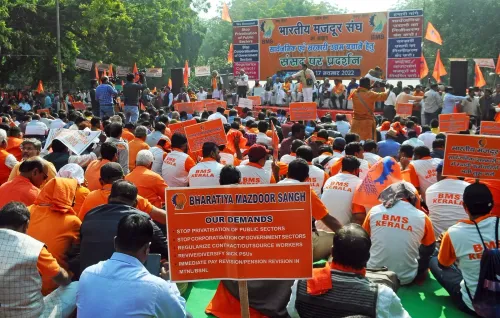
Mumbai, Feb 12 (NationPress) The nationwide Bharat Bandh is currently underway, initiated by various unions to oppose what they label as anti-worker, anti-farmer, and pro-corporate policies from the Centre. On Thursday, a legal adviser from the Forward Seamen's Union of India (FSUI) in Mumbai stated that the government’s labour policies encompass numerous positive elements, particularly advantageous for millions of individuals working in the unorganised sector.
The Bharat Bandh, spearheaded by a coalition of 10 central trade unions and backed by farmers’ organizations, student groups, youth bodies, the Congress party, and other opposition factions, aims to draw attention to issues such as the four Labour Codes, the Electricity Bill 2025, the Seed Bill 2025, and apprehensions regarding recent free trade agreements.
Advocate Akshay Birwadkar, legal adviser to the FSUI, mentioned in an interview with IANS that the recently enacted labour laws incorporate various provisions designed to enhance wages, social security, and workplace rights.
“The government’s labour laws include numerous beneficial provisions. These are especially advantageous for the millions of workers in the unorganised sector of our country,” Birwadkar commented.
He noted that the government’s motto of “Sabka Saath, Sabka Vikas, Sabka Prayas” reflects its intent to support everyone, suggesting that opposing these reforms without valid reasons seems contrary to the national interest.
Birwadkar elaborated that this topic was thoroughly discussed over several years prior to its finalization.
“The discussions spanned from 2019 to 2025. The Bill was introduced in Parliament in 2019, subsequently passed, and implemented in 2025,” he explained.
He underscored significant provisions, stating, “The stipulation that the national minimum wage be consistent nationwide, ensuring no state pays below this threshold, marks a critical advancement. Additionally, equal remuneration for equal work and overtime payment at double the standard rate are essential features embedded in the new legislation.”
Birwadkar accused certain political parties of misleading workers for their own agendas, attempting to disrupt the peaceful atmosphere in the nation.
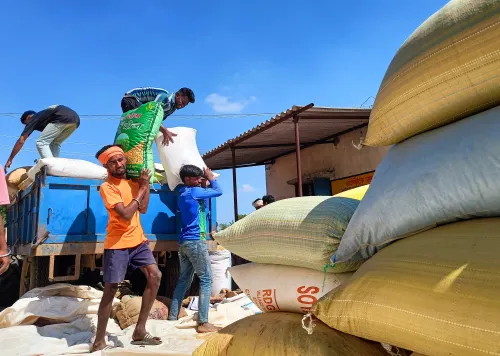
He further remarked that evolving employment patterns necessitated updates to the legal framework since a substantial number of individuals are now engaged in unorganised and emerging sectors.
“Only when jobs exist will there be workers, and only when workers are present can their rights be addressed. Today, the availability of government jobs is lower than in the past, with many people employed in unorganised or newly emerging sectors. Hence, it was imperative to extend legal protections to these new sectors,” he added.
He commended the Central government’s initiative to include more workers within social security frameworks.
“Integrating these workers into EPFO, ESI, and other social security systems is a commendable initiative by the Central government,” Birwadkar concluded.
Point of View
It is crucial to consider the broader implications of the government's labour policies. While protests highlight significant concerns, it is equally important to recognize the potential benefits these new laws could bring, especially to the unorganised sector. As the nation grapples with evolving employment patterns, a balanced dialogue is necessary to ensure that workers' rights are upheld while fostering economic growth.
NationPress
19 Sept 2026
Frequently Asked Questions
What is Bharat Bandh?
Bharat Bandh is a nationwide strike called by various unions to protest against government policies perceived as unfavorable to workers and farmers.
Who supports the Bharat Bandh?
The Bharat Bandh is supported by a coalition of 10 central trade unions, farmers’ groups, students, youth organizations, the Congress party, and other opposition parties.
What are the new labour laws?
The new labour laws aim to improve wages, social security, and workplace rights, particularly benefiting those in the unorganised sector.
Why are these labour laws considered beneficial?
These laws include provisions for a national minimum wage, equal pay for equal work, and improved social security coverage for workers.
What is the significance of the new labour laws?
The laws are significant as they aim to protect workers' rights and adapt to changing employment patterns in India.