Is India Truly Upholding Its Democratic Values?
Click to start listening
Synopsis
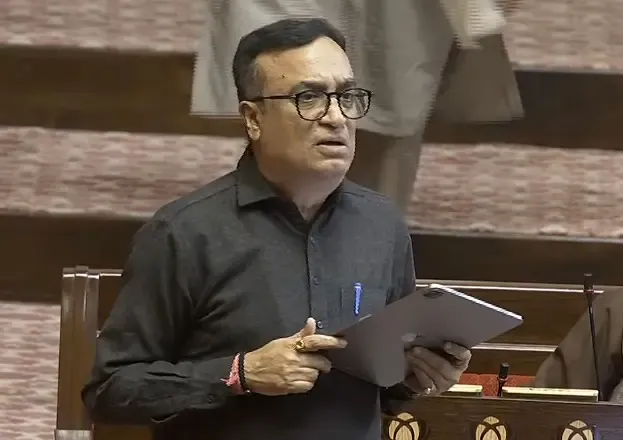
In a passionate address to the Rajya Sabha, Congress MP Ajay Maken raises critical questions about India’s democratic integrity. He highlights disparities in electoral fairness, transparency issues, and the credibility of political processes, urging a reflection on whether the nation’s democratic institutions are genuinely operational.
Key Takeaways
- Disparities in Political Finance: Significant differences in funding among parties post-2014.
- Transparency Concerns: Inconsistencies in voter turnout statistics and limited access to polling footage.
- Credibility Issues: Double standards in how electoral promises are treated.
- Impact of Law Changes: Legal changes cannot suppress public sentiment.
New Delhi, Dec 11 (NationPress) Congress MP Ajay Maken delivered a strong critique in the Rajya Sabha, questioning whether India genuinely embodies its reputation as the “mother of democracy”. He asserted that recent events offer clear evidence that democracy may not be thriving in practice, and identified three critical components of a democratic system: a level playing field, transparency, and credibility.
On the first aspect, Maken referenced his tenure as Treasurer of the Congress party. He stated that upon reviewing the financial records of his party alongside those of other political entities after elections, he discovered significant discrepancies. He noted that the financial resources of competing parties seemed to have inflated post-2014, prompting questions about equity.
“How can this be considered a level playing field?” he questioned.
He further claimed that Congress’s bank accounts were suspended prior to the 2024 general election, only to be restored post-results, thereby compromising the principle of equal opportunity.
Addressing the issue of transparency, Maken highlighted variations in voter turnout statistics in Haryana, which, he noted, differed across announcements by the Election Commission.
He also condemned amendments that limited access to CCTV footage from polling stations, arguing that such limitations diminish public confidence.
“If there’s nothing amiss, why are election officials granted immunity?” he questioned.
On the matter of credibility, Maken raised concerns regarding the enforcement of the model code of conduct. He pointed out that opposition pledges to provide financial support to women were labeled as bribes, while similar initiatives by the ruling party were not subjected to the same scrutiny.
Such inconsistencies, he contended, undermine the credibility of the electoral system.
In conclusion, Maken cautioned that altering laws cannot suppress public sentiment. “You may modify laws, but you cannot silence the voice of the populace,” he asserted, urging the House to consider whether India’s democratic institutions are functioning as they should. His statements heightened the already tense atmosphere in Parliament, where discussions regarding electoral integrity and political fairness have become increasingly fraught.
Point of View
It is imperative to approach this issue with a balanced perspective. Ajay Maken's remarks underscore a growing concern about electoral integrity in India. The call for a fair and transparent electoral process is crucial for the health of our democracy, and it is vital to engage in constructive dialogue on these matters.
NationPress
13/12/2025
Frequently Asked Questions
What did Ajay Maken criticize in his speech?
Ajay Maken criticized the lack of fairness in the electoral process, pointing out disparities in financial resources among political parties and issues with transparency in voting.
What are the three key elements of democracy according to Maken?
Maken emphasized a level playing field, transparency, and credibility as the three essential components of a democratic process.