Lok Sabha Passes Anti-Paper Leak Amendment Bill 2026

Synopsis
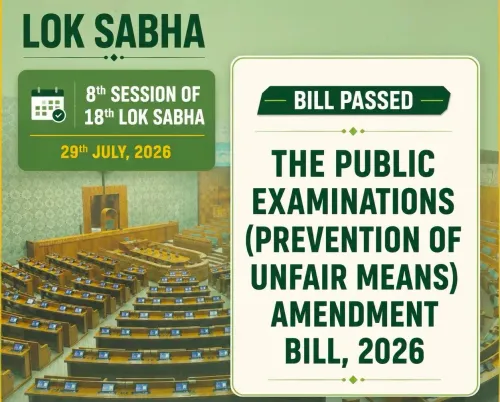
The Lok Sabha passed the Public Examinations (Prevention of Unfair Means) Amendment Bill, 2026 by voice vote on 29 July, introducing fast-track courts, tougher penalties, and expanded investigative powers to dismantle India's paper-leak ecosystem and protect competitive exam aspirants.
Key Takeaways
The Lok Sabha passed the Public Examinations (Prevention of Unfair Means) Amendment Bill, 2026 by voice vote on 29 July 2026 .
The bill introduces fast-track courts specifically for exam-fraud cases to ensure swift prosecution.
It provides for stricter penalties and enhanced investigation mechanisms targeting organised paper-leak networks.
The amendment builds on the Public Examinations (Prevention of Unfair Means) Act, 2024 , which was enacted after large-scale leaks in NEET-UG and other national tests.
The law is intended to protect competitive exam aspirants — including those appearing in NEET, JEE, UPSC , and state recruitment tests — from systemic malpractice.
For the millions of young Indians who have sat through sleepless nights preparing for competitive exams — only to watch their futures unravel in a paper-leak scandal — Wednesday, 29 July 2026 marks a turning point. The Lok Sabha passed the Public Examinations (Prevention of Unfair Means) Amendment Bill, 2026 by voice vote, toughening the legal architecture that governs India's high-stakes examination system.
Union Consumer Affairs Minister Pralhad Joshi hailed the passage as 'a historic step towards ensuring transparency, fairness and credibility in the examination system,' calling it 'a decisive initiative to protect the sanctity of competitive examinations and safeguard the dreams and hard work of crores of young people across the country.'
Building on the 2024 law that paper-leak protests forced
The 2026 amendment does not emerge in a vacuum. Its parent legislation — the Public Examinations (Prevention of Unfair Means) Act, 2024 — was itself a direct legislative response to a wave of high-profile leaks in NEET-UG, JEE, and multiple state-level recruitment tests that triggered street protests and a national reckoning with the integrity of centralised testing. That law criminalised organised malpractice for the first time. The 2026 bill sharpens those teeth.
The amendment introduces fast-track courts to expedite trials in exam-fraud cases, enhanced investigation mechanisms to pursue organised networks, and stricter penalties for those found guilty of exam malpractice. Together, the provisions are designed to dismantle what the bill itself describes as the 'paper leak ecosystem' — the chain of printers, middlemen, coaching-centre operators, and officials whose coordination makes large-scale leaks possible.
Why fast-track courts change the deterrence calculus
The inclusion of fast-track courts is arguably the bill's most consequential procedural addition. Deterrence in criminal law depends not just on the severity of punishment but on the certainty and speed of its delivery. India's regular court system, burdened by decades-long backlogs, has historically blunted the deterrent effect of even strong statutes. Dedicated fast-track benches for exam-fraud cases signal that the Centre intends prosecution — not just legislation — to be the frontline response.
Exam-conducting bodies such as the National Testing Agency (NTA), which has already undergone administrative reforms following the 2024 NEET controversy, will now operate under a reinforced legal canopy. The law's reach extends to aspirants, invigilators, and the organised syndicates that sit between them.
What competitive exam aspirants can expect next
The immediate next steps lie in implementation: the notification of enhanced penalties, the constitution of fast-track courts, and the possible alignment of state-level examination laws with the central framework ahead of the next annual examination cycle. For the crores of students appearing in NEET, JEE, UPSC, SSC, and state board recruitments each year, the bill's value will ultimately be measured not in its passage but in its enforcement.
India has legislated against paper leaks before. The difference this time, the government argues, is the procedural machinery to make the law bite.
Point of View
The bill allows the BJP-led government to sustain its narrative of systemic reform in education after the NEET-2024 controversy damaged public trust in centralised testing. The real test will be whether fast-track benches are actually constituted and staffed before the next major examination cycle, or whether the provision remains dormant in the statute book.
NationPress
29 Jul 2026
Frequently Asked Questions
What is the Public Examinations Amendment Bill 2026?
It is a bill passed by the Lok Sabha on 29 July 2026 that amends the Public Examinations (Prevention of Unfair Means) Act, 2024, introducing fast-track courts, stricter penalties, and stronger investigative powers to combat paper leaks and exam fraud in India's competitive examinations.
Which exams does the anti-paper leak law cover?
The law covers public examinations conducted by central bodies, including competitive tests such as NEET, JEE, UPSC, and SSC examinations, targeting the organised networks that facilitate paper leaks across these high-stakes tests.
What are fast-track courts under the exam fraud bill?
Fast-track courts are dedicated judicial benches set up to hear exam-fraud cases quickly, bypassing the lengthy backlogs of regular courts and ensuring that prosecution is swift enough to act as a real deterrent against paper leak syndicates.
How is the 2026 bill different from the 2024 exam law?
The 2024 Act criminalised organised exam malpractice for the first time. The 2026 amendment adds procedural enforcement tools — fast-track courts and expanded investigative mechanisms — to make prosecution more certain and rapid, strengthening the deterrence framework.
What happens after the Lok Sabha passes the exam amendment bill?
After Lok Sabha passage, the bill must be passed by the Rajya Sabha and receive Presidential assent to become law. Key next steps include notification of enhanced penalties, constitution of fast-track courts, and potential alignment of state examination laws with the central framework.