Maharashtra CM Fadnavis Forms 7-Member UCC Panel
Synopsis
Chief Minister Devendra Fadnavis has constituted a seven-member panel to examine the Uniform Civil Code in Maharashtra, announced during the Monsoon Session 2026. The move follows Uttarakhand's UCC legislation and reflects the BJP's long-standing commitment to uniform personal laws across its governed states.
Key Takeaways
The Chief Minister's Office of Maharashtra announced the formation of a seven-member panel for the Uniform Civil Code on 10 July 2026 .
The announcement was made during the Monsoon Session 2026 of the Maharashtra legislature.
The Uniform Civil Code is a constitutional directive under Article 44 aimed at a common personal law framework for all citizens regardless of religion.
The BJP has held the UCC as a core manifesto commitment since 2014 , with Uttarakhand being the first state to legislate it.
Key stakeholders include religious communities and women's groups , who hold divergent views on the reform.
The panel's recommendations could pave the way for a UCC bill in the Maharashtra assembly.
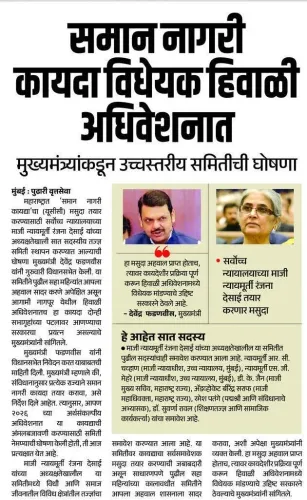
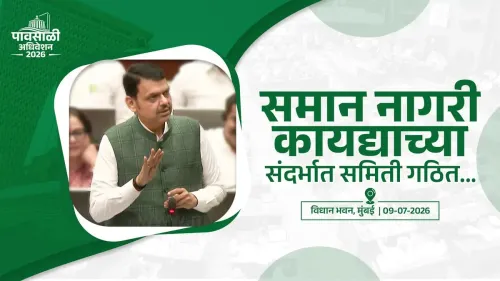
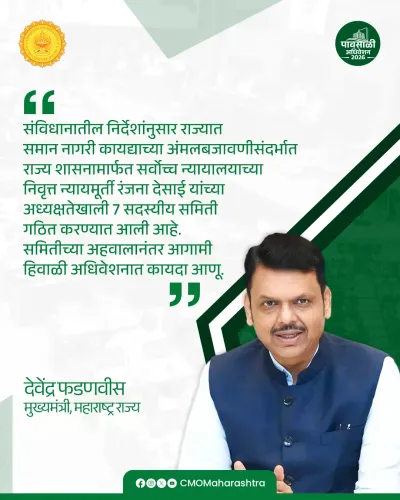
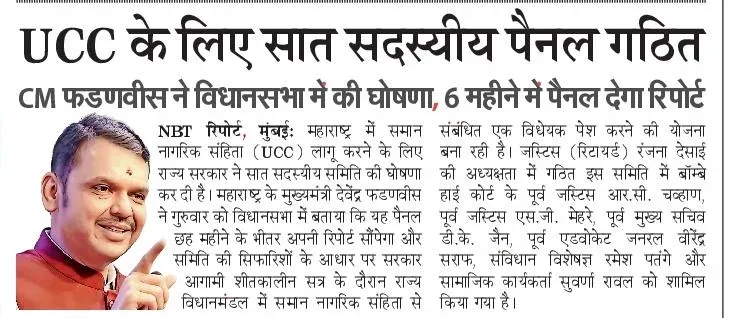
The Chief Minister's Office of Maharashtra announced on Friday, 10 July 2026 that Chief Minister Devendra Fadnavis has constituted a seven-member panel to examine the implementation of the Uniform Civil Code (UCC) in the state, with the announcement made during the ongoing Monsoon Session 2026 of the Maharashtra legislature.
Context
The Chief Minister's Office posted on X, replying to @Dev_Fadnavis, with the message: 'UCC ke liye 7 sadasiya panel gathit' ('A seven-member panel has been constituted for the UCC'). The announcement was accompanied by an image and tagged with #Maharashtra, #DevendraFadnavis, and #MonsoonSession2026, signalling that the move was formally disclosed during the legislature's monsoon sitting.
The Uniform Civil Code refers to the constitutional directive enshrined under Article 44 of the Indian Constitution, which calls for a common set of personal laws applicable to all citizens regardless of religion, covering matters such as marriage, divorce, inheritance, and adoption.
Policy Backdrop
The Bharatiya Janata Party (BJP) has carried the UCC as a core manifesto commitment since its 2014 national election platform, and the issue has remained a consistent governance priority for the party at both the central and state levels. The 21st Law Commission of India released a detailed consultation paper on the feasibility of a UCC in 2018, laying out the legal and social dimensions of such a reform.
Uttarakhand became the first state to pass a UCC legislation, setting a legislative precedent that BJP-governed states have since looked to as a model. Maharashtra's decision to constitute a dedicated expert panel follows this broader pattern of state-level exploration of UCC frameworks within the federal structure.
Stakeholders and Impact
The panel's work is expected to draw close attention from religious communities and women's rights groups across Maharashtra, both of which have historically held divergent positions on the UCC. Proponents argue a uniform code would advance gender justice and equalise rights across communities, while critics raise concerns about the erosion of personal religious practices.
Maharashtra is home to a large and diverse population, making the social and political stakes of any UCC framework particularly significant. The state legislature's Monsoon Session 2026 provides a formal parliamentary backdrop against which the panel's constitution has been announced, suggesting the government intends to keep the issue within the legislative calendar.
What's Next
The immediate next step will be the seven-member panel beginning its deliberations, with stakeholders and legal experts watching for its terms of reference and eventual recommendations. Should the panel submit a report, the Maharashtra government would then need to decide whether to introduce a bill in the state assembly.
The trajectory of Uttarakhand's UCC legislation — from panel to bill to enactment — is likely to serve as a reference point for Maharashtra's process. The outcome of this panel's work could shape the political and legal contours of personal law reform in one of India's most populous and economically significant states.
Point of View
The government lends it legislative weight rather than treating it as a mere administrative exercise. The panel model — rather than a direct bill — allows the government to signal intent while managing the significant social complexity that any UCC framework in a diverse state like Maharashtra would entail. Watched against Uttarakhand's precedent, this step marks a meaningful escalation in the BJP's state-by-state UCC strategy.
NationPress
10 Jul 2026
Frequently Asked Questions
What is the seven-member UCC panel formed in Maharashtra?
The Maharashtra government under Chief Minister Devendra Fadnavis has constituted a seven-member expert panel to examine the implementation of the Uniform Civil Code in the state, as announced on 10 July 2026 during the Monsoon Session of the Maharashtra legislature.
What is the Uniform Civil Code and why does it matter in India?
The Uniform Civil Code (UCC) is a proposed common set of personal laws — covering marriage, divorce, inheritance, and adoption — applicable to all Indian citizens regardless of religion, as envisioned under Article 44 of the Constitution. It matters because India currently has religion-specific personal laws, and the UCC would replace them with a single secular framework.
Which was the first state to implement the Uniform Civil Code in India?
Uttarakhand was the first Indian state to pass a Uniform Civil Code legislation, setting a legislative precedent that other BJP-governed states, including Maharashtra, are now looking to follow.
What will the Maharashtra UCC panel do next?
The seven-member panel is expected to begin deliberations on the feasibility and framework of a UCC for Maharashtra. Its recommendations could eventually lead to the introduction of a UCC bill in the Maharashtra legislative assembly.
Is the UCC a BJP policy commitment?
Yes, the BJP has included the implementation of the Uniform Civil Code as a core commitment in its national manifesto since 2014, and the party has actively pursued UCC frameworks in states where it holds power.