Maharashtra to set separate Ready Reckoner rates for skyscrapers and slums
Synopsis
Maharashtra is scrapping the one-size-fits-all Ready Reckoner model that has long lumped slum dwellers and luxury tower owners under the same property benchmark. GIS-backed micro-zoning, starting in Mumbai, will tie valuations to actual infrastructure — a structural shift that could reshape registration costs for millions of residents and redefine how India's most expensive property market is officially priced.
Key Takeaways
Maharashtra will introduce separate Ready Reckoner (RR) rates for skyscrapers and slums in the same locality, ending uniform pricing.
Rates will be determined by infrastructure and amenities available in each micro-zone, not just location.
The Maharashtra Remote Sensing Applications Centre (MRSAC) will conduct GIS-based mapping across urban, rural, and high-influence zones.
Mumbai rollout is targeted for the ASR financial year 2027-28 ; full statewide coverage expected within two years .
The reform is backed by Maharashtra Stamp (Second Amendment) Government Bill No.
9 , introduced during the Budget Session.
Chief Minister Devendra Fadnavis is credited with initiating the reform in response to public feedback, according to Revenue Minister Chandrashekhar Bawankule .
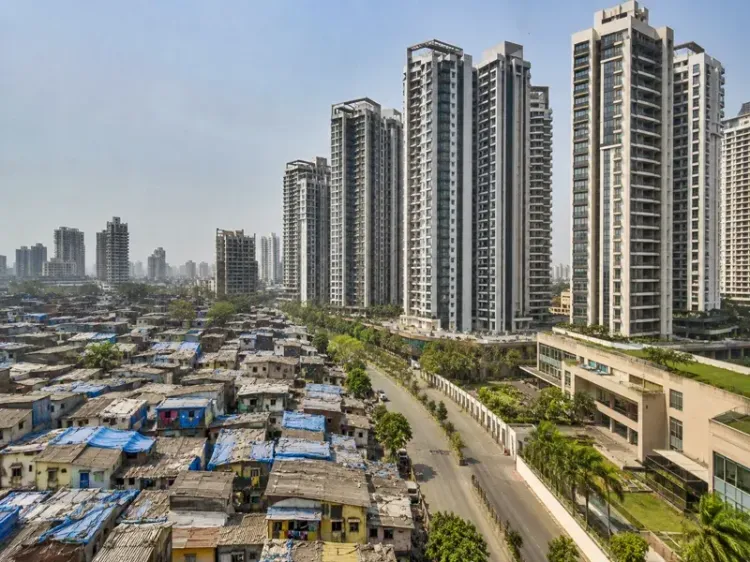
The Maharashtra government has decided to introduce differentiated Ready Reckoner (RR) rates for skyscrapers and slum settlements located in the same neighbourhood, ending a long-standing uniform pricing model that critics argue distorts property valuations. State Revenue Minister Chandrashekhar Bawankule announced the reform on Wednesday, 10 June, marking it as a flagship governance initiative.
What Changes Under the New System
Under the revised framework, property rates will no longer be uniform across a locality. Instead, valuations will be determined by the infrastructure and amenities actually available in a given micro-zone. This means a luxury high-rise and a slum cluster in the same postal address will no longer share an identical government-fixed benchmark rate.
The Ready Reckoner rate is the minimum property value fixed by the government for a specific locality — no property can be legally registered below this floor. Historically, this single rate applied equally to slums, chawls, and premium towers in the same vicinity, producing valuations that neither reflected market reality nor eased the burden on lower-income residents.
The Survey Mechanism and Technology
A comprehensive three-phase survey campaign has been launched across Maharashtra using micro-zoning techniques, beginning with Mumbai. The Maharashtra Remote Sensing Applications Centre (MRSAC) has been officially appointed to lead the exercise.
MRSAC will deploy GIS-based (Geographic Information System) mapping to collect precise spatial data across urban, rural, and high-influence zones in the state. According to Minister Bawankule, these maps will guide the Inspector General of Registration (IGR) in publishing fairer property assessment values on an annual basis.
The Revenue Department has initiated the process under the Maharashtra Stamp (Second Amendment) Government Bill No. 9, introduced in the Legislative Council during the state legislature's Budget Session.
Timeline and Rollout
For the Annual Statement of Rates (ASR) for financial year 2027-28, Mumbai's City Survey Numbers and localised developmental features will undergo detailed micro-zoning. The Revenue Department is fast-tracking preparations to implement the new rating structure by the next financial year, immediately after the survey is completed.
Following Mumbai's rollout, micro-zoning will be extended to all major municipal corporations across Maharashtra in two subsequent phases, with full statewide coverage targeted within two years.
What the Government Said
'Historically, slums, chawls and luxury high-rises situated in the same neighbourhood were subjected to identical standard property rates. The new system will eliminate these discrepancies, ensuring fair, realistic and infrastructure-linked property valuation,' Minister Bawankule said.
He added that the reform is 'set to provide significant financial relief to ordinary citizens, the middle class and slum dwellers during property transactions in major metros like Mumbai.' The minister attributed the initiative to Chief Minister Devendra Fadnavis, saying Fadnavis had 'initiated this reform directly in response to feedback and suggestions from the common public.'
Why It Matters
Mumbai's property market is among the most complex in Asia, with luxury towers and informal settlements often separated by a single lane. A uniform RR rate has long meant that slum dwellers faced registration costs benchmarked against premium real estate, while developers of high-end projects benefited from artificially low government valuations. The GIS-backed micro-zoning approach, if executed with fidelity, could address both distortions simultaneously. Notably, this is also the first time Maharashtra is deploying satellite-based spatial data at this scale for property tax reform.
Point of View
And Maharashtra's track record on large-scale land surveys includes delays and boundary disputes. The bigger question is who verifies the 'infrastructure and amenities' classification: a slum upgraded with a paved road could shift into a higher rate bracket overnight, raising costs for the very residents the scheme claims to protect. Without a transparent appeals mechanism and public disclosure of zone boundaries, this well-intentioned reform risks becoming a new vector for valuation disputes and, potentially, discretionary reclassification.
NationPress
21 Sept 2026
Frequently Asked Questions
What is the Ready Reckoner rate and why is Maharashtra changing it?
The Ready Reckoner (RR) rate is the minimum government-fixed property value for a locality, below which no property can be legally registered. Maharashtra is changing it because the current uniform rate applies equally to slums and luxury towers in the same area, distorting valuations and burdening lower-income residents with registration costs benchmarked against premium real estate.
How will the new Ready Reckoner system work?
Property rates will be determined through GIS-based micro-zoning that maps infrastructure and amenities at a granular level. The Maharashtra Remote Sensing Applications Centre (MRSAC) will conduct the survey, and the Inspector General of Registration will use the resulting spatial data to publish differentiated annual rates for each zone.
When will the new Ready Reckoner rates take effect in Mumbai?
The Revenue Department is targeting implementation by the next financial year, with the revised Annual Statement of Rates (ASR) for financial year 2027-28 incorporating Mumbai's micro-zoned data. The survey of Mumbai's City Survey Numbers is currently being fast-tracked.
Will the reform apply only to Mumbai?
No. Mumbai is the first phase, but the micro-zoning exercise will be extended to all major municipal corporations across Maharashtra in two subsequent phases, with full statewide coverage expected within two years of the Mumbai rollout.
Who announced the Maharashtra Ready Reckoner reform?
State Revenue Minister Chandrashekhar Bawankule announced the reform on 10 June, attributing the initiative to Chief Minister Devendra Fadnavis, who reportedly directed the change in response to public feedback on property valuation inequities.