Maharashtra Government Rejects Proposed Property Rate Hike Amid Global Tensions
Synopsis
Maharashtra's Revenue Minister, Chandrashekhar Bawankule, confirmed the state's decision to reject a proposed 12-14% increase in RR rates, emphasizing the need to safeguard public interests amid global conflicts. The government aims to stabilize property transaction costs and implement micro-zoning for fair pricing.
Key Takeaways
Maharashtra government rejects 12-14% increase in RR rates.
Decision aimed at protecting public interest amid global conflicts.
Implementation of micro-zoning in major cities for fair property pricing.
Stable rates expected to ease financial burdens on citizens.
Revenue target set at Rs 68,600 crore for 2026-27.
Mumbai, April 1 (NationPress) Maharashtra's Revenue Minister, Chandrashekhar Bawankule, announced on Wednesday that the state has decided against a proposed 12 to 14 percent hike in ready reckoner (RR) rates, attributing this decision to the ongoing global conflicts and economic uncertainties.
"The state government has prioritized the public's welfare by rejecting the suggested increase in property rates," he remarked.
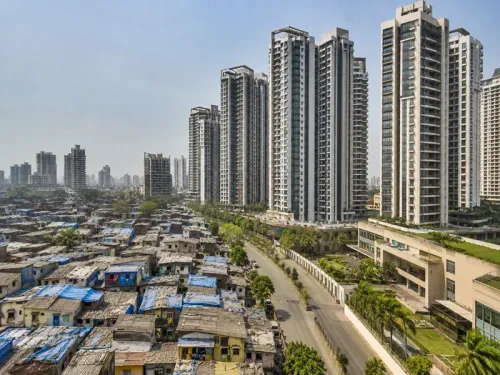
Bawankule outlined that micro-zoning will be introduced in major metropolitan areas like Mumbai, Pune, Thane, Nagpur, and Chhatrapati Sambhajinagar, where property values will be assessed according to local amenities.
"Property rates will be evaluated individually rather than uniformly across the board," he clarified, emphasizing that the rates will be adjusted in accordance with updates in development plans and regional strategies.
This declaration from Bawankule followed his earlier announcement on Tuesday, confirming that the RR rates for the financial year 2026-27 would remain unchanged.
The Inspector General of Registration and Controller of Stamps later confirmed that the rates effective from April 1 would maintain a 'status quo' compared to the previous year (2025-26).
Bawankule stated that by stabilizing rates for 2026-27, the government aims to alleviate any additional financial strain on ordinary citizens during property transactions.
The RR rate, or circle rate, establishes the minimum property valuation set by the state for specific areas, serving as a benchmark to calculate stamp duty and registration fees.
According to the state's Revenue Department Officer, "This system ensures equitable taxation, curbs property undervaluation, and is revised annually based on location, amenities, and market dynamics."
Despite holding rates steady, the Registration and Stamps Department reported a remarkable revenue increase, with a total collection of Rs 60,568.94 crore for the fiscal year 2025-26 (as of March 30, 2026). The 'I-Sarita' system was highlighted as a key contributor, bringing in Rs 49,534 crore of the total revenue.
Bawankule further mentioned that the state government has set a revenue target of Rs 68,600 crore through stamp duty and registration fees in the annual budget for 2026-27.
Moreover, he indicated that encroachments up to 1,500 square feet constructed before January 1, 2011, on government land or within approved layouts would be regularized, contingent upon certain conditions including residency in Maharashtra and inclusion in the 2011 voters' list.
He cautioned that actions would be taken against constructions exceeding 1,500 square feet.
Bawankule announced that the land measurement process would become more affordable and efficient with the rollout of 'Version 2' software by the land records department.
He revealed that measurement fees would decrease to Rs 200 per subdivision, down from around Rs 10,000 to Rs 1,000.
Additionally, property data will be stored on iCloud, leading to reduced processing times.
Furthermore, he stated that powers regarding breach of condition cases have been decentralized, allowing decisions up to Rs 10 lakh at the district collector level, up to Rs 20 lakh at the divisional commissioner level, and up to Rs 1 crore at the local level.
Bawankule asserted that quasi-judicial revenue cases must be resolved within 90 days across two hearings.
He concluded by announcing that actions would be taken against individuals obstructing access roads to farms, including the suspension of their government scheme IDs for five years.
Point of View
Prioritizing public welfare over potential revenue increases. This approach not only safeguards citizens from financial strain but also emphasizes a commitment to fair property valuation practices.
NationPress
5 Oct 2026
Frequently Asked Questions
What are ready reckoner rates?
Ready reckoner rates are the minimum property values set by the state government for specific areas, used as a benchmark to calculate stamp duty and registration fees.
Why did Maharashtra reject the proposed rate hike?
The Maharashtra government rejected the proposed 12 to 14% rate increase to protect public interest amid ongoing global conflicts and economic uncertainties.
What is micro-zoning?
Micro-zoning is a method to determine property rates based on local amenities and specific characteristics of different areas, rather than applying uniform rates.
How will the stable rates affect property transactions?
By keeping rates stable, the government aims to prevent additional financial burdens on citizens during property transactions, facilitating a more accessible real estate market.
What are the revenue targets for the upcoming financial year?
The Maharashtra government has set a revenue target of Rs 68,600 crore through stamp duty and registration fees for the financial year 2026-27.