Mahua Moitra fires five pointed questions at ex-Bengal CEO on EC appeals
Synopsis
TMC MP Mahua Moitra on November 17 publicly demanded former West Bengal CEO Manoj Agarwal answer five legally structured questions — before the Supreme Court and in public — about Election Commission appeals filed against judicial orders that had included voters on electoral rolls.
Key Takeaways
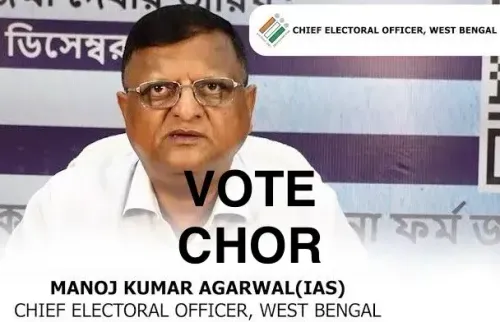
TMC MP Mahua Moitra posted five pointed questions on November 17, 2026 targeting Manoj Agarwal , former Chief Electoral Officer of West Bengal .
The questions demand disclosure of how many appeals were filed against voter-inclusion orders, over what period, and whether the appellant was formally named as the 'Election Commission of India'.
Moitra specifically demands the names, designations, and authorisation instruments of every officer who decided, signed, or filed each appeal.
She also asks whether any guidelines, SOP, or criteria governed the selection of inclusion orders to challenge — and the current status of each appeal.
Moitra's explicit reference to the Supreme Court of India signals the questions may already be tied to a pending or imminent legal petition.
The post underscores long-running tensions between West Bengal 's state administration and the central electoral apparatus over electoral roll revision transparency.
Five sharp, legally precise questions — each demanding names, dates, authorisations, and outcomes — landed on Tuesday, November 17, 2026, when TMC MP Mahua Moitra publicly targeted Manoj Agarwal, former Chief Electoral Officer of West Bengal, over a pattern of appeals allegedly filed by or in the name of the Election Commission of India against judicial orders that had allowed voters onto electoral rolls.
Moitra, addressing Agarwal with the pointed tag 'VoteChor', demanded he answer the questions both before the Supreme Court of India and in the public domain. The five-point interrogation is surgical in structure: it asks not just what happened, but precisely who authorised it, who signed the papers, and whether any standing instruction or standard operating procedure governed which inclusion orders were worth challenging.
What the five questions actually demand
The first two questions go to sheer scale and identity — how many appeals were filed against voter-inclusion orders by judicial officers, over what period, and whether the appellant was formally described as the 'Election Commission of India.' This matters because if the Commission's own name was used without formal delegation, it raises a question of institutional overreach.
The third question is the most granular: Moitra wants the name and designation of every officer who decided to file each appeal, every officer who signed or filed it, and the specific instrument — an order, a resolution, a circular — by which each such officer was authorised to act. That is not political rhetoric; it is the checklist a court would itself construct in a procedural challenge.
Questions four and five widen the frame. Did the Commission, or the Bengal chief electoral officer, issue any guidelines or criteria for selecting which inclusion orders to appeal? And crucially — what is the current status of every one of those appeals: pending, allowed, dismissed, or withdrawn? Has any decision been taken on whether to continue or drop them?
The legal and institutional backdrop
The Representation of the People Act, 1950 governs the preparation, revision, and appellate mechanisms for electoral rolls. Appellate tribunals — typically judicial officers — hear challenges to inclusions and deletions, and their orders are meant to be final at that level unless a higher authority intervenes. The allegation embedded in Moitra's questions is that the Commission, or its officers, systematically appealed upward against orders that had let voters in — an unusual posture for the body constitutionally charged under Article 324 with superintendence of elections, not with pruning voter rolls through litigation.
West Bengal has been a recurring flashpoint in debates over electoral roll revisions, with the state's Trinamool Congress government and the central election apparatus frequently at odds over summary revisions, deletion drives, and procedural transparency. Opposition parties have, across multiple election cycles, raised concerns about whether roll-revision exercises disproportionately affect certain communities or geographies.
Why the Supreme Court reference matters
Moitra's explicit invocation of the Supreme Court suggests these questions are either already embedded in a pending petition or are intended to form the basis of one. Any SC listing on West Bengal electoral roll appeals would force the Election Commission to file a formal counter-affidavit — giving these five questions the status of court-ordered disclosure rather than political rhetoric. That is the lever Moitra appears to be signalling she intends to pull.
The specificity of the demands — officer names, authorisation instruments, SOPs, case-by-case status counts — leaves little room for a broad, non-committal institutional response. Either the records exist and must be produced, or their absence becomes its own answer.
The clock is now on the Election Commission and Manoj Agarwal to respond — in an affidavit box, a press conference, or the court of public opinion. Silence, in this instance, would be a statement of its own.
Point of View
Rather than the institution generically, is a deliberate escalation: it personalises liability and makes it harder for the Election Commission to issue a collective, non-committal denial. This fits a broader opposition pattern of using electoral roll disputes in Trinamool-governed Bengal as a proxy battleground for the larger argument about whether the Commission operates as a neutral constitutional body or as an instrument of central political pressure. Whether the questions force disclosure in court or remain unanswered in public will itself become a data point in that larger debate.
NationPress
17 Nov 2026
Frequently Asked Questions
What did Mahua Moitra post about Manoj Agarwal and the Election Commission?
On November 17, 2026, Mahua Moitra posted five structured questions demanding that Manoj Agarwal, former Chief Electoral Officer of West Bengal, disclose details about appeals allegedly filed by or in the name of the Election Commission against judicial orders that had included voters on electoral rolls.
Who is Manoj Agarwal in the context of West Bengal elections?
Manoj Agarwal served as the Chief Electoral Officer of West Bengal, the state-level officer responsible for implementing electoral roll revisions and overseeing electoral administration under the Election Commission of India.
What is the Supreme Court's role in West Bengal electoral roll disputes?
The Supreme Court of India is the apex forum for constitutional and procedural challenges to electoral administration. Moitra's explicit mention of the SC suggests the questions are linked to a pending or planned petition that would compel formal affidavit-based disclosure from the Election Commission.
What law governs appeals on electoral roll inclusions in India?
The Representation of the People Act, 1950 establishes the framework for preparation, revision, and appellate mechanisms for electoral rolls, including the jurisdiction of appellate tribunals over inclusion and deletion orders.
Why does it matter who authorised the Election Commission appeals in West Bengal?
If appeals were filed in the Commission's name without proper delegation or authorisation instruments, it could constitute procedural overreach by individual officers. Identifying the authorising instrument is central to determining institutional versus individual accountability for the appeals.