India's 7.7% GDP growth in FY26 is fastest among major economies: Amit Malviya
Synopsis
India's FY26 GDP growth of 7.7 per cent — the fastest among major economies — has handed the BJP a sharp political weapon. Amit Malviya turned Rahul Gandhi's own 'economic tsunami' framing against him, pointing to quarter-on-quarter consistency and India's lead over Germany, Japan, and the entire G7 bloc as proof that the Opposition's economic pessimism has been overtaken by facts.
Key Takeaways
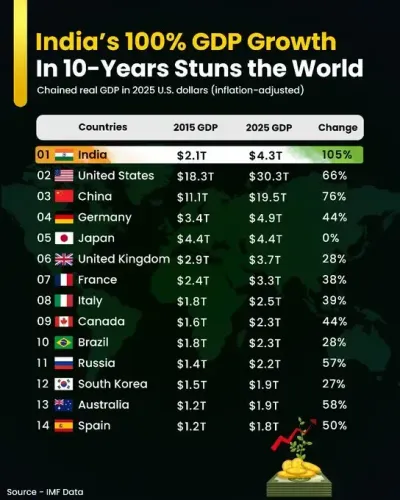
India's GDP grew at 7.7 per cent in FY 2025–26 , the fastest among major economies, according to data released on Friday .
Growth was consistent across all four quarters: 6.7% in Q1, 8.4% in Q2, and 7.8% each in Q3 and Q4.
India outpaced Germany (0.4%) , Japan (0.8%) , the Euro Area (1.3%) , and the G7 (1.6%) .
BJP leader Amit Malviya used the data to rebut Rahul Gandhi's 'economic tsunami' warning about the Indian economy.
Malviya cited auto sales at all-time highs, rising GST collections, strong credit growth, and healthy forex reserves as additional indicators of resilience.
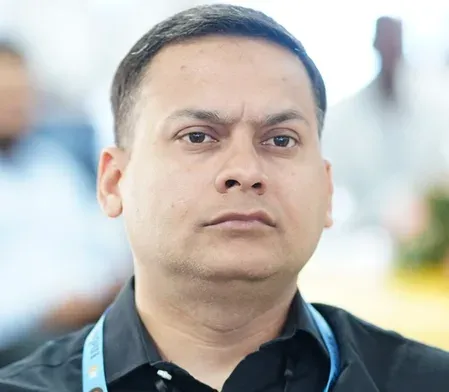
Bharatiya Janata Party (BJP) leader Amit Malviya on 5 June sharply countered Congress leader Rahul Gandhi's 'economic tsunami' warning, pointing to India's 7.7 per cent GDP growth in FY 2025–26 — the fastest among major economies — as evidence that the Opposition's economic pessimism has been decisively refuted by data.
Quarter-by-Quarter Consistency
Malviya highlighted that India's growth was not a one-quarter spike but a sustained performance across the full financial year. Growth came in at 6.7 per cent in Q1, accelerated to 8.4 per cent in Q2, and held at 7.8 per cent in both Q3 and Q4, he noted. The full-year figure of 7.7 per cent places India well ahead of its peers among both developed and emerging economies.
India vs the World
Malviya drew a direct comparison with other major economies. Germany recorded growth of just 0.4 per cent, Japan at 0.8 per cent, the Euro Area at 1.3 per cent, and the G7 bloc at 1.6 per cent. Among emerging economies, India outpaced Indonesia, Malaysia, Mexico, and Thailand, he added. This comes amid a broader global slowdown, making India's performance particularly notable.
On Domestic Economic Indicators
Beyond the headline GDP number, Malviya cited a range of domestic indicators to reinforce his argument. Auto sales are at an all-time high, manufacturing remains in expansion territory, GST collections are rising, credit growth is strong, and forex reserves remain healthy. 'This is resilience, not panic,' he stated.
The 'Fragile Five' to Growth Engine Narrative
Malviya also invoked India's economic trajectory over the past decade. In 2013, India was branded one of the 'Fragile Five' economies — characterised by twin deficits, high inflation, policy paralysis, and economic uncertainty. Today, he argued, the country stands as the world's fastest-growing major economy, with record infrastructure creation, controlled inflation, and decisive policymaking. 'From the Fragile Five to the world's growth engine, the transformation speaks for itself,' he said.
The Political Context
Rahul Gandhi had earlier warned that India was heading towards an 'economic tsunami' because the government had, in his words, removed all shock absorbers. Malviya directly turned that language back on the Congress leader, saying 'the only tsunami visible today is the one drowning the Congress party's malignant thinking.' The exchange reflects a sharpening political battle over the narrative around India's economic performance ahead of the next electoral cycle.
Point of View
But the framing deserves scrutiny. A 7.7 per cent full-year figure is genuinely strong, yet the Q1 reading of 6.7 per cent — the slowest quarter — quietly signals that momentum was uneven. Malviya's comparison with Germany and Japan is also somewhat selective: those economies face structural headwinds that India does not, making the gap less a policy triumph than a structural divergence. The deeper question — whether high GDP growth is translating into broad-based employment and household income gains — goes unaddressed in the political exchange. That gap between macro-headline and lived experience is precisely where the Congress's 'tsunami' framing finds its audience, regardless of what the data says.
NationPress
27 Sept 2026
Frequently Asked Questions
What is India's GDP growth rate for FY 2025–26?
India's GDP grew at 7.7 per cent in FY 2025–26, making it the fastest-growing major economy in the world for that year. Growth was consistent across all four quarters, ranging from 6.7 per cent in Q1 to a peak of 8.4 per cent in Q2.
What did Amit Malviya say about Rahul Gandhi's economic tsunami remark?
BJP leader Amit Malviya said the GDP data has 'washed away' Rahul Gandhi's 'latest sinister attempt to malign India.' He argued that the only tsunami visible is 'the one drowning the Congress party's malignant thinking,' directly inverting Gandhi's own language.
What had Rahul Gandhi said about the Indian economy?
Rahul Gandhi had warned that India was heading towards an 'economic tsunami' because the government had removed all economic shock absorbers. The BJP cited the FY26 GDP data as a direct rebuttal to that claim.
How does India's growth compare with other major economies?
India's 7.7 per cent growth in FY26 far outstripped Germany (0.4%), Japan (0.8%), the Euro Area (1.3%), and the G7 bloc (1.6%). Among emerging economies, India also outpaced Indonesia, Malaysia, Mexico, and Thailand, according to Malviya.
What other economic indicators did Malviya highlight?
Beyond GDP, Malviya pointed to auto sales at all-time highs, manufacturing remaining in expansion, rising GST collections, strong credit growth, and healthy forex reserves as evidence of broad-based economic resilience.